
How Alfvén Waves May Solve the Sun’s Energy Transport Problem
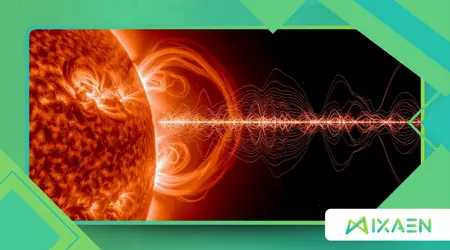
Alfvén Waves represent the most compelling answer to the solar heating paradox that has baffled astrophysicists for nearly a century of observation.
Scientists have long wondered why the Sun’s outer atmosphere, the corona, is hundreds of times hotter than the visible surface sitting below it.
This thermal contradiction defies basic intuition, similar to moving away from a campfire only to find the air becoming millions of degrees hotter.
Modern spacecraft, including the Parker Solar Probe in 2026, are now providing the direct evidence needed to confirm these magnetic oscillations.
Solar Energy Roadmap
- Thermal Paradox: Understanding why the corona reaches 2 million degrees Celsius while the surface remains at only 5,500 degrees.
- Magnetic Vibrations: How plasma tension allows energy to travel along magnetic field lines like vibrations on a plucked guitar string.
- Recent Discoveries: Analyzing 2026 data from solar probes that show magnetic “switchbacks” accelerating the solar wind via wave dissipation.
- Future Implications: What solving this mystery means for predicting solar storms and protecting our global electrical and satellite infrastructure.
What are the mechanics of energy transport in the Sun?
The Sun functions as a massive magnetic laboratory where plasma and fields engage in a violent, eternal dance across the entire solar disc.
Energy originates in the core through fusion, but moving that heat to the outermost layers requires a mechanism more efficient than simple radiation.
Magnetic fields act as the primary highway for this transit, guiding charged particles through the complex architecture of the solar atmosphere.
Without a robust transport system, the corona would simply cool down, yet it remains stubbornly and intensely hot.
Why does the corona stay so hot?
Scientists call this the Coronal Heating Problem because it contradicts the second law of thermodynamics in a seemingly impossible display of physics.
Convection alone cannot explain how energy bypasses the cooler photosphere to dump massive heat into the thin, distant layers of the corona.
High-frequency oscillations known as Alfvén Waves provide the necessary vehicle, carrying energy upward without losing it to the lower, denser layers.
These waves travel through the plasma, vibrating the magnetic lines and releasing heat only when they reach the ultra-thin coronal environment.
++ Why Solar Magnetic Reversals Still Puzzle Science
How do magnetic fields carry heat?
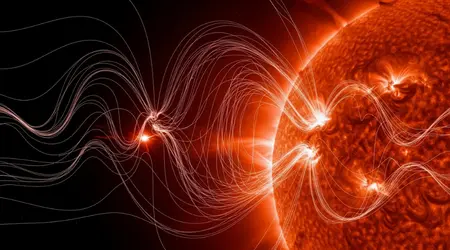
Magnetic tension provides a restoring force that allows waves to propagate through the solar plasma at incredibly high speeds and over vast distances.
Think of these fields as invisible rubber bands that snap and vibrate, pushing energy far beyond the Sun’s churning, visible surface.
When these vibrations eventually dissipate, they dump their accumulated energy directly into the local plasma, causing temperatures to spike into the millions.
This localized heating explains the brilliant glow of the corona during a total solar eclipse, revealing a hidden, energetic world.
Why are these magnetic oscillations the key?
Traditional heating models relied on “nanoflares,” but those small explosions do not occur frequently enough to maintain the corona’s extreme, constant temperature.
Research now suggests that Alfvén Waves offer a continuous, steady stream of energy that keeps the solar atmosphere in its permanent state.
The sheer scale of the Sun’s magnetic network ensures that these waves are generated everywhere, from small sunspots to massive coronal holes.
This ubiquity makes them the most logical candidate for a global heating mechanism that operates across the entire solar sphere.
Also read: The Hidden Physics Behind Solar Magnetic Fields
How did the Parker Solar Probe confirm this?
NASA’s Parker Solar Probe recently flew through the “Alfvén point,” the boundary where solar plasma effectively disconnects from the Sun’s immediate magnetic grip.
Data from this 2026 milestone revealed intense wave activity and “switchbacks” in the magnetic field that directly accelerate the solar wind.
These switchbacks are essentially S-shaped kinks in the magnetic lines that carry immense kinetic energy away from the surface and into space.
Seeing these structures up close has provided the “smoking gun” evidence that wave dissipation is driving the Sun’s most energetic processes.
Read more: Why the Sun Sometimes “Goes Quiet” and What That Means
What is the role of plasma density?
In the dense photosphere, waves move slowly and are often suppressed by the weight of the surrounding material, preventing early energy release.
As the plasma thins out toward the corona, the waves speed up and their amplitude grows until they inevitably break.
This breaking process is where the magic happens, turning the kinetic energy of the wave into the thermal energy of the plasma.
It is a precise physical transition that ensures the heat is delivered exactly where the density is lowest and the temperature is highest.
How does this discovery protect Earth?
Understanding Alfvén Waves is not just an academic exercise in solar physics; it is a vital component of our national space weather defense.
These waves are the primary drivers of the solar wind, which can strip away planetary atmospheres and disrupt our modern technology.
By mapping how these waves accelerate particles, we can better predict when a solar storm will hit Earth’s magnetosphere with dangerous intensity.
This foresight allows satellite operators and power grid managers to take proactive steps to prevent catastrophic failures during peak solar activity.
Can we predict solar flares better now?
Better models of magnetic wave propagation allow us to see the “stress” building up in solar active regions before a flare occurs.
If we can measure the energy being carried by Alfvén Waves, we can estimate the potential magnitude of an impending eruption.
This lead time is crucial for astronauts on the Moon or Mars, who lack the protection of Earth’s thick atmosphere and magnetic field.
Real-time solar monitoring in 2026 has already improved our flare warning windows from minutes to nearly an hour.
Why is space weather a global priority?
A massive solar storm could theoretically knock out global communications and power for months, costing trillions of dollars in damage to infrastructure.
Sophisticated understanding of solar energy transport is our best insurance policy against the Sun’s occasional, violent outbursts that threaten our digital way of life.
Investing in solar research helps us build more resilient systems that can withstand the electromagnetic pulse of a coronal mass ejection.
Every piece of data we gather about magnetic waves brings us closer to a future where space weather is as predictable as rain.
Solar Layer Temperature and Energy Comparison
| Solar Layer | Average Temperature | Dominant Energy Transport | Role of Alfvén Waves |
| Core | 15,000,000°C | Nuclear Fusion / Radiation | Non-existent |
| Photosphere | 5,500°C | Convection | Wave Generation |
| Chromosphere | 10,000°C | Magnetic Reconnection | Initial Wave Acceleration |
| Corona | 2,000,000°C | Alfvén Waves / Dissipation | Primary Heating Source |
The Future of Solar Science
Unmasking the secrets of the Sun’s magnetic heart confirms that our star is far more dynamic than a simple ball of fire.
The confirmation of Alfvén Waves as a primary heating agent marks the end of a long scientific mystery and the beginning of a new era.
With the data gathered in 2026, we are finally moving past theoretical guesses and into a period of hard, observational certainty regarding solar energy.
These invisible vibrations serve as the pulse of our solar system, regulating the environment in which all planets reside.
As we refine our instruments and send more probes into the fire, we will undoubtedly find even more ways that magnetic fields shape our cosmic destiny.
Would we even exist today if the Sun’s corona hadn’t found this unique way to vent its immense internal pressure?
Share your experience in the comments! Have you ever witnessed a total solar eclipse and felt the strange, haunting beauty of the corona?
Frequently Asked Questions
What exactly is an Alfvén Wave?
Named after Hannes Alfvén, these are a type of magnetohydrodynamic wave where ions oscillate in response to a restoring force provided by magnetic tension.
Imagine plucking a tight guitar string made of magnetic field lines; the resulting vibration is an Alfvén wave.
Why did it take so long to prove they heat the corona?
The corona is extremely thin and bright, making it difficult to observe the subtle vibrations of magnetic fields from Earth.
It wasn’t until we sent probes like Parker and Solar Orbiter directly into the solar atmosphere that we could measure these waves in situ.
Do these waves exist on other stars?
Yes, astrophysicists believe that Alfvén Waves are a universal phenomenon occurring in all stars with magnetic fields.
Studying our Sun provides a “Rosetta Stone” for understanding the atmospheres of distant stars across the galaxy.
Can these waves affect my cell phone?
Not directly, but they drive the solar wind which can trigger geomagnetic storms.
These storms can interfere with the satellites that handle your GPS and cellular data, making solar wave research vital for telecommunications.
Is the Sun getting hotter because of these waves?
No, the Sun’s overall energy output is stable. These waves simply redistribute the energy that is already there, moving it from the interior to the outer atmosphere in a consistent, balanced cycle.
