
Are Interstellar Objects Natural or Signs of Technology Elsewhere?
Interstellar Objects represent the ultimate frontier in our 2026 quest to understand whether humanity is truly alone in the vast cosmic ocean.
Anúncios
These wanderers from other solar systems challenge every traditional model of planetary formation and force us to reconsider our place in the universe.
As we deploy more sensitive telescopes, the debate intensifies: are these merely exotic rocks, or could they be the derelict scouts of distant civilizations?
This investigation delves into the latest astronomical data to separate factual anomalies from science fiction, offering a grounded yet daring perspective on deep-space visitors.
Quick Insight: Tracking Cosmic Visitors
- The Anomalies: Why objects like ‘Oumuamua and C/2019 Q4 (Borisov) behave so differently from local comets.
- Technological Signatures: Identifying non-natural acceleration and unusual light-reflective properties.
- The 2026 Frontier: New missions designed to intercept these travelers before they leave our reach.
- Probability Analysis: Balancing the statistical likelihood of natural formations versus artificial debris.
Why are astronomers obsessed with these celestial wanderers?
Scientists are fascinated because Interstellar Objects provide the only physical samples of material born outside the gravitational influence of our own Sun.
Each visitor carries a chemical fingerprint from a distant star, acting as a messenger that bypasses light-years of empty space.
When we observe these travelers, we see a disturbing lack of typical cometary activity, such as the outgassing of ice and dust.
This absence of a “tail” makes their acceleration through our system difficult to explain using only the standard laws of orbital mechanics.
++ Why Galaxy Rotation Curves Still Break Gravity Predictions Today
What makes ‘Oumuamua so different from local comets?
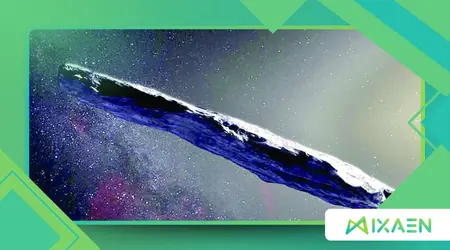
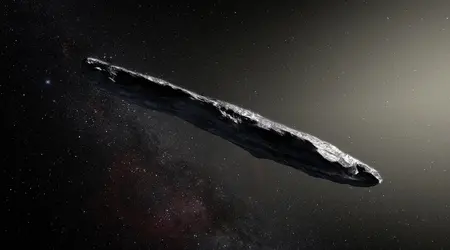
‘Oumuamua displayed a flat, pancake-like shape and a distinct “non-gravitational acceleration” that did not stem from evaporating gases like a normal comet.
This specific movement led Harvard’s Avi Loeb to suggest the object might be a thin light-sail propelled by solar radiation.
Others argue it was a hydrogen iceberg, but such a structure would likely evaporate long before reaching the inner heat of our system.
The mystery remains unsolved, leaving us with a profile that does not match any known rock found within our asteroid belt.
Also read: The Mystery of Objects That Appear Older Than the Universe
How does the Vera C. Rubin Observatory change the search?
In 2026, the Vera C. Rubin Observatory is expected to identify dozens of new Interstellar Objects every year using its high-resolution survey.
This massive influx of data will allow us to determine if ‘Oumuamua was a rare fluke or part of a vast population.
By tracking these visitors in real-time, we can finally move from speculation to statistical analysis, identifying common patterns in their trajectories.
This observatory acts as a cosmic security camera, capturing every uninvited guest that crosses our solar system’s doorstep.
Could these visitors be ancient extraterrestrial technology?
The possibility of “technosignatures” suggests that some Interstellar Objects might be defunct probes or debris from civilizations that existed millions of years ago.
Like a message in a bottle, these relics could wander for eons after their creators have vanished into history.
Looking at space as a cemetery of dead technologies provides a more realistic framework than expecting active, living aliens to greet us.
If we find a piece of scrap metal among the rocks, the implications for our own future survival would be staggering.
Read more: Why the Universe Keeps Producing Anomalies We Can’t Classify
Why is the “Light Sail” theory still debated in 2026?
A light sail would explain the high reflectivity and the smooth acceleration observed without the need for traditional rocket engines or gas jets.
Such a device would naturally become “junk” after its mission ends, drifting aimlessly through the galaxy like a discarded plastic bag.
According to a study published in Nature Astronomy, the probability of finding a natural object with ‘Oumuamua’s specific dimensions is extremely low.
This statistical outlier continues to fuel the argument that we should at least consider artificial origins until we prove otherwise.
What is the purpose of the Comet Interceptor mission?
The European Space Agency’s Comet Interceptor is designed to park in space and wait for a “pristine” object to enter our neighborhood.
This allows us to intercept an Interstellar Objects candidate at high speed, taking close-up images that ground-based telescopes simply cannot capture.
Having a spacecraft ready to “chase” a visitor ensures that we don’t miss the next opportunity to see a foreign surface.
This proactive stance marks a shift from passive observation to active exploration of the mysterious “others” passing through our backyard.
How do we distinguish between natural rocks and alien ships?
Identifying technology requires looking for non-random patterns, such as radio emissions, unusual isotopes, or structural geometry that nature cannot produce alone.
Nature is chaotic, while technology tends to follow specific mathematical efficiencies that leave a distinct mark on the data we collect.
If an object suddenly changes direction without a gravitational cause, we can rule out standard asteroid behavior with a high degree of certainty.
In 2026, AI-driven analysis helps us filter through trillions of data points to find these rare, “impossible” movements in space.
What role does the James Webb Space Telescope play?
The JWST provides the infrared sensitivity needed to detect the heat signature of Interstellar Objects as they move past the colder outer planets.
By analyzing the light spectrum, we can tell if the object is made of silicate rock, frozen nitrogen, or perhaps polished metal.
If we detect alloys like stainless steel or processed titanium, the debate over their “natural” origin would end instantly and change our history.
This telescope acts as our most powerful magnifying glass for examining the skin of these mysterious deep-space wanderers.
Are we prepared for the social impact of a discovery?
A confirmed sign of technology would force a global shift in politics, religion, and how we view our own technological progress.
Are we ready to face the reality that we might be the latecomers to a galaxy already littered with the ruins of others?
Imagine finding a discarded smartphone in the middle of a desert; you don’t need to see the owner to know a civilization exists.
Finding an artificial interstellar traveler would provide that same undeniable proof of life, even if the “owners” are light-years away.
Comparison of Interstellar Objects and Local Asteroids
| Feature | Local Asteroids | Interstellar (e.g., ‘Oumuamua) | Artificial Probe Theory |
| Origin | Inside Solar System | Outside Solar System | Alien Civilization |
| Trajectory | Elliptical/Closed | Hyperbolic/Open | Targeted/Corrected |
| Surface | Dark/Rock-like | Extremely Red/Reflective | Metallic/Coated |
| Acceleration | Gravity Only | Non-gravitational shift | Radiation Pressure |
| Abundance | Trillions | Rare (1 detected per year) | Extremely Rare |
Our journey to understand Interstellar Objects is just beginning as we move into a new era of high-cadence astronomy.
The evidence so far suggests that while many of these visitors are likely exotic natural fragments, a small percentage defies easy explanation.
Whether they are signs of alien technology or simply a type of space rock we haven’t yet categorized, they prove that our solar system is not a closed bubble.
By chasing these messengers, we are really chasing an answer to the most fundamental question of our existence.
The stars are finally starting to speak; we just need to be brave enough to listen to what they are saying.
Share your experience in the comments! Do you think we are looking at rocks or relics?
Frequently Asked Questions
What is the difference between an asteroid and an interstellar object?
Asteroids are local rocks that orbit our Sun, whereas interstellar visitors come from other star systems and pass through ours only once.
Could an interstellar object hit Earth?
The odds are incredibly low due to the vastness of space, but 2026 monitoring systems like NASA’s Sentry are always scanning for any potential trajectory risks.
How fast do these objects travel?
They move much faster than local objects, often exceeding 26 kilometers per second, which is why they can escape the Sun’s gravity so easily.
Can we send a mission to land on one?
Current technology makes a landing difficult because they move so fast, but “fly-by” missions are currently being planned by space agencies for the 2030s.
Why was ‘Oumuamua’s shape so strange?
Its extreme length-to-width ratio is unlike anything seen in our system, suggesting it was either shaped by millions of years of cosmic erosion or was designed.
