
Could a Sudden Solar Shift Disrupt Earth’s Climate?
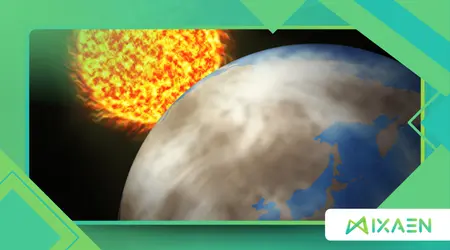
Sudden Solar Shift Disrupt Earth’s Climate is a compelling question that touches upon the fundamental stability of our life support system.
Anúncios
The Sun is the undisputed primary driver of Earth’s climate, dictating everything from temperature to weather patterns. Its output is remarkably steady, varying only minutely over short timescales.
However, the Sun is a dynamic star, subject to cycles and powerful, explosive events.
While astronomical changes happen over eons, we must investigate if sudden, unexpected solar phenomena could trigger swift and catastrophic changes here on our planet.
What are the Mechanisms that Govern the Sun’s Energy Output?
The Sun’s energy output is governed by nuclear fusion occurring deep within its core. Here, hydrogen atoms fuse to create helium, releasing massive amounts of energy according to the famous mass-energy equivalence (𝐸=𝑚𝑐2).
This process is incredibly stable, maintaining a near-constant solar output, known as the Solar Constant, which provides the energy necessary to sustain life on Earth.
++ Why the Sun Sometimes “Goes Quiet” and What That Means
How Stable is the Solar Constant?
The Solar Constant, the average amount of solar radiation received per unit area at Earth’s distance, remains highly stable. Variations are typically less than 0,1% over the 11-year solar cycle.
This minute variability suggests that short-term changes in the Sun’s total energy output are insufficient to cause a massive, instantaneous climate shift on Earth.
Also read: Can the Sun Influence Human Behavior or Mental Health?
What is the 11-Year Solar Cycle?
The 11-year solar cycle refers to the periodic change in the Sun’s activity, marked by the number of sunspots.
At the peak of the cycle (solar maximum), the Sun is slightly brighter and more magnetically turbulent.
Despite the turbulence, the corresponding change in total solar irradiance (TSI) is too small to significantly Sudden Solar Shift Disrupt Earth’s Climate on a global scale.
Read more: Understanding Helioseismology: Listening to the Sun’s Vibrations
How Does Convection Maintain Solar Uniformity?
Energy from the Sun’s core takes millions of years to reach the surface through radiative and convective zones. The boiling, churning action of the outer convection zone ensures the energy is evenly distributed.
This consistent mixing acts like a giant, thermal regulator, preventing localized energy buildup that might otherwise cause a sudden, erratic change in the light reaching Earth.
What Solar Events Could Potentially Trigger a Climate Impact?
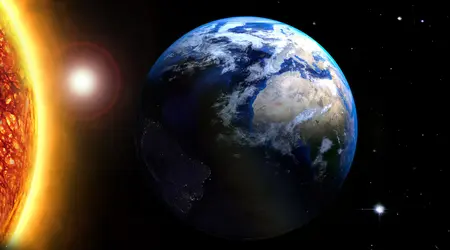
While changes in the Sun’s overall brightness are minimal, certain powerful, sudden solar events, driven by magnetic energy, could potentially impact Earth’s climate indirectly.
These events primarily involve the rapid release of massive amounts of charged particles and high-energy radiation, which interact first with Earth’s protective magnetosphere and atmosphere.
How Do Solar Flares Affect Earth?
A solar flare is an intense burst of radiation coming from the sudden release of magnetic energy. These flares release high-energy X-rays and ultraviolet radiation.
These radiation bursts primarily affect the Earth’s upper atmosphere (ionosphere), causing temporary radio blackouts and navigational interference. They do not significantly penetrate to the surface or alter global temperatures.
Could a Coronal Mass Ejection (CME) Impact Climate?
A Coronal Mass Ejection (CME) is a massive expulsion of plasma and magnetic field from the Sun’s corona. If directed at Earth, it can trigger a severe geomagnetic storm.
While a super-CME could cripple power grids and satellites, its direct impact on global surface temperatures or long-term climate is negligible compared to greenhouse gas forcing.
The Carrington Event Scenario (1859)
The 1859 Carrington Event was one of the strongest geomagnetic storms on record.
It caused widespread telegraph system failures globally, a dramatic example of a Sudden Solar Shift Disrupt Earth’s Climate technologically.
If a similar event struck today, it would devastate modern infrastructure, but it would not trigger an ice age or a rapid global warming event through changes in solar energy output.
The Role of Cosmic Rays and Clouds
One debated, indirect mechanism involves galactic cosmic rays (GCRs). Solar activity can modulate the flow of GCRs reaching Earth. GCRs are theoretically linked to the formation of low-level clouds.
If a Sudden Solar Shift Disrupt Earth’s Climate by dramatically altering the flow of GCRs, it could change cloud cover, which strongly influences Earth’s reflectivity and temperature balance.
This link, however, remains scientifically tenuous.
How Does Earth’s Own Climate System Buffer Solar Changes?
Earth’s climate system possesses immense thermal inertia, primarily stored in the oceans. This inertia acts as a powerful buffer against rapid external temperature shifts, including minor solar variations.
The deep, massive oceans absorb and redistribute heat slowly, ensuring that a small, sudden solar change does not instantly destabilize the planet’s average temperature.
Why is the Ocean’s Thermal Mass Critical?
The oceans have a huge heat capacity. It takes a massive, sustained change in energy input to significantly raise or lower the average temperature of the entire ocean system.
A sudden, slight increase in solar energy is quickly absorbed and dispersed globally, preventing rapid atmospheric overheating. This deep thermal mass makes the planet resilient.
How Do Volcanic Eruptions Compare to Solar Shifts?
Large volcanic eruptions, like Pinatubo in 1991, inject massive amounts of aerosols (sulfur dioxide) into the stratosphere. These aerosols directly reflect sunlight back into space.
A single major eruption can cause a temporary global cooling effect of around 0,5 °C for 1-2 years. This Sudden Solar Shift Disrupt Earth’s Climate far more noticeably than any recent solar cycle variation.
What is the Role of Greenhouse Gases?
Anthropogenic greenhouse gases (GHGs) trap heat within the atmosphere. The energy trapped by GHGs is currently many times greater than the variability caused by the entire 11-year solar cycle.
The current trend of global warming is driven overwhelmingly by this internal forcing, rendering minor solar fluctuations almost insignificant in comparison.
Data from the IPCC (2024 analysis) shows that the change in radiative forcing from anthropogenic greenhouse gases is approximately 30 times greater than the change in forcing from solar irradiance variations over the past century.
This confirms that Earth’s climate is now primarily driven by internal human factors, not external solar fluctuations.
| Type of Solar Event | Primary Energy Release | Earth Impact Pathway | Climate Change Potential (Short-Term) | Frequency/Timing |
| Solar Cycle (TSI Variation) | Electromagnetic Radiation (Light/Heat) | Total Energy Input to Earth | Negligible (sim 0.1\% change) | 11-Year Cycle |
| Solar Flare | High-Energy X-rays/UV Radiation | Upper Atmosphere (Ionosphere) Disruption | None (Affects radio/GPS) | Highly Variable (Common at solar max) |
| Coronal Mass Ejection (CME) | Plasma/Charged Particles | Geomagnetic Storms, Infrastructure damage | None (Indirect technological threat) | Highly Variable (Common at solar max) |
| Solar Grand Minimum | Long-term decrease in TSI and Sunspots | Reduced Heat Input | Minor, localized cooling over decades | Centuries-long recurrence (e.g., Maunder Minimum) |
Could a Solar Grand Minimum Cause Significant Climate Change?
The most plausible, though still limited, form of a Sudden Solar Shift Disrupt Earth’s Climate over a multi-decade timeframe is a Solar Grand Minimum a prolonged period of extremely low solar activity and few sunspots.
These events, like the Maunder Minimum (1645–1715), correlate with cooler periods on Earth, though the effect is localized and small compared to modern warming.
What Was the Maunder Minimum?
The Maunder Minimum was a period when sunspots were exceedingly rare, corresponding with the coldest part of the “Little Ice Age” in parts of Europe and North America.
Scientists estimate that the minimum caused a global cooling of only about 0,1 a 0,2 °C, demonstrating that even a prolonged solar quiet period has a modest effect.
Why Won’t a New Grand Minimum Solve Global Warming?
Due to the powerful warming effect of current greenhouse gas concentrations, scientists agree that a new Grand Minimum would only slightly slow, but not reverse, the present warming trend.
The atmospheric heat already trapped by GHGs far outweighs the small amount of heat reduction that the quiet Sun would provide.
How Do Scientists Monitor the Sun for Sudden Shifts?
Global observatories, like the Solar Dynamics Observatory (SDO) and Parker Solar Probe, continuously monitor the Sun’s magnetic fields, surface temperature, and energy output in real-time.
These sophisticated satellites provide constant, instantaneous data, allowing for early prediction and alerts regarding major solar storms that could threaten infrastructure on Earth.
Conclusion: The Limits of Solar Influence on Climate
While the Sun fundamentally controls our planet’s energy budget, the potential for a Sudden Solar Shift Disrupt Earth’s Climate is scientifically minimal in the short term.
The Sun is remarkably stable, and Earth’s thermal inertia is immense.
The greatest current climate risks stem from changes within Earth’s atmosphere, driven by human activity, not from unpredictable solar fireworks.
The true challenge is not a solar catastrophe, but managing our own planetary impact.
Does the stability of the Sun make us complacent about our own role in climate change? Share your thoughts on the greatest threats to our climate below!
Frequently Asked Questions
Is there any evidence that solar cycles cause modern global warming?
No. The 11-year solar cycle shows a tiny variation. Global temperatures have steadily risen since the 1970s, while solar activity has shown no significant increasing trend.
What is the difference between solar constant and solar irradiance?
Solar irradiance is the measure of the Sun’s power per unit area received at Earth. The Solar Constant is the average value of that irradiance, which is about 1.361 W/m².
Could a CME destroy the atmosphere?
No. Earth’s powerful magnetosphere deflects the charged particles of a CME. While a severe storm can damage ground-based technology, it poses no threat to the existence of the atmosphere itself.
How long does it take for a solar change to affect Earth’s temperature?
Changes in solar irradiance (light) are immediate. However, because of the ocean’s thermal inertia, a sustained change in global temperature from solar forcing would take several decades to fully manifest.
What is the most dangerous solar event for human civilization?
A major Coronal Mass Ejection (CME) is the most dangerous solar event because it could cause a global geomagnetic storm, potentially destroying satellites, communications, and power grids worldwide.
