
Could Dark Energy Be Linked to a Force We Haven’t Discovered?
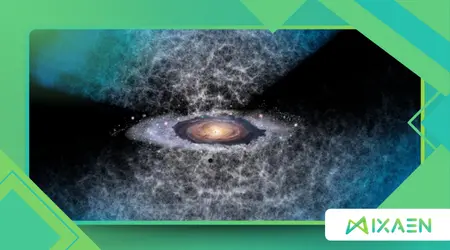
The question, Could Dark Energy Be Linked to a Force We Haven’t Discovered, sits at the very heart of 21st-century cosmology, challenging everything we thought we knew about the universe.
Anúncios
Since its shocking discovery in 1998, Dark Energy has remained the most profound mystery in modern science. It is the invisible force driving the accelerating expansion of the cosmos.
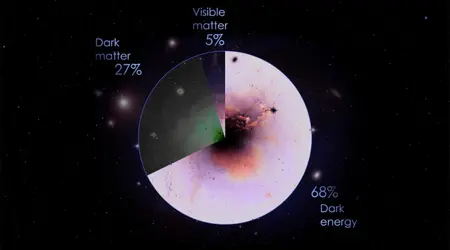
This mysterious component makes up about 68% of the total energy density of the universe, dwarfing all visible matter and even Dark Matter.
Scientists are grappling with the possibility that Dark Energy is not merely a cosmological constant, but rather the manifestation of an entirely new interaction a fifth fundamental force.
What is Dark Energy and Why Does it Demand a New Physics?
Dark Energy is currently modeled as a ubiquitous negative pressure intrinsic to the fabric of spacetime itself.
This pressure works against gravity, acting as a repulsive force that is stretching the universe apart at an ever-increasing rate. Without it, the expansion rate should be slowing down.
Our current understanding, encapsulated in the Standard Model of particle physics, describes three fundamental forces electromagnetism, strong nuclear, and weak nuclear plus gravity.
However, none of these forces adequately explain Dark Energy’s relentless push.
The vast discrepancy between theoretical predictions and observation compels us to ask, Could Dark Energy Be Linked to a Force We Haven’t Discovered?
++Why the Universe Seems Too Ordered to Be Random
Why Does the Standard Model Fail to Explain Dark Energy?
The simplest explanation for Dark Energy is the Cosmological Constant, a term first introduced by Albert Einstein.
Quantum field theory attempts to calculate this constant based on the energy of “virtual particles” popping in and out of existence in a vacuum.
The problem is catastrophic: this calculation overshoots the observed amount of Dark Energy by a staggering factor of up to .
This is arguably the worst prediction in the history of science. This monumental failure suggests a profound incompleteness in our models of gravity and quantum mechanics.
Also read: Why There Are Still No Answers About What Happened Before the Big Bang
Why Do We Need a New Force to Explain Cosmic Acceleration?
If the cosmological constant is incorrect, Dark Energy might be a dynamic, evolving field, not a static entity. This hypothetical dynamic field is often referred to as Quintessence.
Quintessence would necessitate a corresponding particle, and thus an associated force.
Unlike the four known forces, which affect conventional matter in measurable ways, this new force would primarily interact with spacetime itself, making it incredibly difficult to detect in laboratory settings here on Earth.
This new physics is essential to understanding the Dark Energy Be Linked to a Force We Haven’t Discovered.
Read more: Is There a Shadow Universe Interacting with Ours?
How Did We First Discover the Effects of Dark Energy?
The definitive discovery came in 1998 from observations of distant Type Ia Supernovae.
These “standard candles” explode with consistent, known brightness. By measuring how dim they appeared, astronomers could accurately gauge their distance.
Surprisingly, the most distant supernovae were much dimmer and farther away than predicted by a universe where expansion was slowing.
This proved that the expansion has actually been speeding up for the last five billion years, leading to the undeniable conclusion: something unknown, Dark Energy, is at play.
How Could a Fifth Force Manifest Itself in the Cosmos?
If Dark Energy Be Linked to a Force We Haven’t Discovered, this force would need to possess unique characteristics. It would need to be extremely weak and only active over vast cosmological scales.
This is why we haven’t encountered it in our everyday life or powerful particle colliders.
This new interaction, sometimes generically called a “fifth force,” would fundamentally alter the way objects interact over immense distances.
Its effects are subtle in local areas like the Solar System but become overwhelmingly dominant when observed across billions of light-years, where it dictates the universe’s destiny.
What are the Leading Theories for a Fifth Force, Like Chameleon Fields?
One prominent theory suggesting that Dark Energy Be Linked to a Force We Haven’t Discovered involves Chameleon Fields.
These hypothetical fields derive their name from their ability to change their nature depending on the local environment’s density.
In high-density environments, such as labs or planetary systems, the Chameleon field becomes massive, effectively switching off its effects.
However, in the near-vacuum of intergalactic space, the field becomes virtually massless, allowing the corresponding fifth force to emerge and drive cosmic acceleration, escaping terrestrial detection.
Why Do Scientists Study Variations in Fundamental Constants?
Another subtle way a new force might manifest is by causing slight variations in the fundamental constants of nature over cosmic time.
For example, if the fine-structure constant or the ratio of proton to electron mass changed slightly in the distant past.
Astronomers actively study light from extremely distant quasars. Analyzing the light spectra from these objects allows them to check if the fundamental constants were different billions of years ago.
Any confirmed variation could be evidence of a new field coupling to matter, offering a clue to the nature of Dark Energy.
What Original Example Illustrates the New Force’s Scale-Dependence?
Imagine a vast, stretched rubber sheet representing spacetime. Normally, mass creates gravity wells in this sheet. Now, add a thin, invisible layer of oil on top of the sheet this is the hypothetical fifth force.
On a tiny, local scale, like standing on the sheet, you barely notice the oil; it doesn’t affect your jump height (gravity).
But over the sheet’s full cosmological expanse, the oil’s surface tension causes the entire sheet to uniformly pull itself apart, stretching faster and faster.
This illustrates how the fifth force is only dominant on a large scale, yet essential to explaining, Could Dark Energy Be Linked to a Force We Haven’t Discovered?
How Can We Hunt for Evidence of a New Cosmic Force?
The hunt for a new fundamental force linked to Dark Energy requires ingenious experiments and massive sky surveys.
Since the force is likely too weak to measure directly, scientists are looking for subtle deviations from General Relativity across the largest observable scales.
The search involves both “top-down” cosmological observations and “bottom-up” ultra-sensitive laboratory tests.
The key is seeking any sign that gravity, the only force currently explaining cosmic structure on large scales, is behaving differently than predicted.
What Large-Scale Cosmological Surveys Are Currently Operational?
Several ongoing and upcoming surveys are dedicated to precisely mapping the universe’s structure and expansion history.
Projects like the Dark Energy Survey (DES) and the future Vera C. Rubin Observatory’s Legacy Survey of Space and Time (LSST) are essential tools.
These surveys measure billions of galaxies and their clustering patterns, known as Baryon Acoustic Oscillations (BAO).
If Dark Energy is a dynamic fifth force rather than a constant, these clustering patterns should show subtle evolutionary changes over cosmic time, providing a definitive test for the Dark Energy Be Linked to a Force We Haven’t Discovered.
What Laboratory Experiments Are Testing for Tiny Deviations?
On Earth, physicists are using exquisitely sensitive apparatuses to test the inverse-square law of gravity over microscopic distances. If a fifth force exists, it might mediate interactions over ranges as small as a micron.
One original experimental approach uses torsion balances placed near large, dense objects.
These devices are designed to measure any tiny, non-gravitational pull that might arise from a fifth force coupling to the mass of the test objects.
Such a deviation, however small, would be the first direct evidence of a new force.
What Reference Data Supports the Need for Exotic Explanations?
The Planck Collaboration, the most precise mapper of the Cosmic Microwave Background (CMB), provided a crucial data point regarding the universe’s composition.
Their 2018 final data release confirmed the following distribution: 68.3% Dark Energy, 26.8% Dark Matter, and only 4.9% Ordinary Matter.
This compelling statistic reveals that the forces and particles we understand constitute less than 5% of the cosmos.
The remaining 95.1% demands explanations far beyond the Standard Model, making the idea that Dark Energy Be Linked to a Force We Haven’t Discovered not just plausible, but likely.
Why is the Universe Analogous to a Loaf of Rising Bread?
The accelerating expansion of the universe, driven by Dark Energy, can be understood using the analogy of a loaf of raisin bread rising in an oven. The dough represents the expanding spacetime, and the raisins represent the galaxies.
As the dough rises (spacetime expands), the raisins (galaxies) move farther apart. Critically, the raisins themselves do not move through the dough; the space between them is stretching.
Dark Energy is the “yeast” causing the dough to not just rise, but to rise faster and faster. This analogy perfectly captures the nature of cosmological expansion, where distance, not velocity, is the key factor.
Comparison of Fundamental Forces and Dark Energy/Fifth Force
| Characteristic | Gravity | Electromagnetism | Strong Nuclear Force | Dark Energy/Fifth Force (Hypothetical) |
| Range | Infinite | Infinite | Short (Nuclear) | Cosmic (Extremely Long) |
| Strength (Relative) | Weakest | Intermediate | Strongest | Extremely Weak |
| Effect on Spacetime | Curves/Attracts | None (Indirect) | None | Stretches/Repels |
| Status in Standard Model | Not Included | Yes | Yes | Exotic/Unknown |
| Mediating Particle | Graviton (Hypothetical) | Photon | Gluon | Fifth Force Particle (e.g., Chameleon) |
The question, Could Dark Energy Be Linked to a Force We Haven’t Discovered, is driving the next revolution in physics.
The extreme weakness and cosmological scale of Dark Energy strongly suggest that our current framework is incomplete.
Whether it’s a dynamic Quintessence field or a clever Chameleon force, discovering its true nature will fundamentally rewrite our textbooks on the universe.
The pursuit of this “fifth force” represents humanity’s quest to understand the vast majority of our cosmic home, and the answer is out there, awaiting a breakthrough observation.
Share your thoughts in the comments below! If Dark Energy is a fifth force, what do you think its particle should be named?
Frequently Asked Questions
What is the main difference between Dark Matter and Dark Energy?
Dark Matter is an attractive gravitational force; it is a form of unseen matter that clusters galaxies together.
Dark Energy is a repulsive pressure that is pushing the universe apart. Dark Matter slows expansion; Dark Energy accelerates it.
Does Dark Energy violate the law of conservation of energy?
No, Dark Energy does not violate the conservation of energy. As spacetime expands, the volume increases, and new Dark Energy is effectively created within that new space.
However, the total energy density of the universe remains constant, and the overall conservation of energy holds true under the laws of General Relativity.
Why haven’t particle colliders like the LHC detected Dark Energy or a fifth force?
Particle colliders are designed to test high-energy interactions over microscopic scales. If a fifth force is tied to Dark Energy, it is theorized to be extremely weak and only active over vast, cosmological distances.
Its corresponding particle would likely be extremely low-mass, making it virtually undetectable in high-energy, local lab environments.
Could Dark Energy be related to gravity “leaking” into extra dimensions?
Yes, this is a theoretical concept called Modified Gravity or braneworld models. These theories propose that gravity is “diluted” because the graviton (hypothetical gravity particle) can leak into extra spatial dimensions.
If gravity weakens on very large scales due to this leakage, it could mimic the effect of a repulsive Dark Energy.
What is the “Cosmic Coincidence Problem”?
The Cosmic Coincidence Problem asks why the density of Dark Energy is currently comparable to the density of matter (Dark and Ordinary).
These two densities evolve very differently as the universe expands, so they should only be equal for a very brief moment in cosmic history.
This perplexing timing suggests that Dark Energy might be a dynamic field, rather than a static constant, reinforcing the need for new theories.
