
Could Time Be a Psychological Artifact Instead of a Physical Dimension?
Could Time Be a Psychological Artifact Instead of an objective, physical dimension is one of the deepest philosophical and scientific inquiries of 2025.
Anúncios
While we experience time as a relentless flow from past to future, modern physics suggests this perception might be profoundly misleading.
This radical idea posits that the reality we inhabit is a timeless, four-dimensional “Block Universe,” where past, present, and future exist simultaneously.
Our sense of linear progression may simply be a trick of consciousness.
Why Does Physics Struggle with the Concept of “Now”?
Classical physics, especially Einstein’s Theory of Relativity, describes time not as a flowing river, but as a static dimension, interwoven with space, forming spacetime. The mathematics offer no true distinction between moments.
The fundamental equations governing physical laws work equally well whether time runs forward or backward. This lack of a “time arrow” in physics directly conflicts with our everyday experience of constant change.
++ Could the Universe Be an Emergent Pattern Instead of a Physical Structure?
How Does Relativity Undermine a Universal “Present”?
Special Relativity dictates that the concept of simultaneity is relative. Two events considered “now” for one observer might be perceived as happening at different times by another observer moving at a different velocity.
This dependence on the observer destroys the notion of a single, universal “present” moment. The physical reality appears to be observer-dependent, supporting the Block Universe model.
Also read: Is Consciousness a Fundamental Component of Spacetime?
What is the “Block Universe” Model?
The Block Universe model suggests that all events from the Big Bang to the universe’s eventual heat death are simply points within a fixed, immutable four-dimensional geometry.
There is no “becoming” or “passing.” Our consciousness merely navigates this structure sequentially. Could Time Be a Psychological Artifact Instead is strongly supported by this view.
Read more: The Ethics of Knowing Too Much About the Universe
The Relativistic Time Dilation Experiment
When astronauts spend time on the International Space Station (ISS), they move at high velocity relative to Earth.
Upon return, their clocks (and biological aging) show they are fractionally younger than their Earth-bound twins.
This measurable difference proves that time is malleable and subjective. It is not an absolute, steady clock governing the entire universe simultaneously.
How Does Consciousness Create the Illusion of Flow?
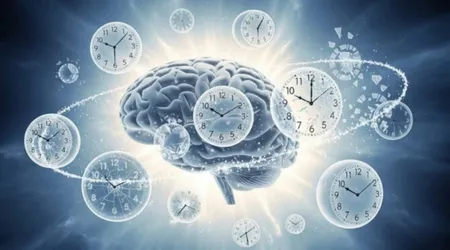
If the physical universe is static, then the sensation of “time flowing” must originate within the human brain.
Psychology and neuroscience offer compelling evidence for how this linear experience is constructed.
Our consciousness stitches together discrete moments, creating a narrative that gives structure and meaning to the constant influx of sensory information we receive.
Why Do We Only Perceive One Moment at a Time?
The brain creates the sense of “now” by constantly buffering and processing sensory data over a very short interval estimated to be about 3 seconds.
This process transforms sensory inputs into a continuous narrative. Without this processing, reality would appear as a fragmented collection of unrelated images and sounds.
What is the Role of Memory in Temporal Perception?
Memory is the engine of the psychological past. We define the flow of time by recognizing the difference between the current perception and the memory of the immediate past perception.
The distinction between past and future is entirely dependent on the brain’s ability to record and categorize sequential events, making time a cognitive filing system.
The Experience of Time Warping During Trauma
During high-stress situations, like a car accident, people often report that time seemed to slow down dramatically. This is a purely psychological phenomenon.
The brain, driven by adrenaline, processes sensory information at an accelerated rate, packing more perceived events into a short objective duration.
The physical clock remains unchanged, but the perceived duration is radically stretched.
Where Does the “Arrow of Time” Really Come From?
If the fundamental laws of physics are time-symmetric, why does our macroscopic universe only move forward?
The answer lies not in dynamics, but in thermodynamics specifically, the concept of entropy.
The inevitable increase in disorder (entropy) is the only physical process that clearly defines a direction for time, linking the past to the future through irreversible change.
What is Entropy and the Second Law of Thermodynamics?
The Second Law of Thermodynamics states that the total entropy (disorder) of an isolated system can only increase over time. Organized energy spreads out; complexity breaks down.
This ubiquitous physical trend provides the macroscopic arrow of time, explaining why broken cups do not spontaneously reassemble and why we age.
How Does the Brain Create its Own “Psychological Arrow”?
Our brain creates its psychological arrow by constantly consuming low-entropy energy (food) and dissipating it as high-entropy heat. This metabolic process requires a constant flow of irreversible chemical reactions.
The brain’s continuous increase in internal disorder requires a constant intake of order. This one-way chemical consumption mirrors, and perhaps drives, our perception of time’s direction.
Time as an Unfurling Scroll
If the Block Universe is a long, finished scroll containing all events, then human consciousness is a small reading light.
The light only illuminates the segment directly in front of it (“now”) and retains the memory of the segments already passed.
The illusion of flow is the act of the scroll unfurling beneath the stationary light.
Could Neurobiology Offer the Final Answer?
Neuroscience is actively investigating how specific neural circuits map and process temporal information, seeking to isolate the biological mechanism that creates the sensation of passing time.
This research suggests time perception is deeply intertwined with spatial memory.
Understanding the neural networks involved might allow us to one day manipulate the perceived rate of time, further proving that Could Time Be a Psychological Artifact Instead of an external constant.
Which Brain Areas are Linked to Time Perception?
Temporal processing involves multiple brain regions, including the hippocampus (critical for spatial memory and episodic events) and the parietal cortex. There is no single “time organ.”
These areas integrate information from the internal circadian rhythm with external events to generate a unified sense of duration and sequence.
How Does Internal Rhythm Influence Perceived Time?
Our internal biological clocks, regulated by the suprachiasmatic nucleus (SCN), affect how we estimate duration. When the SCN is highly active (excitement), time subjectively speeds up.
When metabolic activity slows (boredom or quiet rest), time seems to drag. This variability points to a highly subjective, internally generated temporal experience.
Research published in Nature Neuroscience (2024) identified specific “time cells” in the hippocampus of mammals that fire sequentially to encode elapsed duration, even in the absence of external stimuli.
This discovery strongly supports the theory that the brain possesses an innate, dedicated mechanism for generating the internal sense of time flow.
| Concept | Nature of Time | Perception | Physical Basis (Arrow) | Role of Consciousness |
| Classical Physics | Absolute, Universal | Linear, Constant | Assumed to be linear | Passive Observer |
| Relativity/Block Universe | Static, Fixed Dimension | Illusion of Flow | Non-existent (Symmetric) | Navigator through fixed geometry |
| Psychological/Neuroscience | Subjective, Malleable | Constructed Narrative | Entropy (Thermodynamics) | Active Creator of the present moment |
| Quantum Mechanics (Theories) | Emergent (Time is not fundamental) | Fragmented/Discontinuous | Decoherence | Integrator of discrete events |
Conclusion: The Ultimate Question of Reality
The debate over whether Could Time Be a Psychological Artifact Instead of a physical reality forces a profound re-evaluation of our most basic assumptions.
While physics offers a static, timeless block, our consciousness constructs a vibrant, flowing narrative.
Ultimately, the feeling of time passing may be the necessary interface a neurobiological trick that allows complex systems like us to function within a timeless physical structure.
The most accurate clock we possess might just be our own mind.
Do you feel the relentless march of time, or are you simply experiencing the irreversible increase of your own personal entropy? Share your philosophical insights below!
Frequently Asked Questions
If time isn’t real, why do clocks work?
Clocks measure change and motion in physical systems (e.g., pendulum swing, quartz vibration). They track sequential events, not the flow of time itself.
Is this idea the same as living in the Matrix?
No. The Matrix is an artificial simulation. The Block Universe is a valid mathematical description of physical reality where all moments exist simultaneously, independent of human perception.
If time is an illusion, can we change the past?
The Block Universe model suggests that the past is fixed. The illusion is our perception of moving through it, not the existence or malleability of the events themselves.
What is the biggest hurdle for time being purely physical?
The biggest hurdle is the irreversibility problem. The physical laws are time-reversible, but the universe is not. Entropy is the only physical law that defines a clear, one-way direction.
What is the next major experiment concerning time?
Theoretical physicists are seeking experimental evidence for Quantum Gravity, which is expected to remove time as a fundamental variable from the most basic equations of the universe.
