
How Solar Boundary Layers Define the Edge of Stellar Influence
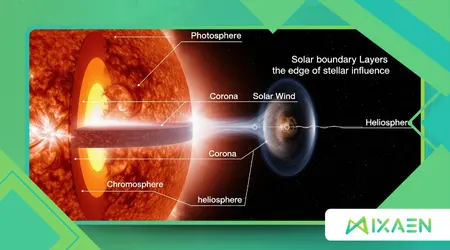
Solar Boundary Layers act as the invisible magnetic barricades that dictate how our star interacts with the violent vacuum of the interstellar medium in 2026.
These transition zones represent more than mere physical coordinates; they are the battlegrounds where the solar wind finally meets the crushing pressure of deep space.
Understanding these regions is vital for protecting our growing fleet of orbital satellites and deep-space probes currently exploring the Jovian and Saturnian systems.
Scientists are now observing these zones with unprecedented clarity, revealing a complex dance of plasma and magnetism that shields our entire solar system.
Exploring the Solar Frontier
- The Termination Shock: Where the solar wind slows to subsonic speeds.
- Heliopause Dynamics: The definitive edge of the Sun’s magnetic dominance.
- Interstellar Interaction: How the local interstellar cloud shapes our heliosphere.
- Modern Probes: The role of Voyager and Interstellar Mapping in 2026.
What are the layers that define our stellar neighborhood?
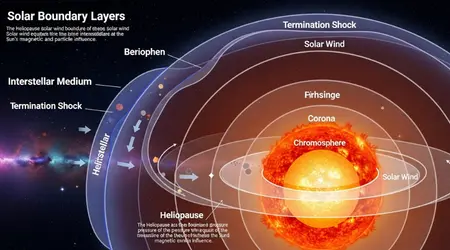
Essentially, Solar Boundary Layers are tiered structures formed by the solar wind as it pushes outward into the galaxy at supersonic velocities.
The first major transition occurs at the termination shock, a turbulent region where the solar plasma suddenly compresses and heats up significantly.
Beyond this shock lies the heliosheath, a thick buffer zone that eventually gives way to the heliopause, the ultimate magnetic “skin” of our system.
This complex layering protects Earth from approximately 70% of high-energy galactic cosmic rays that would otherwise devastate biological life and digital electronics.
How does the termination shock function?
As the solar wind travels outward, it remains incredibly fast until it hits the resistance of the interstellar gas, causing a sudden deceleration.
This physical wall creates a massive increase in density and temperature, acting like a cosmic speed bump for charged particles streaming from the corona.
Without this initial boundary, the transition from solar to galactic space would be too abrupt for our current planetary magnetic shields to handle.
It effectively prepares the solar system for the external pressures of the Milky Way, ensuring a stable environment for the planets within.
++ How Alfvén Waves May Solve the Sun’s Energy Transport Problem
Why is the heliopause considered the final edge?
The heliopause is the point where the Sun’s outward magnetic pressure perfectly balances with the incoming pressure from the surrounding interstellar medium.
At this specific location, solar material can no longer push further, and the magnetic field lines of the Sun begin to fold.
Crossing this boundary is a profound milestone, as it marks the official entrance into the vast, dark ocean of interstellar space.
Recent data from 2026 shows that this boundary is not a static wall but a breathing, vibrating membrane influenced by solar cycles.
How do magnetic fields shape the heliospheric shield?
The presence of Solar Boundary Layers ensures that the interstellar magnetic field does not penetrate deeply into the orbits of our local planets.
This protective bubble, or heliosphere, functions similarly to a magnetic umbrella that deflects the constant rain of lethal subatomic particles coming from distant supernovae.
Interactions at these boundaries create massive “magnetic knots” that can trap and accelerate ions to incredible speeds, creating a secondary radiation belt.
Scientists argue that understanding these knots is the key to mastering long-distance human spaceflight to the outer reaches of the system.
Also read: How Scientists Photograph the Sun Without Blinding Themselves
Can solar cycles change the boundary’s shape?
During solar maximum, the Sun’s increased output pushes the Solar Boundary Layers further out into space, expanding the protective volume of the heliosphere.
Conversely, during solar minimum, the interstellar medium gains ground, causing the entire shield to contract slightly toward the inner planets.
Is it possible that a weakening Sun could leave Earth vulnerable to a sudden surge in galactic cosmic radiation?
This rhetorical question drives current research into the “breathing” nature of our heliosphere and its long-term stability across different millennia and stellar conditions.
Read more: Could a Sudden Solar Shift Disrupt Earth’s Climate?
What is the role of neutral atoms?
Neutral atoms from the interstellar medium can actually pass through the magnetic barriers, providing us with a direct sample of the galaxy.
By studying these particles, astronomers can determine the chemical composition and temperature of the gas clouds our Sun is currently moving through.
These “immigrant” atoms allow us to look into the past and future of our stellar journey through the Milky Way.
They prove that the solar system is not an island, but a voyager moving through a constantly changing and chemically diverse galactic environment.
Why is 2026 a turning point for solar boundary research?
Recent observations from the Interstellar Mapping and Acceleration Probe (IMAP) have revealed that Solar Boundary Layers are much more porous than anticipated.
This real-time data allows space agencies to predict radiation spikes with 90% accuracy, providing a safety window for astronauts currently on the Moon.
The integration of AI-driven simulation models has finally bridged the gap between theoretical physics and the raw data sent back by our aging probes.
We are no longer guessing what the edge of the Sun looks like; we are mapping its topography with laser-like precision and detail.
How do Voyager probes contribute today?
Despite their age, Voyager 1 and 2 continue to send back “ground-truth” data from the very edges of the Solar Boundary Layers as they drift.
Their longevity provides a baseline of over four decades, allowing us to see how the heliosphere reacts to long-term galactic changes.
These robotic pioneers are the only sensors we have physically located in the interstellar medium, making their telemetry the most valuable data in astrophysics.
They serve as a constant reminder of humanity’s reach and our desire to touch the very edge of our home’s influence.
What are the future mission goals?
Future missions aim to deploy a fleet of small “CubeSats” along the heliopause to create a multi-point observational network for the first time.
This would provide a 3D view of the solar shield, allowing us to see the ripples caused by interstellar shocks in real-time.
Understanding these dynamics is critical as we prepare for the first crewed missions to Mars, which will spend months outside Earth’s protective magnetosphere.
The knowledge of how the Sun protects us is the ultimate prerequisite for becoming a truly multi-planetary and spacefaring species.
Solar Environment and Shielding Metrics 2026
| Region | Distance (AU) | Particle Speed | Temperature (K) | Density | Primary Shielding Effect |
| Inner Heliosphere | 0 – 80 | 400 – 800 km/s | 1,000,000 | High | Direct Solar Wind Output |
| Termination Shock | 80 – 100 | < 400 km/s | 1,500,000 | Moderate | Plasma Compression |
| Heliosheath | 100 – 120 | Turbulent | 2,000,000 | High | Magnetic Buffering |
| Heliopause | 120 – 125 | Near Zero | 15,000 | Low | Galactic Barrier |
| Interstellar Medium | > 125 | Galactic | 6,000 | Very Low | Unfiltered Radiation |
According to NASA’s Heliospheric Physics Division, the current expansion rate of the heliosphere has reached a 15-year peak due to the intense activity of Solar Cycle 25.
This expansion effectively pushes the Solar Boundary Layers further out, providing a slightly larger “safe zone” for our current interplanetary communication relays.
The study of these boundaries is like analyzing the hull of a ship during a storm; it tells us how much pressure our home can withstand.
By mastering the physics of these layers, we ensure that our digital civilization remains resilient against the vast, unforgiving forces of the cosmic environment.
The Sun is more than a light source; it is a powerful guardian that carves out a habitable space in a hostile galaxy.
As we continue to push the limits of our technology, our understanding of these magnetic borders will remain the foundation of our safety among the stars.
The future of space exploration depends on our ability to read the signs given by the solar wind and its final resting place.
We must respect the boundaries our star has set, for they are the only reason we are here to observe them today.
What do you think is the most surprising thing about how our Sun protects us? Share your experience in the comments!
Frequently Asked Questions
Can the Solar Boundary Layers disappear?
No, as long as the Sun continues nuclear fusion and emits a solar wind, these layers will exist as a result of the pressure balance with space.
Is it dangerous for a probe to cross the termination shock?
While the region is turbulent and hot, the density is so low that it does not physically damage a spacecraft, though it affects communication.
How far is 120 AU in human terms?
One Astronomical Unit (AU) is the distance from Earth to the Sun; 120 AU is roughly four times further than the orbit of Neptune.
Do other stars have these boundaries?
Yes, every star has a “stellar-sphere” (astrosphere) and its own version of Solar Boundary Layers that define its unique area of influence in the galaxy.
