
How Solar Plasma Loops Defy Simple Physics
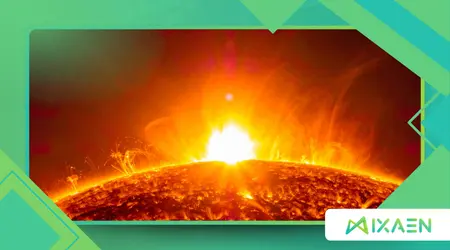
Solar Plasma Loops Defy Simple Physics as they arch across the Sun’s corona, challenging our standard understanding of thermodynamics and fluid motion in 2026.
Anúncios
These colossal structures, often larger than ten Earths, remain mysteriously hot despite being far from the Sun’s nuclear furnace at the core.
Scientists observe these loops with growing fascination as they maintain perfect, smooth shapes while carrying millions of tons of superheated gas through space.
The sheer scale and complexity of these magnetic events represent the ultimate laboratory for understanding the fundamental laws of the entire universe.
Solar Phenomenon Navigator
- Thermal Anomalies: Investigating why the solar atmosphere is significantly hotter than the surface.
- Magnetic Scaffolding: How invisible fields act as structural skeletons for flowing plasma.
- Coronal Rain: The cyclical process of plasma cooling and falling back to the surface.
- Eruption Prediction: Using loop behavior to forecast solar flares and potential Earth-based blackouts.
Why does solar temperature behave so strangely?
The fact that Solar Plasma Loops Defy Simple Physics is most evident in the extreme temperature gradient between the Sun’s surface and its corona.
While the surface sits at roughly 5,500°C, the plasma loops reaching into the atmosphere soar to temperatures exceeding one million degrees.
Imagine standing far away from a campfire and feeling your skin burn more than if you were touching the embers themselves.
This counterintuitive reality suggests that magnetic energy is being converted into heat through processes we are only now beginning to grasp.
How does magnetic reconnection generate heat?
When magnetic field lines within these loops cross and snap, they release incredible amounts of kinetic energy, heating the surrounding plasma almost instantly.
This process, known as magnetic reconnection, acts like a cosmic rubber band snapping and releasing heat into the solar atmosphere.
These snaps are responsible for the sudden brightening we see in high-resolution telescope images from NASA’s Solar Dynamics Observatory.
Every flash represents a massive energy transfer that keeps the loop glowing bright against the dark vacuum of space for days.
++ What Causes Sudden Spikes in Solar Energy Output
What are the “Nanoflare” theories of 2026?
Researchers increasingly believe that millions of tiny explosions, or nanoflares, occur constantly along the base of these loops to maintain their heat.
These events are too small to see individually but create a collective heat that defies traditional convection models used for stars.
By studying these micro-explosions, physicists hope to solve the “coronal heating problem” that has baffled the scientific community for over eighty years.
The data suggests that the Sun is far more vibrant and chaotic at the microscopic level than previously believed.
How do magnetic fields maintain these structures?
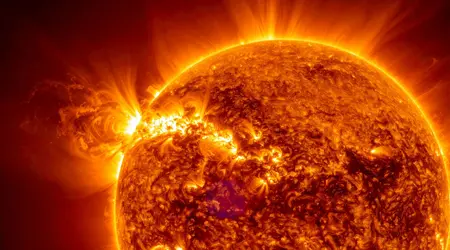
The observation that Solar Plasma Loops Defy Simple Physics extends to their structural integrity, which remains stable despite the chaotic turbulence below.
These loops act like high-speed highways, where plasma is confined by magnetic pressure that prevents it from dissipating into space.
Without this magnetic confinement, the pressurized gas would simply expand and vanish, much like steam rising from a boiling pot of water.
Instead, the fields act as rigid pipes, guiding the flow of matter in perfect, glowing parabolas that can last for weeks.
Also read: How Close Can We Get to the Sun Without Melting?
Why do loops remain so uniform in thickness?
Standard physics suggests that a loop should expand as it moves away from the Sun, where the external pressure is much lower.
However, solar loops often maintain a constant width from base to peak, behaving more like solid tubes than expanding gas clouds.
This uniformity suggests that magnetic forces are far more dominant over gas pressure than traditional fluid dynamics equations typically allow for in space.
It is as if the magnetic “skin” of the loop has a tension that prevents any lateral expansion during its journey.
Read more: How Scientists Photograph the Sun Without Blinding Themselves
How does “Coronal Rain” cycle through the loops?
As the plasma reaches the top of the arch, it occasionally cools and condenses into dense droplets that fall back toward the surface.
This “coronal rain” follows the magnetic field lines, creating a beautiful, slow-motion shower of fire that scientists monitor in real time.
This cycle of heating, rising, cooling, and falling is essential for the Sun’s atmospheric balance and helps regulate the magnetic tension.
Monitoring this rain allows us to predict when a loop might become unstable and eventually erupt into a massive solar flare.
Why is 2026 a turning point for solar research?
We currently observe that Solar Plasma Loops Defy Simple Physics more clearly due to the latest generation of space-based solar observatories.
These tools provide 12K resolution images that allow us to see the “braiding” of magnetic strands within a single plasma loop.
Understanding these braids is crucial because they store the energy that eventually fuels the most powerful explosions in our solar system.
If we can map the tension in these braids, we can finally predict solar storms days before they impact our satellites.
What did the latest Parker Solar Probe data reveal?
The Parker Solar Probe recently dove closer to the Sun than any man-made object in history, flying directly through these plasma loops.
It recorded “switchbacks” sudden reversals in the magnetic field that provide the missing link in how energy moves from the surface upward.
This data confirms that the Sun’s magnetic field is much more “wrinkled” than our smooth mathematical models once predicted.
These wrinkles are the engine rooms where the laws of physics are pushed to their absolute breaking point every single second.
How do solar loops impact Earth’s technology?
When a loop becomes too twisted, it can snap and launch a Coronal Mass Ejection (CME) directly toward our planet’s magnetic shield.
These events can induce currents in our power grids, potentially causing widespread blackouts and destroying sensitive GPS satellite electronics.
Because Solar Plasma Loops Defy Simple Physics, our early warning systems must rely on complex AI models to interpret the Sun’s mood.
In 2026, these AI systems monitor loop oscillations to give us a 48-hour head start on protecting our global infrastructure.
Comparative Data of Solar Atmospheric Layers
| Solar Layer | Average Temperature | Dominant Physics | Visual Characteristic |
| Photosphere | 5,500°C | Blackbody Radiation | Visible Sunspots |
| Chromosphere | 20,000°C | Spectral Emission | Reddish Glow |
| Transition Region | 1,000,000°C | Rapid Thermal Jump | Thin Plasma Shelfs |
| Corona | 2,000,000°C+ | Magnetic Reconnection | Massive Plasma Loops |
| Core | 15,000,000°C | Nuclear Fusion | Invisible Gamma Rays |
The Unsolved Mystery of our Star
The realization that Solar Plasma Loops Defy Simple Physics keeps the scientific community humble and driven toward new discoveries.
We have explored how magnetic tension, thermal anomalies, and “coronal rain” create a landscape that contradicts our everyday experiences on Earth.
As the Parker Solar Probe continues its daring mission, we move closer to unlocking the final secrets of the solar corona.
These loops are not just beautiful lights; they are the keys to understanding how energy and matter interact across the entire cosmos.
By respecting the complexity of our star, we better prepare ourselves for the solar storms of the future while marveling at the sheer power of nature.
Do you think we will ever fully harness the magnetic energy of the Sun, or will it always remain beyond our control? Share your experience in the comments below!
Frequently Asked Questions
Are solar plasma loops dangerous to humans on Earth?
The loops themselves stay near the Sun, but their eruptions can send radiation toward Earth.
Our atmosphere protects our bodies, but our technology like power grids and satellites is very vulnerable to these massive magnetic events.
How big is a typical solar plasma loop?
A single loop can easily span 100,000 kilometers, which is roughly the size of ten Earths stacked together. Some of the largest “prominences” can even reach heights that rival the diameter of the planet Jupiter.
Why are the loops shaped like arches?
They follow the invisible magnetic field lines that emerge from sunspots, which act like the north and south poles of a magnet. The plasma is forced to travel along these curved paths, creating the iconic arch shape we see.
Can we hear the sound of these loops?
Space is a vacuum, so sound cannot travel, but the loops do vibrate at specific frequencies. Scientists can translate these magnetic oscillations into audible sound waves, revealing that the Sun “rings” like a giant, deep bell.
