
What Solar Storm Forecasting Still Gets Wrong
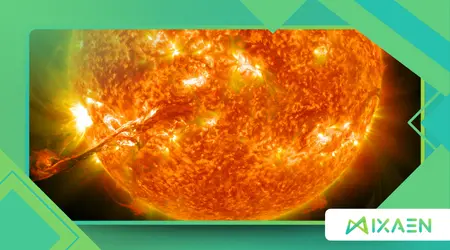
Solar Storm Forecasting Still Gets Wrong the precise arrival time and magnetic orientation of solar eruptions, leaving our global power grids dangerously exposed to sudden shocks.
Anúncios
As we approach the peak of Solar Cycle 25 in early 2026, the stakes for satellite operators and energy providers have never been higher.
While our telescopes capture high-resolution images of solar flares within minutes, the massive clouds of plasma known as CMEs remain a predictive nightmare.
Scientists struggle to determine if a plasma strike will be a glancing blow or a direct hit that could cripple modern communication systems.
Strategic Analysis of Space Weather Gaps
- The Orientation Problem: Why the Bz
 magnetic component remains impossible to measure before the storm arrives.
 - Timing the Strike: How solar wind variations cause arrival errors of up to 12 hours.
- Infrastructure Risk: The vulnerability of undersea cables and high-voltage transformers to induced currents.
- Predictive Evolution: New AI models vs. traditional physics-based simulations in 2026.
Why does the magnetic orientation of a CME matter?
The greatest challenge in space weather today is that Solar Storm Forecasting Still Gets Wrong the magnetic polarity of an incoming Coronal Mass Ejection.
If the magnetic field of the storm points north, it bounces off Earth’s shield, but if it points south, it causes havoc.
This Bz component acts like a key; only the “southward” key opens the door to our atmosphere, pouring billions of watts into our power grids.
Current sensors at the L1 Lagrange point only give us about 30 minutes of warning, which is barely enough to protect sensitive electronics.
Understanding this magnetic “handshake” is like trying to guess the color of a ball thrown from 93 million miles away.
Without better deep-space buoys, we are essentially blindfolded until the very last second, risking billions in damage to our orbital infrastructure.
Researchers at the Space Weather Prediction Center (SWPC) emphasize that until we can “see” the internal magnetic structure of a CME, our forecasts remain educated guesses.
This gap represents the single most significant hurdle in protecting the global economy from a “Carrington-level” event.
++ The Mystery of Uneven Solar Heat Distribution
How do solar wind speeds complicate timing?
Solar wind acts like a turbulent river, accelerating or slowing down plasma clouds as they journey through the cold vacuum toward our planet.
Solar Storm Forecasting Still Gets Wrong the exact speed of these winds because our current models lack enough real-time data points.
A difference of just a few kilometers per second in solar wind speed can shift the arrival of a storm by several hours.
This uncertainty makes it difficult for airlines to reroute flights or for grid operators to manage voltage stability effectively.
Also read: Understanding Helioseismology: Listening to the Sun’s Vibrations
What is the role of the L1 Lagrange point?
The L1 point is where our best “early warning” satellites sit, positioned directly between the Sun and Earth to catch oncoming particles.
While these tools provide vital data, they are positioned too close to Earth to allow for long-term preparation during extreme events.
In 2026, we still rely heavily on the DSCOVR and ACE satellites, which are aging and frequently face telemetry challenges during high radiation.
We desperately need a network of sensors closer to the Sun to extend our current 30-minute warning window to several hours.
Why do we fail to predict the intensity of G5 storms?
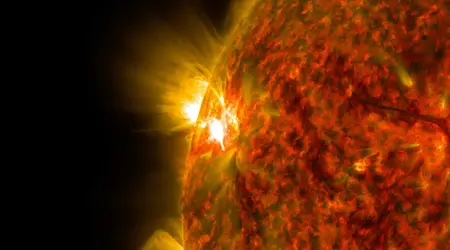
Even with advanced supercomputers, Solar Storm Forecasting Still Gets Wrong the peak intensity of G5 geomagnetic storms until the impact has already begun.
The interaction between the storm and Earth’s complex magnetosphere is non-linear, making small variations in solar density lead to massive ground effects.
During the May 2024 solar storms, many models predicted a moderate G3 event, yet the world witnessed a historic G5 geomagnetic disturbance.
This discrepancy shows that our understanding of how energy transfers into the ionosphere is still fundamentally incomplete and requires better physics.
Data from a 2025 NASA study revealed that nearly 40% of extreme geomagnetic forecasts missed the mark by at least one storm category.
This margin of error is unacceptable for an era where our reliance on GPS and star-link constellations is absolute and growing.
If we cannot accurately predict the “weight” of the solar hammer, how can we expect power companies to justify expensive emergency shutdowns?
This uncertainty creates a “cry wolf” scenario where repeated false alarms might lead to complacency during a truly catastrophic strike.
Read more: Can Solar Eruptions Trigger Earthquakes?
How does AI improve or hinder our predictions?
Artificial intelligence can process vast amounts of historical solar data faster than any human, identifying patterns that traditional physics models often miss.
However, AI lacks the ability to account for “black swan” events that have no precedent in our relatively short digital record.
Many 2026 models now use machine learning to refine arrival times, but these systems still struggle with the initial “launch” physics of CMEs.
The combination of human intuition and algorithmic speed is currently our best, albeit flawed, defense against the Sun’s unpredictable nature.
What are the dangers of Geomagnetically Induced Currents (GIC)?
When a solar storm hits, it creates “ghost” currents that flow through the ground and enter our power lines through massive transformers.
Solar Storm Forecasting Still Gets Wrong exactly which specific transformers will fail, as the local geology significantly influences where these currents concentrate.
A storm hitting the rocky soil of Quebec will behave differently than one hitting the sandy plains of Florida, complicating regional safety protocols.
Without precise geological mapping of GIC risks, we are playing a dangerous game of chance with our national power distribution networks.
Why are undersea cables the next great vulnerability?
As we build more transcontinental fiber-optic links, Solar Storm Forecasting Still Gets Wrong the potential for “voltage surges” in the repeaters under our oceans.
These cables are the backbone of the 2026 internet, yet they have never been tested by a true solar superstorm.
The salt water of the ocean conducts electricity, and during a geomagnetic storm, the vast distance of these cables allows voltage to build up.
A single failure in a mid-Atlantic repeater could disconnect entire continents from the global web, causing trillions in lost economic activity.
Imagine the global internet as a massive spider web vibrating in a hurricane; one snapped strand can cause the entire structure to collapse.
We are currently building a faster world without fully understanding the solar weather that can bring it all down in minutes.
Recent warnings from the International Telecommunication Union suggest that our current maritime infrastructure is largely unprepared for G5-level induction.
Forecasting must evolve to include “sub-surface” impacts if we hope to maintain global connectivity during the next inevitable peak of solar activity.
How do satellite operators manage “drag” during storms?
When the atmosphere heats up from solar radiation, it expands outward, creating more “thick” air for low-earth orbit satellites to push through.
This increased drag can cause satellites to lose altitude and burn up in the atmosphere if they aren’t moved in time.
In 2022, SpaceX lost 40 Starlink satellites to a relatively minor solar event because the atmospheric drag was underestimated by nearly double.
This serves as a grim example of how even “minor” forecasting errors can lead to multi-million dollar losses in the blink of an eye.
Why is the Parker Solar Probe essential for 2026?
The Parker Solar Probe is currently diving closer to the Sun than any previous spacecraft, “touching” the corona to measure magnetic fields.
The data it provides is vital for correcting the errors that Solar Storm Forecasting Still Gets Wrong regarding the initial acceleration of solar plasma.
By 2026, the insights from this mission are being integrated into new global models, but we still lack a “real-time” feed from the corona.
Until we have permanent monitors at the Sun’s doorstep, our ability to forecast the birth of a storm will remain limited.
Comparison of Solar Forecasting Accuracy (2024 vs. 2026)
| Forecast Metric | 2024 Accuracy | 2026 AI-Enhanced Accuracy | Primary Cause of Error |
| CME Arrival Time | ± 12 Hours | ± 7 Hours | Solar Wind Turbulence |
| Bz(Polarity) | 15% Accuracy | 22% Accuracy | Lack of Remote Sensing |
| Intensity (G-Scale) | 65% Accuracy | 78% Accuracy | Local Magnetosphere Variance |
| Atmospheric Drag | 50% Accuracy | 82% Accuracy | Ionospheric Heating Delay |
| GIC Location | 30% Accuracy | 45% Accuracy | Geological Conductivity Data |
Our current struggle with solar weather proves that even in 2026, nature remains the ultimate wild card for our digital civilization.
While we have improved arrival timing, the magnetic “hit or miss” nature of CMEs continues to be the Achilles’ heel of global preparedness.
We must invest in more deep-space sensors and better geological mapping to turn these “educated guesses” into actionable intelligence.
The Sun is a temperamental star, and our survival as a tech-driven society depends on finally solving the physics that current forecasting still misses.
As we ride the peak of Solar Cycle 25, the only certainty is that the Sun will surprise us again; will we be ready to catch the next strike, or will we be left in the dark by a forecast that failed to see the light?
Could our reliance on automated electrical grids be the very thing that makes a solar storm catastrophic? Share your experience in the comments!
Frequently Asked Questions
What is the “Carrington Event”?
It was the strongest recorded solar storm in 1859, which caused telegraph wires to spark and set fires. If it happened today, it could destroy most modern electronics.
Why can’t we just shield our power grids?
Shielding is possible through “capacitive blocking,” but it is incredibly expensive to implement across every single transformer in a national grid.
Does a solar storm affect my smartphone?
Usually, no. Handheld devices aren’t long enough to catch induced currents. However, the GPS and internet services your phone relies on can be completely disabled.
How often do G5 storms happen?
G5 storms occur roughly 4 times per solar cycle (every 11 years), but “extreme” events like the Carrington one happen only once every century or two.
Is there a way to see the magnetic field before it hits?
Not currently. We can only infer it from the shape of the eruption at the Sun, but we cannot measure it directly until it reaches our sensors at L1.
