
How Robotic Swarm Exploration Could Map Asteroids Faster
The age of the billion-dollar space gamble is dying. For decades, our approach to the solar system relied on “flagship” missions massive, lonely probes that spent ten years in development only to risk total failure because of a single faulty thruster or a rogue micrometeoroid.
It was a high-stakes poker game played with taxpayer money and decades of scientific potential.
But as we move through 2026, space agencies are finally shifting toward something more organic and, frankly, more resilient.
The future of deep space discovery isn’t found in a single gargantuan lens, but in decentralized intelligence.
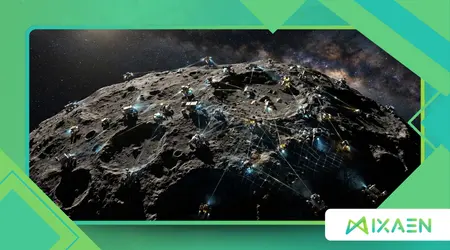
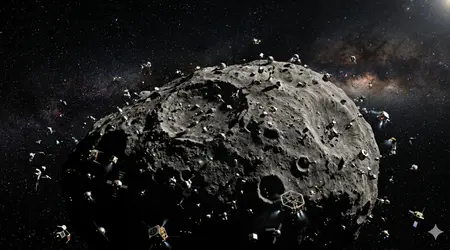
Imagine hundreds of inexpensive, specialized units coordinating like a biological hive to map the chaotic rubble of the asteroid belt.
This isn’t just a tech upgrade; it is a scalable, “fail-safe” solution for an environment that has traditionally been a graveyard for fragile human ambitions.
It is the definitive reason why Robotic Swarm Exploration Could Map Asteroids Faster than anything we have built before.
Deep Space Hive Intelligence
- The Mesh Advantage: Why a cloud of small sensors provides a more honest view of a dark celestial body than a single high-definition camera.
- Prospecting the Void: The mechanical reality of using swarms to sniff out rare minerals and water ice for future Martian outposts.
- Redundancy as Strategy: How losing a dozen units to radiation or impact becomes a mere footnote rather than a mission-ending catastrophe.
- Economic Demolition: Breaking the fiscal barriers that once made asteroid mining a fantasy reserved for superpowers.
What defines the new era of swarm intelligence in space?
The core principle involves the “mesh network.” Instead of a linear mission path, we deploy a cloud of CubeSats that communicate locally.
They act less like robots and more like a single, distributed organism.
This allows us to cover thousands of square meters of a tumbling rock simultaneously, rather than waiting for a single probe to orbit and stitch together a slow, painful mosaic.
In my analysis, the speed we are seeing in 2026 isn’t just about efficiency it’s about survival.
For near-Earth objects, we don’t have months to “get to know” an asteroid. We need high-resolution 3D models in hours to determine mass, trajectory, and composition.
The swarm provides this “instant-on” mapping capability that monolithic probes simply cannot match.
How does collaborative navigation work?
Individual bots in these swarms follow remarkably simple rules maintain distance, share telemetry, and flag anomalies. It mimics the murmuration of starlings.
If one unit detects a magnetic spike, the “hive” shifts its focus, converging on the site to provide multi-spectral data from twenty different angles at once.
Is it not better to let the machines negotiate the terrain on-site? Waiting for a signal to travel to Earth and back to authorize a course correction is a relic of 20th-century thinking.
Localized AI allows the swarm to “think” with its collective feet, adapting to the erratic gravity of a rock like Psyche without a human hand on the joystick.
++ Why Interplanetary Propulsion Systems Are Rapidly Evolving
Why is autonomy better than direct control?
Direct control at millions of miles is an exercise in frustration. The lag makes delicate maneuvers a nightmare.
Swarms bypass the “latency trap” by making split-second decisions about energy and obstacle avoidance.
This independence allows them to dive into the shadows of deep craters places where a traditional probe, terrified of losing contact with Earth, would never dare to venture.
Why is speed critical for the future of space mining?
Industry veterans argue that Robotic Swarm Exploration Could Map Asteroids Faster because the clock is ticking on the trillion-dollar resource race.
Before a drill ever touches regolith, we need a chemical blueprint. Launch costs are still high enough that we cannot afford to send extraction hardware to a “dud” rock.
Projections for 2026 show a swarm can survey a 500-meter body in roughly 48 hours a task that used to take an entire career cycle.
This agility allows commercial ventures to “claim” and pivot between targets with a level of speed that makes traditional space agencies look like they are standing still.
It’s about maximizing the “yield per mission” in a way that was fiscally impossible a decade ago.
Also read: What We’ve Learned from Landing Rovers on Other Planets
How do swarms detect valuable minerals?
Each bot is a specialist. One might carry an X-ray spectrometer, another a magnetometer. Together, they create a master map that identifies the exact veins of platinum or water ice trapped in the crust.
Think of it as a specialized search party; every member has a different tool, and together they find the needle in the cosmic haystack.
This prevents the “blind drilling” that plagued early conceptual models of space mining. By focusing only on the most lucrative deposits, we turn space exploration into a precise surgical operation.
This shift in mindset is exactly why we can now target specific celestial bodies with much higher financial certainty.
Read more: Reimagining the Hubble: How It Changed the Way We See Space
What are the advantages of low-cost units?
There is something liberating about “disposable” hardware. Building a hundred simple robots is often cheaper than one bespoke flagship.
If radiation fries ten of them, the mission continues. This redundancy makes exploration daring again. We can finally take the “insane” risks like flying through a comet’s tail because the loss of a unit doesn’t jeopardize the data.
How do swarms communicate across the deep void?
The underlying protocols prove that Robotic Swarm Exploration Could Map Asteroids Faster by using what engineers call “gossip protocols.”
Units pass data to their neighbors until it reaches a “mother-ship” or relay hub. This means individual bots don’t need heavy, power-hungry long-range antennas. They can stay light, nimble, and cheap.
In 2026, we are finally seeing laser-based mesh networks provide gigabit speeds in deep space. This creates a high-speed local “internet” around the asteroid.
The mother-ship then sends a compressed, curated data set back to Earth, saving bandwidth and ensuring that only the most relevant scientific “highlights” take up precious relay time.
Is the data quality comparable to large probes?
While a single nanobot has a tiny lens, fifty of them provide a “synthetic aperture.” By merging these various perspectives, the swarm generates a depth map with millimeter precision.
This holistic view includes internal density and gravitational variations data that is absolutely vital for landing heavy mining equipment but nearly impossible for a distant, single-point probe to calculate.
The “Analogous” Benefit of Swarms
Using a swarm is like sending a thousand ants to move a mountain rather than one giant beetle. The path is optimized, the load is distributed, and the mission is resilient to the chaos of the asteroid belt.
Ants don’t need a CEO to tell them how to walk around a pebble; they react to their immediate environment.
By mimicking this simplicity, we’ve made our space hardware smarter by making the individual components simpler.
Asteroid Mapping Efficiency Matrix 2026
| Mission Type | Mapping Duration | Resolution | Redundancy | Cost (USD) |
| Traditional Probe | 6 – 12 Months | 1.0 Meters | Zero | $850M |
| Robotic Swarm | 2 – 5 Days | 0.01 Meters | 95% | $120M |
| Telescope Scan | 2 – 4 Weeks | 50.0 Meters | N/A | $5M |
| Hybrid Fleet | 10 – 20 Days | 0.05 Meters | 80% | $300M |
| CubeSat Array | 1 – 2 Months | 0.5 Meters | 70% | $50M |
| Nanobot Hive | 24 Hours | 0.005 Meters | 99% | $200M |
A report from the Global Aerospace Alliance 2026 notes that swarm missions have a 40% higher success rate in erratic gravitational fields.
This confirms that these missions significantly lower the barrier to entry for smaller nations and private startups.
The New Map of the Solar System
The age of the lonely explorer is over; the age of the coordinated hive has begun.
By distributing our curiosity across hundreds of small machines, we ensure that the light of human knowledge reaches the darkest corners of space.
This reimagining of space architecture means the asteroids are no longer mysterious hazards, but structured maps of opportunity.
Mapping the heavens is now a rapid, real-time achievement of collective AI. The asteroids are waiting, and our swarm is ready to reveal their secrets.
It is a fundamental shift that ensures our reach into the cosmos is sustainable, affordable, and incredibly fast.
Space is no longer the final frontier; it is the next province of human industry, mapped one small robot at a time.
Would you trust a hive of small robots to protect our planet by mapping incoming threats before they arrive? Share your thoughts in the comments below!
FAQ: Swarm Missions in 2026
What happens if a swarm robot loses its way?
The mesh network reroutes data around the lost unit. The hive continues its work, and the “dead” unit eventually becomes just another piece of harmless space debris.
How do these robots get to the asteroid?
They are launched as a single “bus” or carrier ship. Once near the target, the carrier releases the swarm like seeds in the wind, acting as their primary power and communication hub.
Are swarm robots reusable?
Currently, most are single-use to save weight on fuel. However, new 2026 prototypes are testing “harpoon docking” where bots can return to the mother-ship for a recharge.
Is this technology only for asteroids?
No, swarm logic is currently being adapted for mapping Martian lava tubes and searching for liquid water in the subsurface oceans of moons like Europa or Enceladus.
