
The Mystery of Twisting Magnetic Fields in Solar Plasma Motion
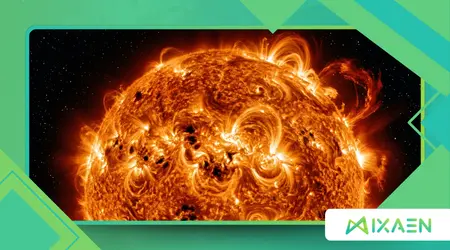
The Mystery of Twisting Magnetic Fields remains a cornerstone of heliophysics in 2026. Scientists are currently tracking unprecedented solar activity during this particularly intense solar maximum.
Our star is not a silent orb. It is a turbulent laboratory where magnetic tension and plasma fluid dynamics engage in a celestial dance.
This chaotic interaction creates massive structures that defy simple explanation. They launch energy across the void toward Earth’s fragile digital infrastructure.
Understanding these invisible, spiraling forces is no longer just an academic pursuit. It is a vital necessity for protecting our modern, hyper-connected way of life.
Solar Dynamics Overview
- The Plasma Engine: How ionized gas carries magnetic flux through the solar interior to the visible surface.
- Helicity and Tension: The process of magnetic lines winding around each other until they reach a breaking point.
- Space Weather Impact: The direct consequences of magnetic reconnection on satellite communications and power grids.
- Observational Breakthroughs: Utilizing data from the Parker Solar Probe to map the sun’s magnetic skeleton.
What causes the magnetic lines to twist so violently?
The primary driver here is differential rotation. The sun’s equator rotates much faster than its poles. This uneven movement stretches internal magnetic bands.
It forces them to wrap around the solar core like rubber bands being pulled to their limit. There is something almost violent about this stretching. It stores an incredible amount of latent power.
Convection currents then push these strained fields toward the surface. They erupt as sunspots and complex loops. As the plasma boils, it drags the magnetic lines into intricate, corkscrew shapes.
These shapes store staggering amounts of potential energy. It is a high-stakes buildup that eventually requires a release.
How does plasma motion affect flux?
Plasma is highly conductive. This means it “freezes” magnetic fields into its flow. This is a phenomenon known as the frozen-in theorem.
When plasma moves in turbulent cells, the embedded magnetic lines must follow every swirl and vortex created by the sun’s immense heat.
This relationship creates a feedback loop. The magnetic field eventually becomes strong enough to push back against the plasma. The result is a highly unstable environment.
Energy accumulates until the magnetic structure can no longer support its own weight. It is a constant battle between fluid motion and magnetic resistance.
++ How Solar Boundary Layers Define the Edge of Stellar Influence
Why is helicity important in solar physics?
Magnetic helicity measures the degree of twisting and kinking within a field. It acts as a signature of the sun’s internal dynamo.
High helicity levels often precede major flares. They provide a crucial warning sign for researchers monitoring space weather.
Scientists use these measurements to predict which sunspot groups are likely to explode. They identify which will remain dormant.
Without understanding this twist, we would be blind to the most dangerous eruptions. It is the difference between a minor aurora and a global blackout.
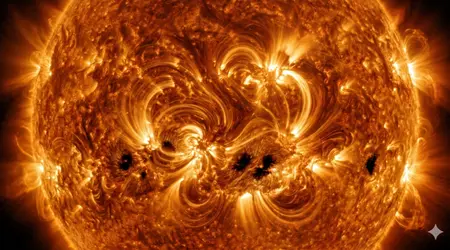
Why does the sun’s corona reach such extreme temperatures?
Solving the Mystery of Twisting Magnetic Fields may finally explain why the outer atmosphere is millions of degrees hotter than the surface.
This has always been a bit of a scientific scandal. It feels counter-intuitive. Recent data suggests that “magnetic braiding” releases heat through constant, small-scale reconnection events.
These “nanoflares” act like millions of tiny explosions. They pump energy into the surrounding gas and keep it at a permanent boil.
It is a strange reality where moving away from the heat source leads to an increase in temperature. This occurs because the energy is being delivered magnetically rather than thermally.
Also read: How Close Can We Get to the Sun Without Melting?
What is magnetic reconnection?
Reconnection happens when oppositely polarized magnetic lines cross and snap. They rearrange themselves into a simpler, lower-energy configuration.
This process releases massive bursts of kinetic energy and heat. It accelerates particles to nearly the speed of light in seconds.
Think of it as a cosmic short-circuit. It happens on a scale larger than entire planets. It is capable of disrupting the very fabric of space-time locally.
These events are the engines behind the most brilliant auroras. They also drive the most destructive solar storms recorded in history.
Read more: How Scientists Photograph the Sun Without Blinding Themselves
How do Alfven waves contribute to heating?
Alfven waves are vibrations that travel along magnetic field lines. They carry energy from the boiling surface deep into the outer atmosphere.
These waves act like a whip being cracked. They send a pulse of energy that dissipates as heat in the thin coronal gas.
Observations from the Solar Orbiter in 2026 have confirmed these waves are common. They represent a steady “hum” of energy.
This hum complements the violent outbursts of flares and mass ejections. It is a constant, rhythmic transfer of power.
How do these solar mysteries affect Earth today?
Solar activity directly influences the frequency of Coronal Mass Ejections (CMEs). These can paralyze our technological world.
When a twisted magnetic filament snaps, it hurls billions of tons of plasma toward Earth. These particles move at millions of miles per hour.
In 2026, our reliance on satellite GPS and low-earth orbit constellations makes us more vulnerable. We are effectively shooting solar “bullets” at our own infrastructure.
A direct hit could cause trillions of dollars in damage. It would affect global communication networks and international power distribution systems.
What happened during the May 2024 storm?
The historic G5-class geomagnetic storm of May 2024 served as a wake-up call. It demonstrated how magnetic twisting on the sun could create auroras in tropical latitudes.
It also disrupted precision farming equipment. This was a clear sign that our technology has a “solar ceiling.”
This event proved that even a “modern” society is at the mercy of solar cycles. We are currently using those lessons to harden our infrastructure.
We are preparing for the next inevitable solar superstorm. The goal is resilience in the face of an unpredictable star.
How do we monitor these fields in real time?
A fleet of spacecraft provides a constant stream of high-resolution magnetic maps. These include the Parker Solar Probe and SDO.
These tools allow us to “see” the invisible forces. We can identify the Mystery of Twisting Magnetic Fields before they erupt.
By combining AI-driven models with direct observations, forecasters can now provide better lead times. We can get up to 48 hours of warning for major events.
This window is essential for airlines to reroute flights. It allows grid operators to stabilize voltage across continents.
Solar Magnetic Activity Data 2026
| Phenomenon | Typical Speed | Temperature | Magnetic Impact | Earth Warning Time |
| Solar Flare | Light Speed | 20M Kelvin | Radio Blackout | 8 Minutes |
| CME | 1-3k km/s | 1M Kelvin | Grid Failure | 15-72 Hours |
| Solar Wind | 400-800 km/s | 100k Kelvin | Aurora | Continuous |
| Sunspots | Static | 4k Kelvin | Flux Source | Days/Weeks |
| Alfven Waves | Variable | N/A | Energy Transfer | Continuous |
According to a 2025 study published in Nature Astronomy, the magnetic complexity of Cycle 25 has exceeded all predictions.
This confirms that the sun is more active and unpredictable than we assumed. We are dealing with a star that refuses to follow our neat, linear models.
Visualizing these fields is like trying to map individual threads in a ball of yarn during a hurricane.
The fluid nature of the sun means no two structures are ever exactly the same. Every eruption is a unique event. It requires a custom response.
Could it be that the sun’s magnetic heart is far more organized than our models suggest? This question keeps solar physicists awake at night.
They sift through terabytes of new data from deep-space missions. They are looking for the hidden order within the chaos.
Understanding our star is a journey into the soul of the solar system. Magnetic tension creates the light and life we enjoy.
We are spectators to a grand, invisible theater. It has been performing for billions of years.
As we move deeper into 2026, the sun will continue to surprise us. Its raw power and magnetic elegance are unmatched.
Our task is to keep watching. We must keep learning and preparing for the next great twist in the solar story.
Have you ever noticed how the Northern Lights seem to dance in sync with an invisible rhythm during a strong solar storm? Share your experience in the comments!
The Magnetic Future
The Mystery of Twisting Magnetic Fields is the key to unlocking the secrets of stellar evolution. It is vital for planetary protection in the modern age.
By mastering the language of solar magnetism, we secure our place among the stars. We safeguard our future on this planet.
Frequently Asked Questions
Can solar magnetic fields hurt humans on the ground?
No. Earth’s atmosphere and magnetic field protect us from direct physical harm. However, technology can be severely affected by the resulting storms.
What is the “Solar Maximum” and why does it matter?
It is the period of highest activity in the sun’s 11-year cycle. It is characterized by more sunspots, flares, and twisted magnetic eruptions.
How does the Parker Solar Probe survive the heat?
It uses a specialized carbon-composite heat shield. This keeps the instruments at a comfortable room temperature while the exterior faces thousands of degrees.
Are all CMEs dangerous to Earth?
No. Most CMEs are launched in directions that miss our planet entirely. Only those with the right magnetic orientation cause significant interference.
