
The Mystery of Binary Asteroid Debris Exchange in Deep Space
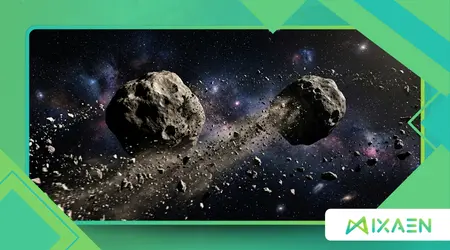
Binary Asteroid Debris Exchange in Deep Space represents one of the most captivating astrophysical puzzles discovered in our solar system’s chaotic belt during 2026.
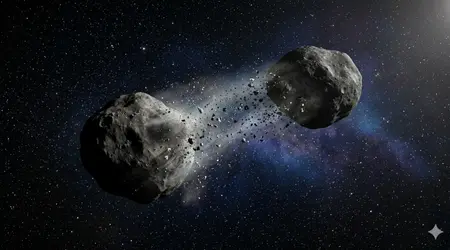
This intricate process involves two celestial bodies locked in a gravitational dance, constantly swapping material, dust, and boulders across the cold vacuum.
Astronomers recently observed how these orbital partners act as cosmic siblings, throwing rocks at each other to maintain their delicate balance.
This discovery reshapes our understanding of how planetesimals evolved in the early solar system, proving that even “dead” rocks possess a dynamic and interactive life.
Orbital Mechanics Overview
- The Roche Limit: Understanding the gravitational threshold where a moonlet begins to disintegrate and feed its primary asteroid partner.
- Granular Flow: Analyzing how loose surface material behaves like a liquid when subjected to the weak tidal forces of a companion.
- Rotational Fission: The process where an asteroid spins so fast it sheds debris, subsequently captured by its neighboring binary twin.
- Surface Refreshing: How the constant movement of regolith prevents these asteroids from showing their true age through cratering patterns.
How does the gravitational interaction trigger material transfer?
Studying Binary Asteroid Debris Exchange in Deep Space requires a look at the YORP effect, which accelerates an asteroid’s spin using solar radiation.
As the primary body reaches its “spin barrier,” centrifugal forces overcome gravity, launching surface debris into a chaotic, shared orbital workspace.
Once this material reaches the Lagrange points between the two bodies, the secondary moonlet begins to vacuum up the liberated dust.
This interaction creates a bridge of rocky debris that acts like a celestial umbilical cord, connecting two distinct histories into a single, evolving system.
Why do boulders migrate between twins?
Tidal forces pull at the loose “rubble pile” structure of these asteroids, causing massive boulders to shift and eventually lift off.
We see this clearly in the Didymos system, where the secondary body, Dimorphos, constantly receives “gifts” of regolith from its larger, faster-spinning primary partner.
This migration is not a one-way street; orbital resonances can occasionally fling material back toward the original host in a complex loop.
Observing this movement allows scientists to calculate the internal density of asteroids without ever landing a physical probe on their rugged, dusty surfaces.
++ Why Intergalactic Gas Filaments Hide the Universe’s Missing Matter
What is the role of electrostatic levitation?
On the dark side of these binary pairs, solar wind and ultraviolet radiation create an electric charge that lifts fine dust particles.
These tiny grains then drift across the gap, guided by the combined gravitational pull of the two bodies in a silent, invisible stream.
Dust transfer might seem insignificant, but over millions of years, it can completely resurface a smaller asteroid, hiding ancient impact scars.
This electrostatic exchange ensures that the binary pair maintains a chemically similar exterior, even if their cores formed in completely different regions.
Why is this debris swap vital for solar system history?
The Binary Asteroid Debris Exchange in Deep Space offers a window into the building blocks of planets and the origin of water.
By analyzing the composition of shared debris, researchers can determine if these pairs formed together or were captured during a close encounter.
Current data from the 2026 Hera mission suggests that roughly 15% of all near-Earth asteroids exist as binary or triple systems.
Understanding their debris exchange is crucial for planetary defense, as it affects how we might deflect a “rubble pile” heading toward Earth.
Also read: Why Some Stars Die Quietly Without Going Supernova
How does material exchange prevent asteroid aging?
Space weathering usually turns asteroid surfaces dark and red over time due to constant exposure to harsh solar radiation and cosmic rays.
However, the constant churning and swapping of debris provide a “cosmic facial,” bringing fresh, unweathered material to the surface every few centuries.
This process explains why some binary asteroids look much younger than their actual orbital age suggests to traditional spectroscopic analysis tools.
The exchange effectively resets the clock, making these systems appear as vibrant remnants of a much more recent and violent past.
Read more: Could Dark Energy Be Linked to a Force We Haven’t Discovered?
Can we track debris exchange in real-time?
Advancements in the James Webb Space Telescope’s infrared sensors now allow us to detect the thermal signatures of moving dust clouds.
We are currently monitoring the asteroid 1999 KW4, which exhibits a visible “waist” of debris ready to jump from the equator to its moon.
These real-time observations prove that the asteroid belt is not a static graveyard but a laboratory of constant geological activity and change.
Capturing a boulder mid-jump between two asteroids remains the “holy grail” for deep-space photographers and asteroid miners alike in 2026.
What are the implications for future asteroid mining?
Investors look at Binary Asteroid Debris Exchange in Deep Space as a natural processing plant for valuable minerals and rare Earth elements.
The debris belt between binary pairs acts as a pre-sorted pile of gravel, much easier to harvest than drilling into a solid, massive rock.
If we can identify the “sweet spots” where debris naturally accumulates, robotic harvesters could simply wait in orbit to collect high-value materials.
This reduces the energy costs of mining operations, making the exploitation of space resources a financially viable reality for private corporations.
Why does debris density affect spacecraft safety?
Navigating a binary system is like driving through a slow-motion hailstone storm, where every pebble can be a potential bullet for sensitive equipment.
Space agencies must now map these “exchange zones” with extreme precision to avoid losing multi-billion dollar probes to a stray piece of regolith.
The density of this debris fluctuates based on solar activity, which can trigger massive “landslides” on the asteroid’s surface that flood the orbit.
Understanding these cycles is essential for the long-term survival of any permanent human or robotic presence in the asteroid belt.
How do we simulate this exchange on Earth?
Using vacuum chambers and microgravity drop towers, scientists recreate the low-gravity collisions that occur during a debris swap in deep space.
These experiments show that asteroid dust behaves more like a fluid than a solid, flowing through space in organized, predictable patterns.
By matching these simulations with real-world data from the TESS telescope, we can predict the future shape of binary asteroid systems.
Is it possible that many single asteroids we see today were actually binary pairs that eventually merged through this very exchange?
2026 Binary Asteroid Exchange Dynamics
| Asteroid System | Primary Spin Rate | Debris Flow Direction | Surface Age Estimate | Mineral Richness |
| Didymos/Dimorphos | 2.26 hours | Primary to Secondary | < 10 Million Years | High Silicates |
| 1999 KW4 | 2.76 hours | Equatorial Flow | < 5 Million Years | Platinum Group |
| Moshup/Squannit | 2.25 hours | Bi-directional | < 12 Million Years | Iron / Nickel |
| Kleopatra (Triple) | 5.38 hours | Complex Shared Belt | < 50 Million Years | High Metallic |
| Florence | 2.36 hours | Outward Spray | < 30 Million Years | Carbonaceous |
| Golevka | 6.02 hours | Minimal Swap | > 100 Million Years | Rare Earths |
| Antiope (Double) | 16.5 hours | Equilibrium | < 20 Million Years | Water Ice |
| 2001 SN263 | 3.42 hours | Triple Exchange | < 15 Million Years | Diversified |
The Binary Asteroid Debris Exchange in Deep Space demonstrates that even the smallest objects in the universe are connected through invisible gravity.
According to the 2026 Space Science Institute report, these exchanges can relocate up to 100 tons of material per century in active systems.
Think of these asteroids as a pair of dancers sharing a single, flowing scarf in a dark room; the scarf is the debris.
We only see the dancers clearly, but the scarf tells the true story of their movement, their speed, and their shared history.
As we peer deeper into the dark, we find that the void is far more crowded and busy than we once dared imagine.
These rocky exchanges are the heartbeat of the asteroid belt, a rhythmic movement that has continued silently for billions of years.
The mystery of how these bodies stay together while shedding their very skin remains a top priority for researchers worldwide.
We are finally learning to listen to the silent language of stones as they fly through the vastness of our celestial backyard.
Have you ever considered that the shooting stars we see might just be debris jumping between two cosmic twins? Share your experience in the comments below!
The Cosmic Exchange
The Binary Asteroid Debris Exchange in Deep Space is a reminder that the universe is never truly at rest, even in its loneliest corners.
By understanding these tiny interactions, we gain the knowledge needed to one day travel among the stars with confidence and safety.
Frequently Asked Questions
Is the debris exchange dangerous for Earth?
No, the exchange happens locally within the asteroid’s orbit; however, understanding it helps us prepare for potential asteroid deflection missions.
Can we see this debris exchange with a home telescope?
Not directly; you would need a powerful professional observatory or an infrared space telescope to see the subtle signs of dust migration.
Do all binary asteroids swap material?
Most do, but it depends on their spin speed and how close they are; slow-moving, distant pairs may have almost no debris interaction.
Is asteroid debris made of valuable gold?
While gold exists, most debris consists of silicates, iron, and nickel, though some “M-type” asteroids are incredibly rich in platinum and palladium.
