
Why Background Independence Matters in Modern Cosmology

Background Independence stands as the cornerstone of our quest to understand the universe, challenging how we define physical reality within space and time.
Anúncios
It demands that laws of nature remain invariant, regardless of the arbitrary coordinate systems we impose upon the cosmos.
Without this principle, modern theoretical physics remains confined to static frameworks that fail to account for the dynamic, evolving nature of gravity itself.
General relativity successfully treats spacetime as a malleable entity, yet quantum mechanics often struggles to relinquish fixed, rigid background structures.
This fundamental tension drives contemporary research, pushing scientists toward a deeper, unified description of existence.
As we refine our cosmological models in 2026, the necessity for a truly background-independent approach becomes increasingly undeniable for breakthroughs in quantum gravity.
Navigating the Cosmological Framework
- The conceptual necessity of removing fixed backgrounds in physical laws.
- How general relativity breaks traditional constraints of absolute space and time.
- Implications for quantum gravity and the future of unified field theories.
- Essential metrics comparing fixed-background models with dynamic, relational systems.
What Is Background Independence and Why Does It Matter?
At its simplest level, Background Independence suggests that physics should not rely on a pre-existing “stage” where events occur.
Traditional models often assume a fixed geometric stage, but true reality appears more relational, where objects define their own space.
This shift mirrors how we move from absolute Newtonian frameworks toward Einstein’s vibrant, active, and interconnected geometry.
Without this flexibility, our math struggles to describe the birth of the universe or the internal dynamics of black holes.
By removing external dependencies, we allow spacetime to emerge dynamically from fundamental interactions, offering a more complete picture.
Scientists argue that any theory of everything must respect this inherent freedom to avoid artificial constraints.
How Does Einstein’s Gravity Utilize This Principle?
General relativity provides the blueprint by ensuring that gravitational equations hold true in every possible frame of reference.
This elegance allows gravity to act as the geometry itself rather than a force operating within an empty container.
Consequently, the fabric of reality behaves like a fluid, warping and stretching based on the mass distribution it contains.
++ Why False Vacuum Decay Could Redefine Cosmic Stability
Why Is This Concept Difficult to Implement?
Quantum field theories typically function within fixed backgrounds, providing an established grid for particles to interact upon.
Merging this rigid structure with the fluidity of relativity creates profound mathematical conflicts that have persisted for decades.
Overcoming this divide remains the primary objective for researchers attempting to bridge the quantum and gravitational realms successfully.
Also read: Why Conformal Cyclic Cosmology Still Divides Physicists
Can We Achieve a Fully Relational Physics?
Achieving a purely relational description requires us to view the universe as a network of interactions without reliance on external observers.
Research indicates that as we progress toward higher energy scales, this transition becomes critical for consistency.
This objective is not merely aesthetic; it is essential for the logical integrity of our evolving cosmic theories.
How Does This Principle Influence Modern Quantum Gravity?
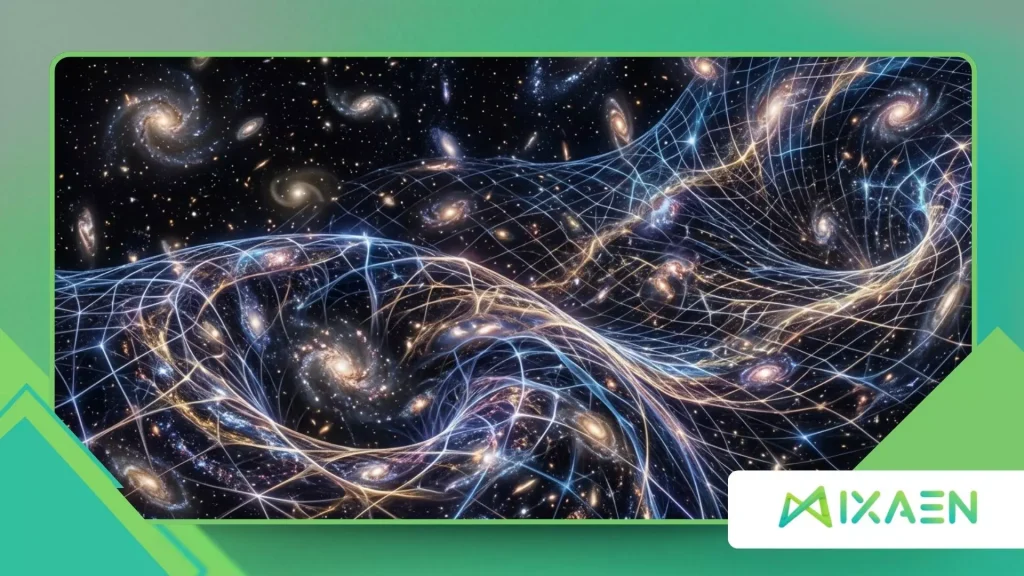
Many promising theories, such as loop quantum gravity, adopt Background Independence as a core axiom to describe the discrete nature of spacetime.
By quantizing geometry itself, these frameworks avoid the pitfalls of theories that treat space as a smooth, continuous backdrop. This approach reveals that space at the smallest scales resembles a woven fabric of quantum excitations.
Such insights suggest that the universe emerges from more fundamental entities, rather than existing as an independent, unchanging arena.
By focusing on connections and relationships, we begin to decode the information-theoretic properties governing cosmic expansion and evolution.
This perspective is vital for resolving paradoxes that arise when spacetime curvature reaches extreme, singularity-defying levels.
Read more: Can Logic Fully Explain the Cosmos?
What Are the Implications for String Theory?
String theory originally struggled with this principle, though recent developments aim to incorporate more dynamic, non-perturbative descriptions of its foundational objects.
This evolution reflects the broader shift in cosmology, where flexibility and relational accuracy take precedence over previous, more rigid formulations.
These advancements represent a maturing understanding of how fundamental strings relate to the geometry of their environment.
Are There Observable Consequences in 2026 Data?
Current observations from advanced observatories are beginning to test the limits of these theoretical frameworks through precise measurements of gravitational wave propagation.
While we have yet to confirm a specific quantum gravity effect, the precision of our data forces models to become increasingly robust.
This interplay between theory and observation is the lifeblood of modern, responsible cosmological science.
How Do Relational Models Handle Causality?
Relational models define causality through the sequence of events rather than fixed temporal indices, ensuring consistency across disparate observers.
This approach prevents causal paradoxes while allowing for the complex, non-linear dynamics inherent in high-energy physics.
It is a profound, albeit challenging, shift in how we interpret the basic narrative flow of the universe.
Why Is the Shift Toward Relational Models Critical?
Moving toward a framework defined by Background Independence helps us escape the limitations of localized observers, allowing for a truly global perspective.
It forces scientists to account for the role of information and the observer within the system’s dynamics. In this sense, the universe acts as a self-contained entity, governed entirely by its internal laws and evolutionary pressures.
Consider this analogy: traditional physics views the universe like a musical performance held inside a rigid, pre-built concert hall.
A background-independent view treats the universe like an impromptu jazz session where the music itself builds the hall, the stage, and the acoustics.
This dynamic, self-creating process offers a far more accurate representation of our observed cosmic reality.
What Are the Major Advantages of This Approach?
The primary advantage lies in its mathematical elegance and ability to avoid singularities that occur in fixed-background models.
By allowing the system to adjust its own geometry, we achieve more stable predictions regarding the early state of the universe. This resilience makes it a preferred pathway for researchers seeking deeper, more fundamental descriptions of physical reality.
Does This Change Our Definition of Time?
Yes, time stops being a universal, ticking clock and becomes a relative measurement based on the interactions of physical states.
This interpretation is consistent with our best observations of relativity, where time dilates and contracts based on velocity and gravity.
It is a liberating, if complex, realization for those who define time through mechanical precision.
Can We Predict Future Cosmological Events?
While precise prediction remains challenging, these models improve our understanding of long-term cosmic evolution and stability.
By mapping the relational structure of spacetime, we can better identify the threshold limits of our current physical understanding.
This clarity is invaluable as we push the boundaries of what is known versus what remains speculative.
Comparative Data: Physical Frameworks
The table below contrasts traditional fixed-background theories with modern relational approaches, illustrating why the latter is favored for deep-space cosmological research.
| Feature Category | Fixed-Background Theories | Relational/Independent Models |
| Spacetime Status | Rigid, immutable container | Emergent, dynamic, and adaptive |
| Coordinate Systems | Essential for defining location | Arbitrary and logically irrelevant |
| Singularity Treatment | Prone to mathematical breakdown | Resolvable through quantized geometry |
| Observer Role | External to the system | Integral to the relational state |
| Predictive Range | Limited to flat spacetime regions | Applicable to extreme gravity states |
Conclusion
The pursuit of Background Independence is far more than a technical exercise; it is a profound philosophical commitment to understanding the universe as it truly is.
By stripping away our comfortable, arbitrary coordinate assumptions, we gain a clearer view of the deep, relational laws that govern all physical existence.
As we continue to refine our models with real-time cosmological data, this principle will undoubtedly guide us toward a more unified and coherent map of reality.
The journey toward a deeper understanding is ongoing, and your engagement is part of that discovery. If you find these concepts fascinating, join the conversation below and share your thoughts on the nature of space and time!
Frequently Asked Questions
Why do some theorists argue against background independence?
Critics often point to the immense mathematical complexity required to formulate fully relational theories without the simplicity of a fixed coordinate background.
They argue that fixed structures provide essential tools for making concrete, testable predictions in high-energy environments, even if those structures are ultimately approximations of a more fundamental, dynamic reality.
How does this affect our understanding of black holes?
In traditional physics, the center of a black hole creates a singular breakdown in math, often viewed as a failure of our current models.
A background-independent approach suggests that space itself is granular or discrete, potentially smoothing out these singularities into physically manageable quantum states that avoid the infinite densities predicted by older, rigid theories.
Is Background Independence considered a proven law of nature?
It is not a proven physical law but rather a guiding principle, much like symmetry or energy conservation, that informs the development of successful theories.
Most physicists believe that any successful, complete theory of quantum gravity must respect this principle to accurately reflect the dynamic, interdependent nature of the gravitational force.
