
Why Conformal Cyclic Cosmology Still Divides Physicists
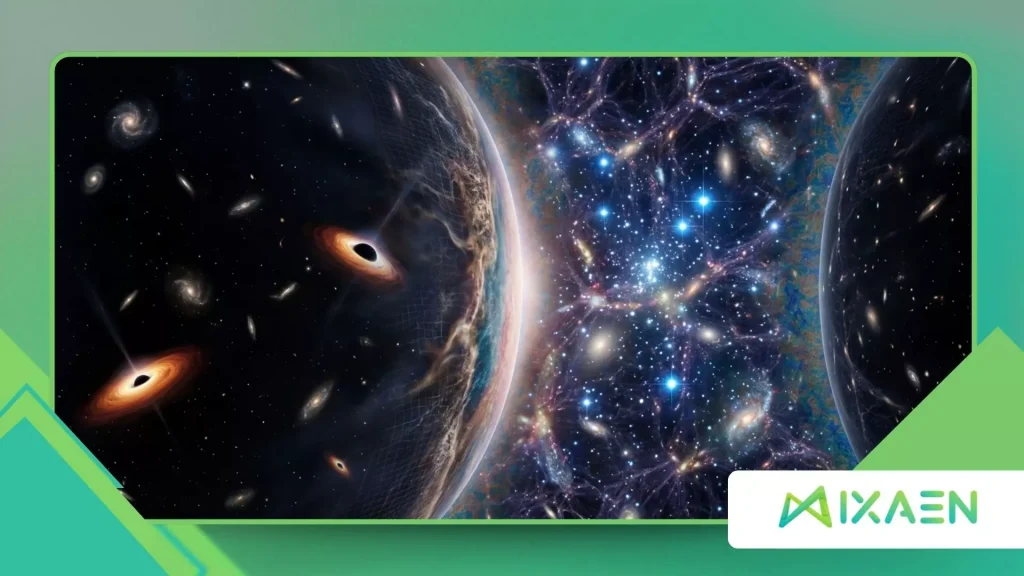
Conformal Cyclic Cosmology fundamentally challenges the conventional Big Bang paradigm by suggesting our universe is merely one eon in an infinite series of cosmic cycles.
This radical philosophical framework eliminates the need for an absolute beginning of time, rewriting the laws of cosmic history completely.
As observational astrophysics advances through 2026, this provocative model continues to trigger intense debates within the global physics community.
While standard inflation models remain deeply entrenched, new anomalies found in space telescope data force scientists to reconsider alternative ideas about reality.
Key Theoretical Elements
- Eternal Recurrence: The timeline consists of successive cosmic eons, where the cold, remote future of one universe triggers the next Big Bang.
- Conformal Rescaling: Without mass, the geometric concepts of scale, size, and distance completely lose physical meaning, allowing infinity to match a singularity.
- Observational Remnants: Supposed gravitational imprints from dead supermassive black holes could leave visible energy rings within the cosmic microwave background radiation.
What Is the Mathematical Core of Sir Roger Penrose’s Vision?
How Does Conformal Geometry Redefine Cosmic Scale?
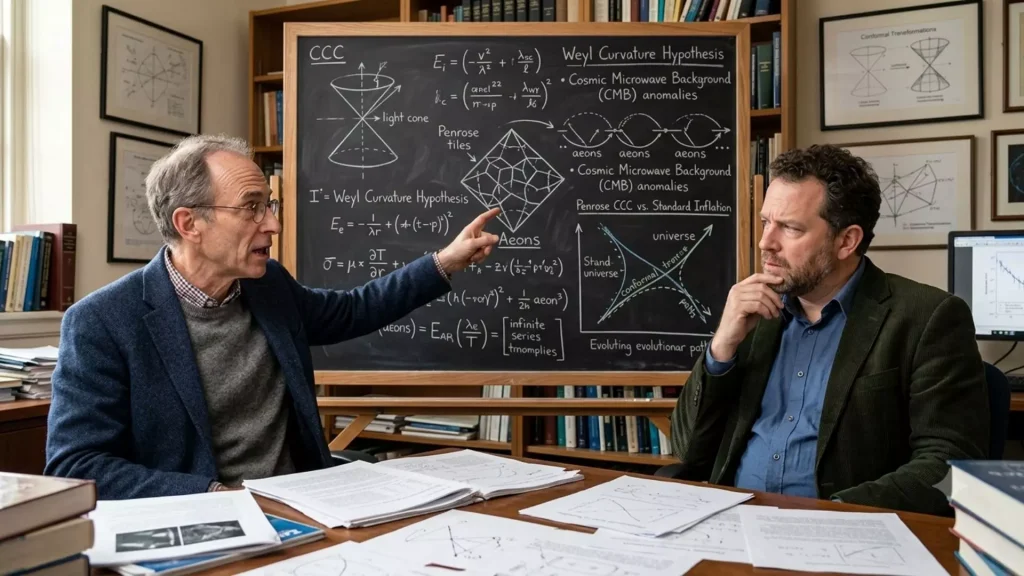
The conceptual foundation of Conformal Cyclic Cosmology rests on the advanced mathematical principles of conformal geometry, which preserves shapes while completely disregarding absolute sizes.
In the extremely deep, cold future of our universe, all matter eventually decays into massless particles like photons that travel constantly at the speed of light.
Because massless particles do not experience time or spatial distance, the universe loses its ability to track its own physical scale.
Consequently, an infinitely expanded, freezing cosmos becomes physically identical to an ultra-dense, localized Big Bang singularity because geometry loses its scale baseline.
Sir Roger Penrose uses this radical mathematical identity to link the ultimate end of an old universe directly to the birth of a new cycle.
This elegant geometry shifts our understanding of space, showing that cosmic extremes can seamlessly blend into one another when mass completely vanishes.
Why Does the Second Law of Thermodynamics Pose a Paradox?
Mainstream physicists routinely question how a cyclic universe can reset its total entropy without violating the fundamental laws of classical thermodynamics.
The Second Law states that total entropy, which measures disorder, must constantly increase over time across any isolated physical system.
If our universe inherits the immense messiness of a previous cosmic era, the next eon should begin in absolute thermodynamic chaos.
Penrose elegantly resolves this apparent paradox by leveraging the extreme gravitational behavior of supermassive black holes during the final stages of an eon.
These cosmic titans swallow vast amounts of disordered matter, eventually evaporating completely via Hawking radiation over trillions of years.
This evaporation removes massive amounts of gravitational entropy from the universe, allowing the cosmic baseline to reset before the next spark occurs.
++ Why Noncommutative Spacetime Models Challenge Classical Physics
What Happens to Massless Particles at the Ultimate Cosmic Horizon?
When the universe reaches its final era of expansion, the absence of massive particles changes the behavior of the remaining radiation fields.
Photons and gravitational waves stretch across unimaginable distances, yet they experience the boundless void as a single, uniform point of origin.
Without physical clocks or measuring rods, the vast cosmic horizon becomes indistinguishable from the infinitely dense starting point of a subsequent universe.
This transition acts like a lens that focuses scattered light back into an intense, highly organized beam of pure creative energy.
The massless environment allows the universe to shed its historical baggage, transitioning smoothly into a brand-new cycle without mechanical breakdown.
It transforms the absolute cold of deep space into the fiery cradle of an entirely new generation of matter.
Why Does the Cosmic Microwave Background Generate Intense Controversy?
What Are Hawking Points and How Do We Identify Them?
The primary observational battleground for Conformal Cyclic Cosmology centers on the statistical analysis of the Cosmic Microwave Background, the ancient radiation left from the early universe.
Penrose claims that the explosive collisions of supermassive black holes in the previous eon leave permanent, circular imprints of electromagnetic energy.
Analysts call these specific thermal anomalies “Hawking Points,” describing them as narrow rings of elevated temperature embedded within cosmic data.
Finding these rings would provide definitive empirical proof that a complex, structured universe existed long before our own Big Bang occurred.
For supporters, these hot spots represent messages sent across the boundaries of time, proving that space possesses an ancient, cyclical memory.
For critics, these thermal variations are nothing more than random statistical noise amplified by over-optimistic data processing techniques.
Also read: Could Time Be a Psychological Artifact Instead of a Physical Dimension?
Why Do Mainstream Cosmologists Dismiss the Alleged Evidence?
Independent research teams analyzing data from the Planck satellite frequently conclude that the alleged circular rings are completely explained by standard inflationary fluctuations.
Mainstream institutions argue that if you look closely enough at any random data set, you will inevitably find geometric patterns that look meaningful.
They assert that the standard inflation model predicts these exact thermal variations without needing to rewrite the laws of physics.
Furthermore, critics argue that the mathematical filters used by Penrose’s team inadvertently introduce the very circular patterns they claim to discover.
This methodological disagreement has created a profound scientific standoff, with both sides analyzing the exact same sky maps while reaching opposite conclusions.
The debate highlights how difficult it is to extract objective truths from the quiet, ancient echoes of the cosmos.
Read more: Is Consciousness a Fundamental Component of Spacetime?
How Do Modern Space Telescoping Projects Alter the Debate?
As we progress through 2026, advanced data streams from next-generation space-based observatories provide unprecedentedly clear maps of subtle primordial polarization patterns.
These hyper-detailed datasets allow astrophysicists to test the competing mathematical models with a degree of precision that was entirely impossible five years ago.
If these new observations show no structured polarization alignment, the cyclical model will lose its remaining empirical support among younger researchers.
Conversely, any verified discovery of unexplainable concentric thermal structures will completely shatter the dominant paradigm of cosmic inflation, forcing a total theoretical revolution.
Scientists are watching these incoming data feeds in real time, knowing the results could redefine our understanding of time itself.
The high stakes of this astronomical detective work keep the entire international physics community on edge.
What Intellectual Obstacles Keep Physicists Deeply Divided?
Why Do Quantum Gravity Theories Clash With Cyclical Models?
The primary theoretical barrier preventing widespread acceptance of Conformal Cyclic Cosmology is its reliance on unproven assumptions about particle physics and quantum mechanics.
For the model to function, all fundamental particles must eventually lose their rest mass, a claim that contradicts current particle physics data.
Standard quantum mechanics suggests that certain particles possess stable mass that cannot simply disappear over time, creating a massive theoretical conflict.
String theorists and loop quantum gravity researchers view the universe through the lens of fundamental micro-structures that resist conformal stretching.
They argue that Penrose’s smooth geometric transitions fail to account for the chaotic, pixelated nature of space-time at the smallest Planck scale.
This deep intellectual divide separates pure geometric relativity from the probabilistic world of modern quantum field theories.
How Does Cosmic Inflation Offer a Simpler Alternative Explanation?
Mainstream astrophysics overwhelmingly favors cosmic inflation because it elegantly explains why the universe looks remarkably flat, smooth, and uniform in every direction.
Inflation suggests the cosmos underwent a superluminal expansion fraction of a second after the Big Bang, smoothing out any initial structural irregularities.
This theory relies on a single hypothetical scalar field, making it mathematically simpler and highly adaptable to new discoveries.
Inflation easily fits within our existing understanding of quantum physics, providing a reliable framework that has survived decades of intense scrutiny.
To displace such a successful theory, an alternative model must offer vastly superior predictive power, not just philosophical elegance.
Most working physicists prefer to perfect the inflationary model rather than embrace a radical rewrite of cosmic history.
What Is the Philosophical Appeal of an Infinite Timeline?
Beyond the mathematical equations, the fierce debate over Conformal Cyclic Cosmology touches on a profound philosophical struggle regarding the true nature of time.
A linear universe with an absolute beginning forces us to confront an uncomfortable question: what happened before the Big Bang?
Inflation avoids this question, whereas a cyclical model completely eliminates the problem of a first cause by making time infinite.
The idea of an endless succession of cosmic eons provides a deeply poetic, harmonious view of reality that resonates with ancient philosophical traditions.
It frames our current universe not as an isolated, accidental flash in a void, but as a single chapter in an eternal cosmic story.
This profound conceptual beauty continues to attract brilliant minds, ensuring the model remains alive despite fierce institutional resistance.
Cosmological Model Comparison
The informative matrix below compares the structural features of competing cosmological paradigms.
| Theoretical Feature | Conformal Cyclic Cosmology | Standard Inflationary Model | Loop Quantum Cosmology |
| Nature of Time | Infinite / Successive Eons | Finite Beginning / Linear | Infinite / Big Bounce |
| Initial Singularity | Eliminated via Rescaling | Present (Before Inflation) | Replaced by Quantum Bounce |
| Entropy Management | Reset via Black Hole Decay | Starts at Ultra-Low Baseline | Maximum Density Limit |
| Primary Proof Claim | CMB Hawking Thermal Rings | Flatness & Horizon Uniformity | Theoretical Quantum Math |
| Mass Stability | Assumes Ultimate Mass Decay | Assumes Stable Mass States | Assumes Quantized Space |
| Cosmic Acceleration | Driven by Conformal Changes | Driven by Dark Energy Field | Driven by Quantum Pressure |
Beyond the Boundaries of a Single Beginning
Analyzing Conformal Cyclic Cosmology reveals a brilliant intellectual attempt to conquer the ultimate boundary of cosmic time through the sheer power of geometry.
By transforming the freezing, infinite void of a dying universe into the dense seed of a new creation, this model challenges our deepest assumptions.
It forces us to ask whether our current laws of physics are permanent fixtures or merely temporary rules for this specific eon.
While the wider scientific community remains deeply skeptical of the empirical evidence, the model serves as an invaluable check against theoretical complacency.
It reminds us that our understanding of the universe’s birth remains incomplete, open to radical revision as new data arrives.
Whether this cyclical vision is proven true or false, it expands our imagination, driving humanity to look deeper into the night sky.
Do you believe our universe had an absolute beginning, or are we living in an endless cycle of cosmic rebirth? Share your thoughts and theoretical perspectives in the comments below!
Frequently Asked Questions
Does Conformal Cyclic Cosmology imply that history repeats itself exactly?
No, the model states that each eon develops its own distinct distribution of matter, stars, and galaxies, creating an entirely unique history.
How long does a single eon last under this cyclical framework?
A single eon lasts for an unimaginably long duration, requiring trillions of years for all matter and black holes to decay completely.
Can humans ever send a message or data into the next cosmic eon?
Physical objects cannot survive the transition, as only pure gravitational wave signatures can potentially imprint energy patterns onto the next cycle.
Is Sir Roger Penrose the only prominent physicist supporting this model?
While Penrose is the primary architect, a small group of international mathematicians and astrophysicists actively develop the model’s observational frameworks.
