
Why Relic Radio Structures Remain Among Space’s Biggest Mysteries
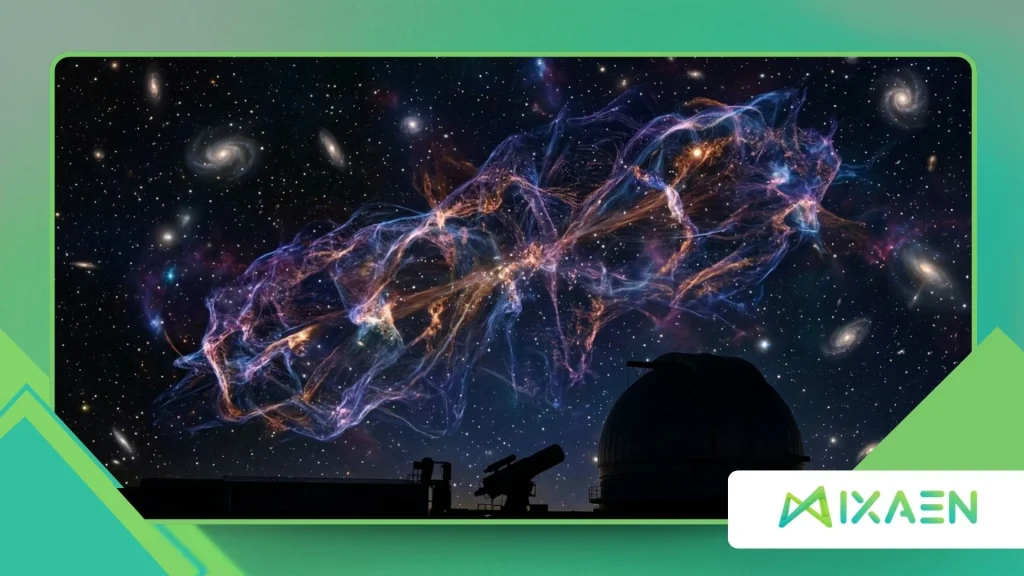
Relic Radio Structures remain among the most profound and baffling anomalies in modern astrophysics, challenging our fundamental understanding of galactic evolution, cosmic magnetic fields, and the ancient universe.
As radio astronomy advances with cutting-edge instruments like the Square Kilometre Array and the Low-Frequency Array, astronomers continuously discover colossal filaments, giant lobes, and mysterious emission arcs scattered across distant cosmic voids.
These enigmatic formations stretch across millions of light-years, persisting long after the initial energetic events that powered them have faded into obscurity.
Understanding why these structures endure requires a deep dive into particle physics, plasma dynamics, and the hidden mechanisms of intergalactic space.
Researchers around the globe dedicate their careers to decoding the subtle radio signatures emitted by these cosmic relics, hoping to unlock secrets about the early epochs of galaxy formation and the mysterious magnetic webs connecting the universe.
Quick Navigation
- What Are Relic Radio Structures and Where Do They Form?
- How Do Shock Waves and Magnetic Fields Sustain Relic Emission?
- Why Do These Cosmic Anomalies Remain Open Mysteries in Modern Astrophysics?
What Are Relic Radio Structures and Where Do They Form?
What Defines a Relic Radio Structure?
Relic Radio Structures are massive, elongated arcs of synchrotron radio emission found primarily in the peripheral regions of galaxy clusters.
These structures typically originate from colossal merger events where two massive galaxy clusters collide at immense speeds, generating gigantic shock waves.
These powerful shocks accelerate electrons to near-light speeds, injecting energy into tenuous magnetic fields that permeate the intergalactic medium.
Consequently, astronomers observe these diffuse, unpolarized radio sources glowing faintly across vast cosmic distances without any apparent optical counterpart or active galactic nucleus driving them.
Where Do These Anomalies Typically Reside?
These fascinating formations usually inhabit the outskirts of massive galaxy clusters, far away from the central cluster galaxies where active galactic nuclei typically reside.
Their peripheral location serves as a direct geographical signature of ancient cluster-cluster collisions that occurred billions of years ago.
Because the intergalactic medium in these outer regions is extremely sparse, relativistic electrons lose their energy very slowly via synchrotron radiation and inverse Compton scattering.
This unique environment allows the radio-emitting plasma to survive and remain visible for hundreds of millions of years after the primary shock wave has dissipated.
++ Could Cosmic Rays Be Messengers from Another Dimension?
Why Are They So Difficult to Detect?
Detecting these faint cosmic relics demands extraordinary technological sensitivity because their surface brightness is remarkably low compared to normal radio galaxies.
Modern interferometers must filter out intense foreground interference from our own Milky Way and distant point sources to reveal these diffuse structures.
Furthermore, their low-frequency emissions require specialized receivers capable of capturing extremely subtle signals without distortion.
Consequently, many relic candidates remain hidden beneath the noise floor of current astronomical surveys, waiting for next-generation instruments to confirm their existence and map their intricate morphologies.
How Do Shock Waves and Magnetic Fields Sustain Relic Emission?
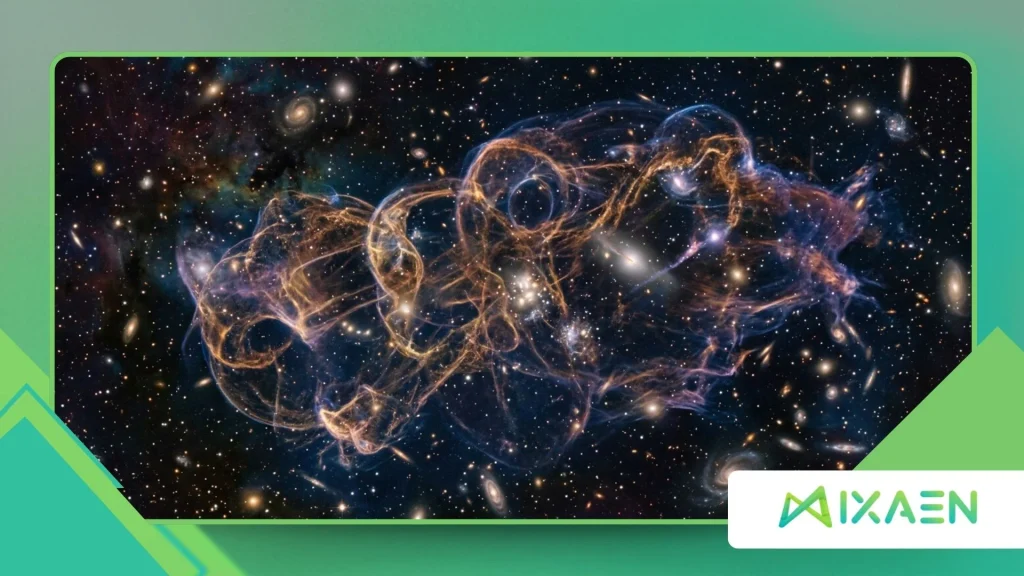
How Do Colliding Clusters Generate Shock Waves?
Cluster mergers represent some of the most energetic events in the universe, releasing gravitational binding energy equivalent to thousands of supernovae simultaneously.
When two massive clusters collide, supersonic shock waves propagate outward through the ambient gas, sweeping across millions of light-years of intergalactic space.
These powerful shocks compress the tenuous plasma and amplify weak seed magnetic fields embedded within the cosmic web.
As the shock front plows through the gas, it acts as a giant particle accelerator, energizing ambient electrons to relativistic velocities and setting the stage for synchrotron emission.
Also read: The Most Powerful Explosion Ever Detected: Still No Clear Explanation
What Role Do Magnetic Fields Play in Particle Acceleration?
Intergalactic magnetic fields are crucial for trapping and organizing relativistic electrons so they can emit coherent synchrotron radiation detectable by Earth-based telescopes.
Without these magnetic fields, the accelerated electrons would rapidly disperse into the cosmic void without leaving any observable radio signature.
Theoretical models suggest that these magnetic seeds might be relics of primordial cosmic magnetism or generated by turbulence during early galaxy formation processes.
As the shock wave compresses these fields, the magnetic energy density increases, enhancing the synchrotron luminosity and allowing astronomers to map the invisible architecture of cluster outskirts.
Read omre: Why Extreme Magnetar Flares Produce Unusual Gamma-Ray Signals
How Long Can Relic Emission Persist?
The longevity of these radio structures puzzles astrophysicists because standard synchrotron cooling models predict rapid energy loss for high-energy electrons.
However, various secondary re-acceleration mechanisms, such as turbulent revival or continuous injection from fossil plasma, help sustain the emission over extended periods.
Observational studies confirm that some relics maintain their brightness for up to one billion years, defying simple theoretical decay timelines.
This prolonged visibility provides a unique historical archive of energetic events that shaped the thermodynamic state of galaxy clusters throughout cosmic history.
Why Do These Cosmic Anomalies Remain Open Mysteries in Modern Astrophysics?
What Makes Their Morphologies So Complex?
The physical appearance of relic structures often defies simple categorization, displaying twisted filaments, sharp edges, and asymmetric arcs that vary wildly between clusters.
These complex shapes reflect the chaotic nature of cluster mergers, where shock fronts interact with turbulent gas motions and preexisting magnetic inhomogeneities.
Simulating these intricate environments requires massive supercomputer calculations that incorporate magnetohydrodynamics and relativistic particle physics simultaneously.
Despite advanced numerical models, matching simulated radio relics with actual observational data remains a formidable challenge for computational astrophysicists.
How Do Relics Inform Us About the Intergalactic Medium?
Studying these radio-emitting structures offers a rare window into the physical properties of the invisible intergalactic medium that fills the vast spaces between galaxies.
By measuring the polarization and spectral index of the radio waves, researchers can map the strength and orientation of magnetic fields across cosmological scales.
This information helps scientists test theories about the origin of cosmic magnetism and its role in regulating star formation and galaxy evolution.
Ultimately, relics serve as natural probes of the deepest, most elusive regions of the universe, bridging the gap between local plasma physics and large-scale cosmology.
What Future Discoveries Await Radio Astronomy?
Upcoming astronomical facilities, including the Square Kilometre Array and next-generation space-based observatories, promise to revolutionize our understanding of these enigmatic phenomena.
With vastly superior sensitivity and resolution, researchers expect to discover thousands of new relic structures hidden in the deep universe.
These future observations will clarify the evolutionary lifecycle of cluster shocks and provide definitive answers regarding the origin of intergalactic magnetic fields.
As technology marches forward, the veil shrouding these cosmic anomalies is slowly lifting, revealing a more interconnected and magnetically rich universe than previously imagined.
| Characteristic | Relic Radio Structures | Radio Galaxies | Halo Radio Sources |
| Location | Outskirts of galaxy clusters | Center of host galaxies | Centered on cluster cores |
| Morphology | Elongated, arc-like filaments | Jet and lobe structures | Diffuse, roughly spherical |
| Polarization | Highly polarized emission | Variable polarization | Low or unpolarized emission |
| Origin | Merger shock waves | Active galactic nuclei jets | Turbulence from cluster mergers |
Final Thoughts on Cosmic Mysteries
The exploration of Relic Radio Structures exemplifies humanity’s relentless drive to comprehend the grandest scales of the cosmos and the invisible forces shaping our reality.
Through advanced radio interferometry and rigorous theoretical modeling, astronomers continue to unravel the complex physics governing these ancient intergalactic beacons.
Each new discovery brings us closer to mapping the hidden magnetic architecture of the universe and understanding the energetic history of galaxy clusters.
We invite you to share your thoughts and questions about these cosmic wonders in the comments below.
Frequently Asked Questions
What are relic radio structures in astrophysics?
They are massive, elongated arcs of synchrotron emission found in galaxy cluster outskirts, generated by ancient merger shock waves.
How long do these radio structures typically last?
They can persist and remain observable for hundreds of millions to up to one billion years under specific intergalactic conditions.
Why are they difficult to detect with standard telescopes?
Their surface brightness is extremely low, requiring high-sensitivity radio interferometers to separate them from foreground galactic noise.
What instruments are used to study these cosmic anomalies?
Astronomers utilize advanced radio telescopes and arrays, such as the Low-Frequency Array and upcoming Square Kilometre Array facilities.
What do these structures reveal about the universe?
They provide crucial insights into intergalactic magnetic fields, cosmic shock physics, and the evolutionary history of massive galaxy clusters.
