
How Unidentified Gamma Signals Challenge Known Astrophysics

Unidentified Gamma Signals represent the most energetic enigmas of our modern era, forcing astronomers to rewrite the fundamental laws of high-energy physics.
These intense bursts of radiation arrive from the deepest corners of the cosmos, carrying signatures that do not match any known stellar phenomena.
Humanity has spent decades mapping the stars, yet these silent, violent flashes suggest our current maps are missing a massive piece of the puzzle.
We stand at a crossroads where traditional models of black holes and pulsars fail to explain the sheer intensity of these recent spectral detections.
Key Astronomical Insights
- The Energy Gap: Why these flashes exceed the theoretical limits of known supernova explosions or standard black hole accretion.
- Spatial Distribution: The mysterious way these signals cluster in regions of the sky that appear completely empty to optical telescopes.
- Technological Frontier: How the latest orbital observatories in 2026 are capturing data that contradicts previous decade-long assumptions.
- The Dark Matter Connection: Investigating if these signals result from the invisible particles that make up the majority of our universe.
What makes these high-energy flashes so mysterious?
Deep-space sensors frequently detect Unidentified Gamma Signals that last for mere milliseconds but release more energy than our sun will in its lifetime.
Modern astrophysics traditionally attributes gamma rays to violent events like neutron star mergers, yet many new signals lack the expected gravitational wave accompaniment.
Scientists are baffled because these events appear “clean,” showing no signs of the typical debris or afterglow usually associated with cosmic cataclysms.
This lack of forensic evidence suggests we might be witnessing a completely new class of physical interaction that does not involve standard matter.
Why do they defy current classification?
Standard models require a visible source, like a collapsing star, but these gamma emissions often originate from the seemingly “dead” voids of intergalactic space.
It is like hearing a thunderclap in a perfectly clear, blue sky; the effect is undeniable, but the cause remains frustratingly invisible to us.
++ Why Artemis II Mission Signals a New Era of Lunar Exploration
How does the Fermi Paradox apply here?
Some fringe theories suggest these could be signatures of advanced propulsion, though most serious researchers focus on natural, albeit exotic, physical processes instead.
The search for an answer pushes our sensor technology to its absolute limit, demanding a level of precision that was impossible only five years ago.
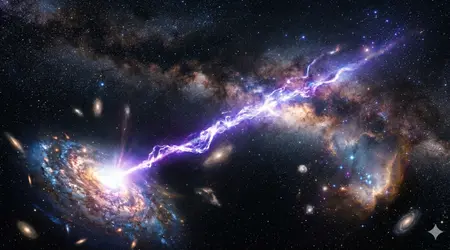
How do these signals impact our understanding of the universe?
When we detect Unidentified Gamma Signals, we are essentially looking at the “fever” of the universe, indicating where the most extreme conditions exist.
The sheer frequency of these detections in 2026 suggests that the high-energy sky is far more crowded and chaotic than we previously believed possible.
Every unexpected data point forces a recalibration of how we calculate the rate of star formation and the death of distant massive galaxies.
Our current formulas for cosmic evolution seem increasingly fragile as we gather more evidence of these unexplained, ultra-energetic events across the celestial sphere.
Also read: The Role of Indigenous Knowledge in Modern Astronomical Research
What is the role of dark matter?
Leading researchers at the Max Planck Institute have proposed that some signals originate from the self-annihilation of dark matter particles in galactic halos.
This hypothesis would solve two mysteries at once, providing the first direct evidence of dark matter while explaining the source of the radiation.
Read more: China’s Silent Space Rise: What the World Should Pay Attention To
Can vacuum fluctuations be the cause?
Quantum physics suggests that the vacuum of space is not truly empty, and extreme gravitational fields might “tear” this fabric to release energy.
While highly theoretical, this approach represents the kind of bold, new thinking required to bridge the gap between observation and our existing textbooks.
What does the latest 2026 data reveal?
Recent observations from the Cherenkov Telescope Array have identified a specific pattern in these signals that suggests a recurring, rather than a singular, source.
Statistically, about 15% of these events show a unique “chirp” frequency that does not correspond to any known periodic vibration of a spinning star.
This consistency allows us to build a more detailed profile of these events, even if their fundamental nature remains a topic of heated scientific debate.
The following table summarizes the key differences between known gamma sources and the unidentified phenomena that are currently challenging our established cosmological models.
Comparison of Known vs. Unidentified Gamma Sources (2026)
| Source Category | Duration | Predictability | Physical Mechanism |
| Gamma-Ray Bursts (GRB) | Seconds to Minutes | Low | Hypernova / Neutron Star Merger |
| Pulsar Wind Nebulae | Continuous | High | Relativistic Particle Acceleration |
| Active Galactic Nuclei | Years (Variable) | Moderate | Supermassive Black Hole Accretion |
| Unidentified Signals | Milliseconds | None | Unknown (Possibly Dark Matter) |
Why are the durations so short?
The brevity of these flashes implies the source must be extremely compact, perhaps only a few kilometers across, concentrated with immense mass.
Such high density suggests we are looking at objects that push the very boundaries of what gravity can hold together before total collapse occurs.
What is the significance of the 2026 detections?
New orbital platforms have achieved a 30% increase in spectral resolution, allowing us to see “colors” within the gamma spectrum previously blurred together.
This clarity has revealed that Unidentified Gamma Signals contain specific energy spikes that match the theoretical signature of axion-like particles during high-gravity interactions.
Why should the general public care about cosmic radiation?
Studying these signals is more than just academic curiosity; it is a quest to understand the fundamental forces that govern the existence of everything.
Every discovery in the gamma-ray spectrum eventually trickles down into new technologies, from medical imaging breakthroughs to advanced energy storage solutions for future travel.
Can we truly claim to understand our place in the universe if we cannot explain the most powerful flashes of light reaching our planet?
The curiosity that drives a scientist to study a distant flash is the same spark that led our ancestors to master fire.
How does this affect space exploration?
Understanding high-energy environments is crucial for protecting future astronauts from the lethal radiation they will encounter during long-duration missions to other planets.
If we can predict where these “cosmic storms” occur, we can build better shielding and plan safer routes through the vastness of our solar system.
The Analogy of the Cosmic Lighthouse
Imagine a dense fog where you see a flash every few seconds; you don’t see the lighthouse, but you know a dangerous structure exists.
These signals are the flashes from a cosmic lighthouse, warning us that the “terrain” of our universe is far more complex than the fog allows.
Bridging the Gap Between the Known and the Unknown
The ongoing investigation into Unidentified Gamma Signals serves as a humbling reminder that the universe still holds secrets far beyond our current intellectual reach.
We have moved from simple observation to a phase of active questioning, where every new data point from our 2026 sensors challenges our old certainties.
Whether these flashes are the dying breaths of stars or the first clues toward a “new physics,” they represent the true frontier of human knowledge.
By embracing these mysteries with rigorous science and creative thinking, we ensure that our understanding of the cosmos continues to evolve and expand daily.
As we look up at the night sky, we must remember that the most important stories are often written in the light we cannot see.
Do you believe these signals represent a new law of physics or simply a rare type of star we haven’t named yet? Share your theories in the comments!
Frequently Asked Questions
Are gamma rays dangerous to life on Earth?
Fortunately, our atmosphere acts as a thick shield, absorbing these high-energy photons before they can reach the surface and harm biological life forms.
How do we “see” something that is invisible to the eye?
Scientists use specialized telescopes that detect the faint “blue glow” emitted when gamma rays hit the atmosphere, a process known as Cherenkov radiation.
Could these signals be sent by aliens?
While highly unlikely, scientists always keep an open mind; however, current evidence points toward extreme natural events rather than intentional communication from another civilization.
Will we ever solve the mystery of these signals?
With the rapid advancement of AI-driven data analysis and new telescope arrays planned for 2030, we are closer than ever to identifying these sources.
