
Why Orbital Spin-Orbit Resonance Stabilizes Multi-Planet Systems
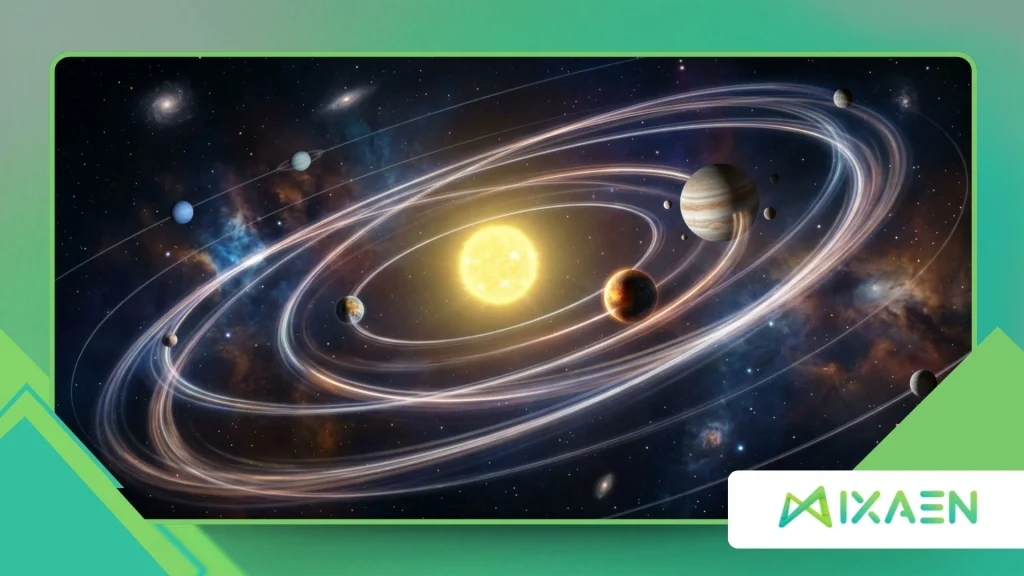
Orbital Spin-Orbit Resonance governs the delicate celestial mechanics that keep complex multi-planet systems from tearing themselves apart through gravitational chaos.
Modern astrophysics increasingly demonstrates that planetary architectures rely heavily on resonance mechanisms to maintain stability across billions of years of cosmic evolution.
Researchers publishing recent findings in planetary dynamics emphasize that these gravitational locks prevent catastrophic collisions by synchronizing orbital periods and rotational axes.
Exploring these intricate patterns reveals how planetary systems manage to survive gravitational disturbances that would otherwise fling worlds into interstellar space.
This exploration covers how orbital locks operate, why multi-planet architectures depend on them, and what observational data reveals about alien worlds.
What Is Orbital Spin-Orbit Resonance?
How Do Gravitational Forces Create Resonance?
Orbital Spin-Orbit Resonance emerges when gravitational interactions between celestial bodies establish precise mathematical ratios between their orbital periods and rotational speeds.
These gravitational tethers pull planets into harmonious rhythms, mitigating the erratic gravitational pulls that typically destabilize young stellar systems.
Tidal forces continuously exchange angular momentum between the host star and its orbiting worlds, gradually locking them into stable resonant configurations.
Without this fundamental synchronization, planetary orbits would rapidly decay or cross paths, leading to frequent planetary collisions and system destruction.
Astrophysicists utilize advanced numerical simulations to track how gravitational resonances preserve multi-planet architectures over astronomical timescales.
Observational data gathered by space telescopes confirm that resonant chains are surprisingly common among compact exoplanetary systems discovered recently.
These delicate balances prove that celestial mechanics favors configurations capable of distributing gravitational stress evenly across all participating planetary bodies.
Consequently, understanding these interactions provides critical insights into the long-term survival probability of newly discovered solar systems.
++ What If We Discover Life That Doesn’t Want to Be Found?
Why Are Spin-Orbit Ratios Critical For Stability?
Resonant configurations act as natural shock absorbers that dissipate destructive orbital energy through periodic gravitational flexing and tidal heating.
When multiple planets share synchronized orbits, their closest approach points occur predictably, preventing cumulative gravitational distortions from flinging bodies out of bounds.
This protective mechanism ensures that eccentric orbits remain bounded within safe geometrical limits throughout the lifetime of the host star.
Mathematical modeling demonstrates that systems lacking these specific resonances experience chaotic orbital evolution within mere millions of years.
Recent observational studies published by exoplanet researchers highlight several multi-planet systems exhibiting remarkably stable resonance chains that defy standard chaotic models.
These findings suggest that planetary formation processes naturally funnel worlds into resonant states during the protoplanetary disk dissipation phase.
Furthermore, maintaining this equilibrium prevents orbital resonances from breaking, which would otherwise trigger immediate dynamical instability and planetary ejection.
Therefore, spin-orbit synchronization serves as a universal prerequisite for the preservation of complex planetary architectures across the galaxy.
Also read: Why Finding Life Elsewhere Might Force Us to Rethink Religion
What Role Do Tidal Forces Play In Evolution?
Tidal dissipation acts as the primary engine driving planetary bodies toward stable spin-orbit resonances by continuously converting rotational energy into heat.
As planets orbit their host stars, gravitational gradients stretch their structures, creating internal friction that gradually alters their spin rates.
This relentless tidal friction works in tandem with orbital resonances to damp out unwanted orbital eccentricities and inclinations over vast epochs.
Over billions of years, this evolutionary process settles planets into synchronized states where tidal bulging perfectly matches orbital passage frequencies.
Laboratory analogs and planetary interior models indicate that dissipation rates depend heavily on mantle viscosity, core composition, and orbital distance from the host star.
Systems orbiting close-in environments experience accelerated tidal evolution, reaching synchronized resonance states much faster than outer planetary systems.
Recognizing these distinct evolutionary pathways helps astronomers reconstruct the chronological history of multi-planet systems found beyond our solar system.
Ultimately, the interplay between tides and resonance dictates whether a planetary system stabilizes or disintegrates.
How Do Multi-Planet Systems Maintain Equilibrium?
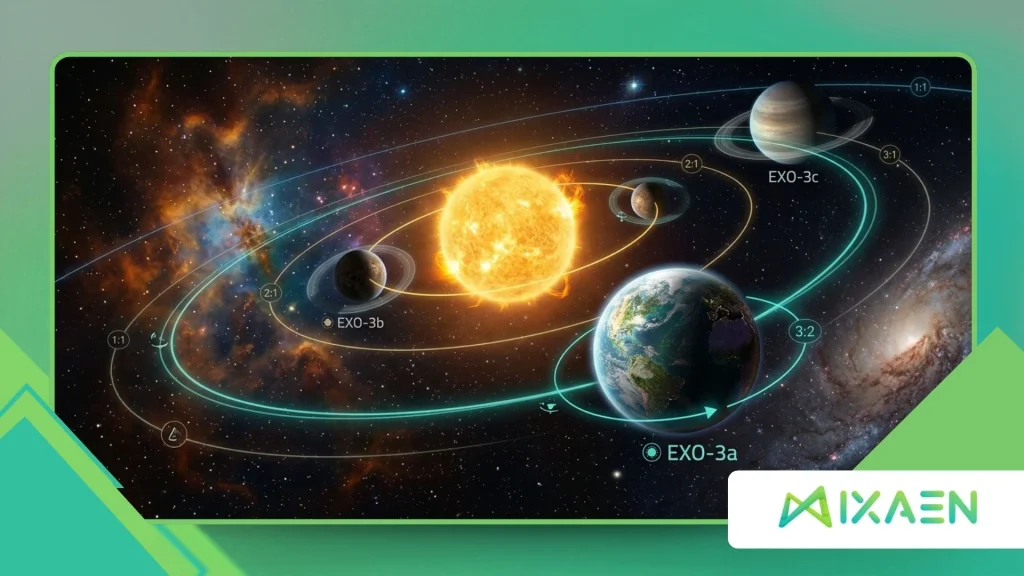
How Do Resonant Chains Prevent Collisions?
Resonant chains prevent catastrophic collisions by ensuring that planets never approach close enough to exert mutually destructive gravitational accelerations on each other.
When three or more planets lock into a sequence like a Laplace resonance, their conjunctions always occur at safe, predefined spatial locations.
This geometric spacing acts as an invisible shield, redirecting stray gravitational energy harmlessly through the entire multi-planet network. Mathematical proofs confirm that such chains minimize close encounters, thereby preserving orbital spacing indefinitely.
Astronomers studying compact exoplanet systems frequently uncover intricate chains where every adjacent pair of planets maintains simple integer orbital ratios.
These configurations resemble a finely tuned clockwork mechanism where every gear depends on the precise movement of its neighbors.
If one planet experiences a minor gravitational perturbation, the rest of the resonant chain absorbs and redistributes the disturbance.
Thus, resonant chains represent one of nature’s most effective strategies for maintaining long-term dynamical order in space.
Read more: How Exoplanet Water Inventories Influence Climate Stability
Why Do Eccentric Orbits Remain Bounded?
Orbital eccentricities would normally spiral out of control due to secular gravitational perturbations from massive neighboring giant planets or stellar companions.
However, spin-orbit resonances enforce strict upper limits on eccentricity growth by coupling orbital shape changes directly to precession rates.
This coupling forces eccentricities to oscillate within narrow, safe boundaries rather than growing indefinitely toward intersection orbits.
Consequently, planets avoid crossing paths with adjacent worlds, ensuring systemic longevity even in crowded stellar environments.
Advanced numerical integrations show that systems outside resonance frequently exhibit wild eccentricity fluctuations that lead to planetary scattering or stellar ingestion.
In contrast, resonant systems maintain remarkably circularized or mildly elliptical paths that protect volatile atmospheres from extreme stellar flux variations.
This stabilizing effect is particularly vital for maintaining stable climate conditions on worlds residing within circumstellar habitable zones. Therefore, bounded eccentricities directly correlate with the enhanced survivability of multi-planet architectures.
What Happens When Resonances Break?
Breaking a resonance unleashes latent gravitational instabilities that rapidly transform an orderly multi-planet system into a chaotic arena of flying debris.
When tidal evolution or external stellar flybys push planets out of their synchronized states, close encounters resume almost immediately.
These violent interactions typically result in the ejection of lighter planets, dramatic orbit stretching, or high-velocity collisions that shatter planetary mantles.
Observational anomalies, such as highly eccentric or retrograde exoplanets, often bear the scars of such ancient resonant fractures.
Astrophysical surveys indicate that broken resonances account for a significant percentage of disrupted planetary systems observed throughout the Milky Way galaxy.
Reconstructing these disruption events allows scientists to estimate the frequency of dynamical catastrophes in young stellar neighborhoods.
Understanding the thresholds where resonance fails provides crucial boundaries for theoretical models of planetary system formation and evolution.
Consequently, monitoring the stability of current resonant chains remains a top priority for modern exoplanet researchers.
What Do Recent Discoveries Reveal About Exoplanets?
What Did Recent Space Telescope Data Uncover?
Recent observations from advanced space telescopes have cataloged dozens of multi-planet systems locked in exceptionally tight, pristine resonant configurations.
These discoveries challenge older formation models by showing that planets often migrate inward through protoplanetary disks while maintaining mutual resonances.
Data analysis confirms that multi-planet systems are far more common and dynamically complex than previously imagined by theoretical astrophysicists.
These empirical findings underscore the necessity of incorporating tidal resonance dynamics into all future models of planetary architecture.
| Parameter | Typical Resonant System | Unstable Chaotic System |
| Orbital Period Ratio | Simple integer ratios (e.g., 2:1, 3:2) | Irrational, shifting ratios |
| Eccentricity Range | Bounded, low eccentricity (0.0 – 0.1) | Highly erratic, crossing orbits |
| System Lifespan | Billions of years of stability | Rapid decay within millions of years |
| Tidal Dissipation | Balanced angular momentum exchange | Extreme, destructive internal heating |
How Do Planetary Architectures Vary Across Space?
Exoplanetary architectures display breathtaking diversity, ranging from tightly packed super-Earth systems to sprawling architectures resembling our own solar system.
Despite this physical variety, the underlying physical laws governing gravitational resonance remain universal across all observed stellar environments.
Systems orbiting red dwarf stars exhibit extreme tidal locking and resonance due to their ultra-close habitable zones. Conversely, solar-type stellar systems rely on outer giant planets to shepherd inner rocky worlds into stable resonance patterns.
Comparative planetology reveals that stellar metallicity and protoplanetary disk mass heavily influence whether a system develops robust resonance chains or chaotic instability.
High-metallicity environments tend to foster massive multi-planet systems that require precise spin-orbit synchronization to avoid self-destruction.
Mapping these architectural variations helps astrobiologists identify which stellar neighborhoods offer the most stable environments for long-term planetary habitability.
Ultimately, understanding these cosmic variations illuminates our place within a diverse and dynamic universe.
What Future Observations Will Clarify Resonance?
Upcoming space-based observatories and next-generation ground telescopes will soon measure exoplanet spin rates and orbital inclinations with unprecedented precision.
These advanced instruments will allow astronomers to detect subtle resonant perturbations and tidal flexing signatures across distant solar systems.
Direct imaging missions will also help map the outer boundaries of complex multi-planet architectures, revealing hidden giant planets that influence inner resonance chains.
These technological leaps promise to resolve long-standing debates regarding the formation and stabilization of alien worlds.
As observational techniques improve, researchers anticipate discovering even more exotic resonance phenomena, including secular resonances involving stellar magnetic fields.
Combining high-precision astrometry with advanced spectroscopic data will provide a complete picture of how planetary systems survive cosmic turbulence.
This ongoing quest not only satisfies human curiosity about distant worlds but also deepens our fundamental understanding of gravity.
Therefore, the study of orbital resonance remains a cornerstone of modern astrophysical research and exoplanet exploration.
Final Reflections On Cosmic Stability
Examining the mechanics of celestial architecture reveals that the universe relies on delicate mathematical harmonies to maintain order among worlds.
Orbital Spin-Orbit Resonance stands out as a masterclass in cosmic engineering, proving that gravitational forces can build enduring stability out of potential chaos.
By synchronizing periods and bounding eccentricities, these resonance networks protect multi-planet systems from premature destruction across vast epochs of time.
Sharing your thoughts or experiences regarding exoplanet dynamics in the comments below helps foster an engaging community discussion on space exploration.
Frequently Asked Questions
What Is Orbital Spin-Orbit Resonance?
Orbital Spin-Orbit Resonance is a gravitational phenomenon where a planet’s orbital period and rotational speed lock into precise mathematical ratios.
This synchronization helps stabilize multi-planet systems by preventing erratic gravitational interactions and destructive collisions over billions of years.
Why Are Resonant Chains Important For Exoplanets?
Resonant chains act as gravitational shock absorbers that evenly distribute tidal forces and orbital energy across multiple planetary bodies. They ensure that planets maintain safe spatial distances during close conjunctions, preventing chaotic orbital decay.
How Do Tidal Forces Affect Planet Stability?
Tidal forces continuously convert rotational energy into internal heat through gravitational friction, gradually guiding planets into synchronized resonance states.
This process damps out unwanted orbital eccentricities and helps preserve long-term dynamical equilibrium.
What Happens When A Planetary Resonance Breaks?
When a resonance breaks due to external perturbations or tidal evolution, gravitational instability takes over, leading to high-velocity collisions or planetary ejection. This disruption transforms orderly systems into chaotic configurations.
How Do Scientists Detect Spin-Orbit Resonances?
Astronomers detect these resonances by analyzing precise transit timing variations and orbital period ratios gathered by advanced space-based telescopes and observatories.
These observational methods reveal the hidden dynamical architecture of distant solar systems.
