
Could the Sun Ever Flare Strong Enough to Strip Earth’s Atmosphere?
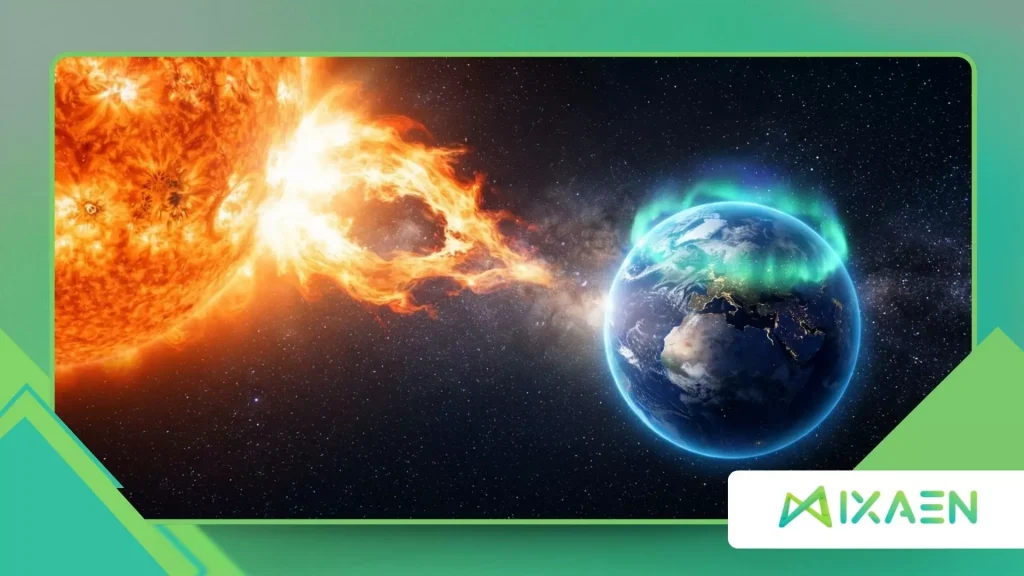
Sun ever flare intensity limits spark intense scientific debate whenever violent coronal mass ejections strike planetary magnetic shields across our solar system.
Modern astrophysics research continuously monitors stellar behavior to determine whether our G-type yellow dwarf possesses enough magnetic energy to strip Earth’s protective atmosphere away.
Space weather reporters frequently sensationalize solar storms, frightening the public with unrealistic apocalyptic scenarios regarding permanent atmospheric erosion.
Understanding real stellar physics separates genuine planetary hazard assessments from science fiction exaggerations.
Evaluating stellar evolution requires examining historical isotope records preserved within ancient ice cores and tree rings worldwide.
Our home star undergoes regular eleven-year activity cycles, producing gorgeous auroras and minor satellite disruptions without threatening global breathability.
Think of Earth’s geomagnetic field as an invisible titanium shield deflecting high-energy plasma particles effortlessly into polar regions. Are you ready to explore the actual physical boundaries of solar eruptive power?
Navigating Stellar Physics and Atmospheric Stability
- Investigating historical solar proton events recorded within ancient polar ice layers.
- Analyzing planetary magnetic field dynamics and protective magnetosphere mechanics.
- Comparing our stable solar output with violent superflares observed on distant stars.
- Evaluating long-term atmospheric retention factors across billions of future years.
What Are the Physical Limits of Solar Flare Energy?
Sun ever flare maximum thresholds are strictly bounded by the total magnetic flux stored within our star’s convective zone.
Unlike active red dwarf stars capable of unleashing sterilizing superflares, our Sun lacks the rapid rotation rate required for catastrophic magnetic reconnection events.
Imagine a tightly wound rubber band snapping under extreme tension; stellar magnetic loops possess a definitive breaking point before energy exhausts completely.
Astrophysical models confirm that our local star cannot generate the multi-exajoule output needed to strip planetary air molecules.
Data published by the National Aeronautics and Space Administration regarding solar dynamics show that historic events like the Carrington Event disrupted telegraph lines without damaging atmospheric integrity.
Earth’s robust gravity well securely anchors nitrogen and oxygen molecules, preventing solar wind stripping from occurring during standard geomagnetic storms.
While extreme flares threaten orbital satellites and high-voltage power grids, they pose zero direct threat to our atmospheric mass. Physics dictates safe operational boundaries for our planetary home.
How Do Magnetic Loops Store Stellar Energy?
Convective plasma currents twist subsurface magnetic fields into complex configurations that store immense amounts of potential energy over decades.
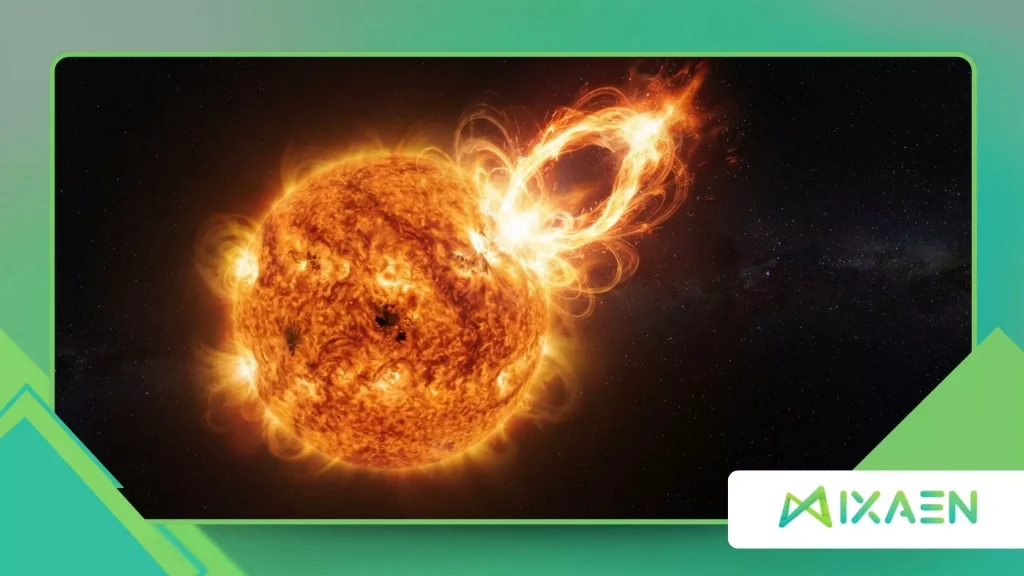
When these magnetic field lines snap and realign, they release sudden bursts of radiation and high-speed protons. This process fuels standard solar flares and coronal mass ejections.
++ How the Sun’s Magnetic Field Shapes the Entire Solar System
Why Do G-Type Stars Defy Superflare Risks?
Rapidly spinning young stars generate ferocious superflares because their high angular momentum drives intense dynamo action across outer layers.
Our mature Sun rotates slowly once every twenty-seven days, dropping its peak energetic output far below the threshold required for atmospheric destruction. Age brings stellar stability.
Also read: Solar Tornadoes: What They Are and Why They Matter
What Role Does Gravity Play in Atmosphere Retention?
Earth’s massive planetary mass generates a strong gravitational pull that firmly retains lighter atmospheric gases against thermal escape.
Solar wind particles interact primarily with the upper magnetosphere miles above the surface, leaving lower dense air layers completely unaffected. Gravity acts as an inescapable anchor.
How Does Earth’s Magnetic Shield Deflect Solar Storms?
Sun ever flare impacts are neutralized daily by our planet’s invisible magnetosphere, a dynamic protective shield generated by molten iron swirling in the outer core.
When high-velocity coronal mass ejections slam into this magnetic bubble, charged particles divert safely around our globe toward polar regions.
Think of the magnetosphere as a force field deflecting incoming plasma projectiles away from a vulnerable spaceship hull.
Without this planetary dynamo, solar winds would slowly erode our air molecules over millions of years.
Geological research proves that Earth has maintained a stable magnetic field for over three billion years, shielding evolving biological ecosystems from cosmic radiation damage.
Even during periods of historical geomagnetic pole reversals, residual atmospheric protection prevented any catastrophic loss of breathable air.
Our planetary architecture was specifically engineered by physics to withstand stellar tempests. Nature provides robust redundancies against space weather hazards.
Read more: The Parker Solar Probe: Flying Into the Heart of Our Star
How Does the Core Dynamo Generate Magnetism?
Convective movements of liquid iron and nickel in Earth’s outer core create self-sustaining electric currents that power our global magnetic field.
This geodynamo extends thousands of miles into space, creating the protective magnetopause boundary. Internal heat drives this planetary shield.
What Happens During Severe Geomagnetic Storms?
Extreme solar proton events compress the dayside magnetosphere and inject massive electrical currents into upper polar atmospheric layers.
These energetic displays ignite brilliant auroral light shows while temporarily disrupting GPS navigation and radio transmissions. The system absorbs the shock without failing.
Can Solar Wind Strip Atmosphere Without Magnetism?
Unprotected planets like Mars lost most of their ancient atmosphere because weak gravity and dead cores failed to deflect solar wind erosion over eons.
Earth’s robust combination of strong gravity and active core magnetism completely prevents this vulnerability. Planetary mass makes all the difference.
What Do Stellar Observations Reveal About Future Sun Behavior?
Sun ever flare research gains critical context when astronomers observe thousands of sun-like stars using advanced space-based observatories like the Transiting Exoplanet Survey Satellite.
These stellar audits demonstrate that mature G-type stars rarely produce superflares once they pass their volatile youth phase.
Imagine observing thousands of elderly individuals running marathons to gauge the athletic limits of a healthy middle-aged adult.
Observational data confirms our star has entered a calm, stable middle age that will persist for billions of years.
Astrophysical consensus indicates that the Sun will gradually brighten over the next billion years due to normal nuclear fusion evolution within its core.
However, this gradual luminosity increase will cause planetary warming long before any sudden magnetic flare strips our atmosphere away.
Long-term climate modeling proves that stellar aging represents a thermodynamic challenge rather than an explosive flash threat. Science relies on empirical observation rather than speculative panic.
What Can Kepler and TESS Data Teach Us?
Photometric space telescopes monitor distant solar analogs to measure frequency distributions of starspots and unexpected magnetic outbursts.
Statistical analysis proves that superflares occur almost exclusively on young, fast-rotating stars rather than stable middle-aged yellow dwarfs. Empirical data calms speculative fears.
How Does Core Evolution Affect Stellar Brightness?
Nuclear fusion converts hydrogen into helium in the solar core, slowly increasing density and core temperature over vast geological timeframes.
This internal shift causes the Sun to brighten by roughly ten percent every billion years. Gradual warming replaces sudden solar flare catastrophes.
Why Is Long-Term Climate Stability Assured?
Atmospheric modeling shows that Earth’s carbon silicate cycle buffers slow solar luminosity increases through natural weathering feedback loops.
While distant future climates will eventually become uninhabitable due to heat, the atmosphere itself remains securely anchored. Physics protects our skies.
Solar Activity and Planetary Defense Matrix
The structured table below contrasts solar flare myths with verified scientific realities regarding atmospheric stability.
| Phenomenon Metric | Apocalyptic Science Fiction Myth | Verified Astrophysical Reality |
| Maximum Flare Potential | Stripping Earth’s entire atmosphere instantly | Releasing electromagnetic radiation and localized auroras |
| Core Shielding Mechanism | Zero protection against high-energy plasma | Robust planetary magnetosphere and strong gravity |
| Historical Precedent | Total global atmospheric collapse in ice cores | Minor grid disruptions and stunning polar light shows |
Safeguarding Our Planet Against Cosmic Misconceptions
Sun ever flare anxiety highlights how easily complex astrophysics can be misunderstood when filtered through sensationalized media headlines and internet rumors.
Our Sun operates as a stable, predictable energy source whose physical boundaries prevent any catastrophic stripping of Earth’s atmosphere.
Understanding real stellar science empowers us to appreciate the magnificent resilience of our planetary home without unnecessary fear. Take time this week to look up at the night sky and appreciate our cosmic shield.
How do you view the balance between space weather risks and planetary safety? Share your perspective in the comments below!
Frequently Asked Questions
Could a future solar superflare disable global power grids permanently?
While an extreme solar superflare similar to the 1859 Carrington Event could temporarily damage high-voltage transformers and satellite networks, it cannot strip Earth’s atmosphere.
Modern grid operators continuously improve infrastructure hardening to protect electrical systems against severe space weather events.
Is the Sun getting more dangerous as it ages?
No, our Sun is currently in a stable main-sequence phase and rotates too slowly to produce dangerous superflares.
Its energy output remains remarkably consistent, providing safe environmental conditions for ongoing biological evolution across our planet.
