
How Cosmic Birefringence Challenges Our Picture of the Early Universe
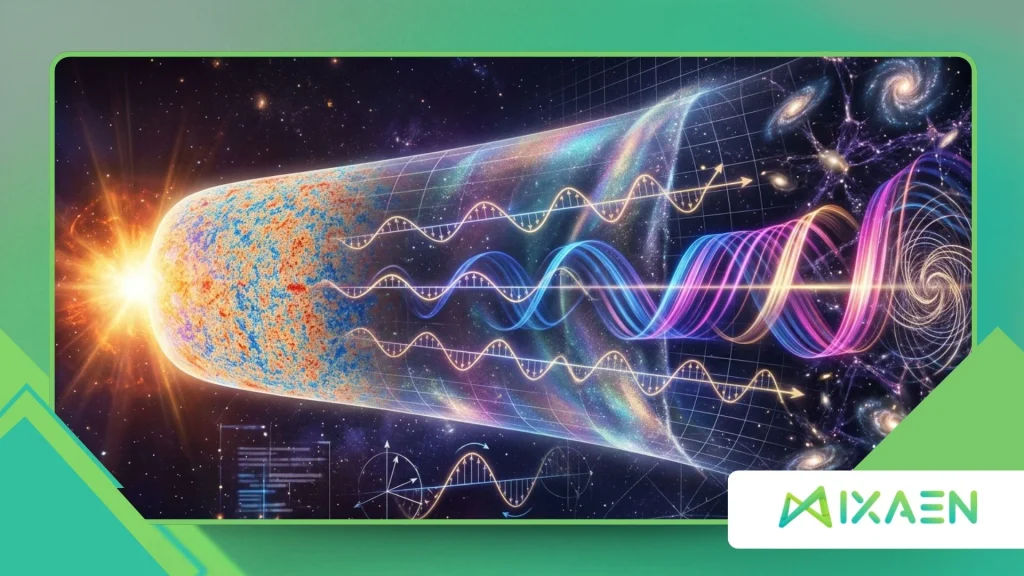
Cosmic Birefringence opens a breathtaking window into the foundational mechanics of our expanding universe, challenging standard cosmological models established over decades of rigorous astrophysical observation.
As modern researchers analyze polarization patterns within the ancient Cosmic Microwave Background radiation, subtle anomalies suggest that parity symmetry might be violated at a cosmic scale.
This phenomenon forces theoretical physicists and observational astronomers to rethink how light travels across billions of light-years through a vacuum permeated by mysterious fields.
Understanding this breakthrough requires examining deep theoretical frameworks, advanced cosmic microwave background data releases, and potential extensions to standard general relativity.
In this deep exploration, we examine the core mechanisms, observational data, and profound implications of this cosmic phenomenon:
- What defines this mysterious optical rotation across the cosmos and its detection in ancient light?
- How polarization signatures reveal subtle parity violations in early cosmological epochs.
- Which observational challenges and future space missions will validate these revolutionary findings?
What Is Cosmic Birefringence and How Does It Manifest?
What Is the Core Definition of Cosmic Birefringence?
Cosmic Birefringence represents a rotation of the polarization plane of linear polarization of photons as they travel across cosmological distances from the early universe.
This subtle rotation occurs when photons interact with a pseudoscalar field, such as quintessence or axion-like dark matter particles permeating the vacuum of space.
Unlike traditional optical birefringence observed in physical crystals, this cosmic variant affects right-handed and left-handed circular polarization states differently across vast intergalactic voids.
Researchers quantify this rotation angle to map out hidden topological features of spacetime and test the fundamental constants of nature across billions of years.
++ Why Quantum Reference Frames Could Redefine Observation
How Does Polarization Shift Across Intergalactic Space?
The journey of ancient photons begins at the surface of last scattering, where photons acquire linear polarization through Thomson scattering with free electrons.
As these polarized electromagnetic waves propagate toward modern detectors, parity-violating interactions twist their polarization vectors by a fraction of a degree.
Modern cosmologists detect this tiny rotation by cross-correlating the E-mode and B-mode polarization patterns of the cosmic microwave background radiation.
Advanced statistical analyses of Planck satellite data and ground-based telescope arrays continually refine these measurements to isolate genuine cosmic signals from instrumental noise.
How Do Parity Violations Challenge Standard Cosmology?
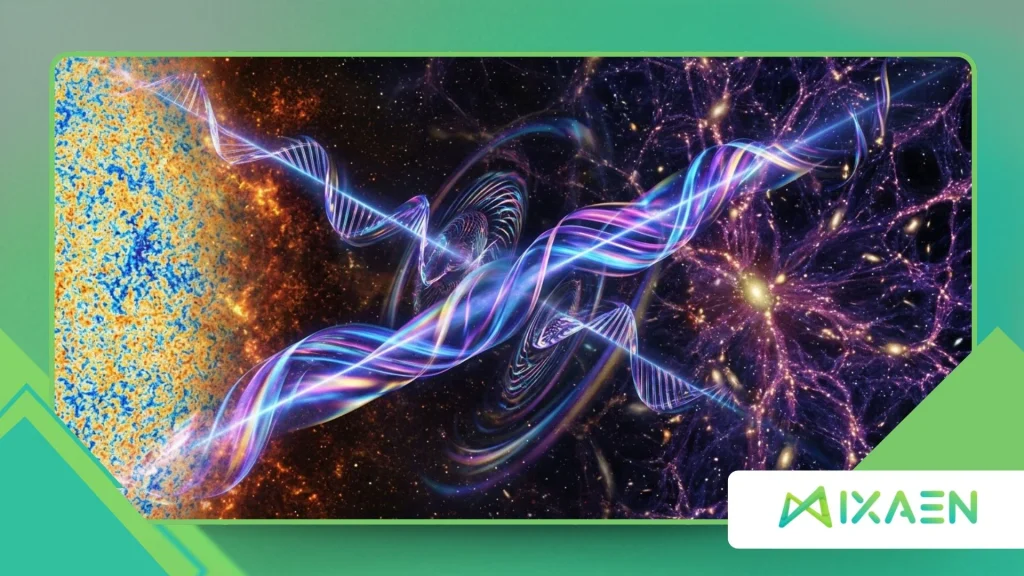
Why Does Parity Violation Disrupt Established Physics?
Standard cosmology relies heavily on the cosmological principle and the assumption that physical laws preserve parity symmetry on large scales throughout the universe.
When observational data indicates a nonzero rotation angle in polarization maps, it directly challenges the foundational parity-conserving framework of standard electromagnetism and general relativity.
This unexpected symmetry breaking implies that the cosmic vacuum is not entirely neutral or uniform, possessing an inherent chiral orientation that distinguishes left from right on cosmological scales.
Consequently, theoretical physicists must construct extended frameworks incorporating dynamical dark energy fields that couple directly to electromagnetic radiation.
Also read: Why Conformal Cyclic Cosmology Still Divides Physicists
What Role Do Axion-Like Particles Play in This Phenomenon?
Axion-like particles serve as primary theoretical candidates capable of generating the observed vacuum rotation without violating local conservation laws or destabilizing stellar nucleosynthesis models.
These hypothetical ultralight bosons couple to photons through a Chern-Simons term, creating a refractive index difference for orthogonal polarization states in the expanding universe.
As these fields evolve dynamically over cosmic time, they imprint a frequency-independent rotation angle onto the traveling photons of the cosmic microwave background.
Laboratory experiments and astrophysical observations work in tandem to constrain the mass and coupling constant ranges of these elusive dark sector candidates.
What Are the Observational Challenges and Future Horizons?
What Hurdles Complicate Accurate Polarization Measurements?
Detecting tiny rotation angles amidst overwhelming astrophysical foregrounds demands extreme precision and sophisticated data-cleaning algorithms across multiple radio and microwave frequencies.
Galactic dust emission, synchrotron radiation, and instrumental systematic errors can easily mimic or obscure the genuine cosmological birefringence signal in sensitive detectors.
Researchers must develop advanced component separation techniques to decouple foreground polarization from the primordial CMB signal captured by state-of-the-art instruments.
Calibrating absolute polarization angles across wide focal planes remains one of the most demanding engineering challenges in modern observational cosmology.
Read more: Can Logic Fully Explain the Cosmos?
Which Upcoming Space Missions Will Validate These Discoveries?
Next-generation cosmic microwave background missions, including ground-based projects like the Simons Observatory and CMB-S4 alongside space concepts like LiteBIRD, promise unprecedented sensitivity levels.
These advanced observatories will map polarization patterns with remarkable fidelity, dramatically reducing statistical uncertainties and confirming whether the hint of parity violation holds up.
By examining primordial B-mode polarization across wider sky fractions, scientists will definitively establish the nature of cosmic birefringence and its implications for fundamental physics.
| Observation Parameter | Current Planck Constraints | Projected CMB-S4 Sensitivity | Primary Scientific Impact |
| Rotation Angle (β) | 0.30° ± 0.11° | 0.01° precision | Confirms parity violation |
| Systematic Calibration | Limited by instrumental tilt | Sub-arcminute accuracy | Eliminates false positives |
| Frequency Coverage | 30 to 857 GHz multi-band | Ultra-wide cryogenic bands | Separates dust from signal |
| Dark Sector Probing | Indirect axion bounds | Direct pseudoscalar mapping | Identifies dark matter nature |
Final Thoughts and Outlook
Exploring the nuances of our expanding universe continually pushes the boundaries of human ingenuity, transforming theoretical speculation into testable observational science.
The investigation into cosmic birefringence exemplifies how tiny anomalies in ancient radiation can revolutionize our understanding of fundamental physical laws and spacetime geometry.
As upcoming telescope arrays and space missions come online, researchers stand on the verge of confirming whether parity symmetry truly breaks on a cosmic scale.
Share your thoughts on these revolutionary astrophysical findings in the comments below and join the ongoing discussion about the nature of our universe
Frequently Asked Questions
What Is Cosmic Birefringence in Simple Terms?
It is the mysterious twisting of light’s polarization plane as it travels across the universe from the ancient Big Bang fireball to modern telescopes.
This phenomenon occurs because the vacuum of space acts differently on left-handed and right-handed light wave orientations.
Scientists study this effect to uncover hidden properties of dark energy and test whether standard physics holds true on cosmological scales.
How Do Scientists Measure This Optical Rotation?
Researchers analyze data collected by specialized microwave telescopes mapping the polarization patterns of the ancient cosmic microwave background radiation left over from the early universe.
By comparing the expected polarization angles with actual telescope data, they calculate the exact rotation angle imparted during billions of years of travel.
Sophisticated statistical methods help separate this tiny cosmic signal from interfering galactic dust and instrumental noise.
Why Is Parity Violation So Significant for Physics?
Parity symmetry dictates that physical laws should work identically in a mirror-reflected universe, forming a core assumption of modern particle physics and general relativity.
Discovering that the universe violates this symmetry on a grand scale proves that our current fundamental theories remain incomplete.
It opens exciting pathways toward discovering new particles and forces operating within the dark sector of the cosmos.
What Connection Exists Between Dark Matter and Polarization?
Certain dark matter candidates, such as ultralight axion-like particles, can interact with electromagnetic radiation and cause the observed polarization twist in transit.
As photons pass through fields generated by these exotic particles, their polarization vectors rotate depending on the local energy density.
Consequently, measuring this optical rotation provides a novel indirect method for detecting elusive dark matter components.
What Future Telescopes Will Resolve This Mystery?
Upcoming ground-based observatories like CMB-S4 and dedicated space missions designed to map primordial polarization will dramatically improve measurement precision in the coming years.
These advanced instruments feature thousands of ultra-sensitive superconducting detectors capable of isolating tiny rotation angles with unprecedented accuracy.
Their upcoming data releases will ultimately determine whether parity violation represents a true cornerstone of modern fundamental physics.
