
How Coronal Magnetic Channels Influence Solar Wind Formation
Coronal Magnetic Channels define the intricate highways of plasma streaming through the solar atmosphere, fundamentally shifting our understanding of how space weather originates and impacts planetary systems.
Modern astrophysics increasingly relies on space-based solar observatories to track these magnetic conduits in real time.
Advanced telemetry from missions like NASA’s Parker Solar Probe and the European Space Agency’s Solar Orbiter allows researchers to decode how plasma escapes the sun’s gravitational pull.
Understanding these dynamics is essential for predicting geomagnetic storms that threaten orbital satellites and terrestrial power grids.
- Quick breakdown of what lies ahead:
- Exploring solar wind genesis mechanisms
- Mapping magnetic conduit architecture
- Reviewing real data from recent solar observations
- Examining practical implications for space weather forecasting
What Are Coronal Magnetic Channels?
How Do These Channels Form?
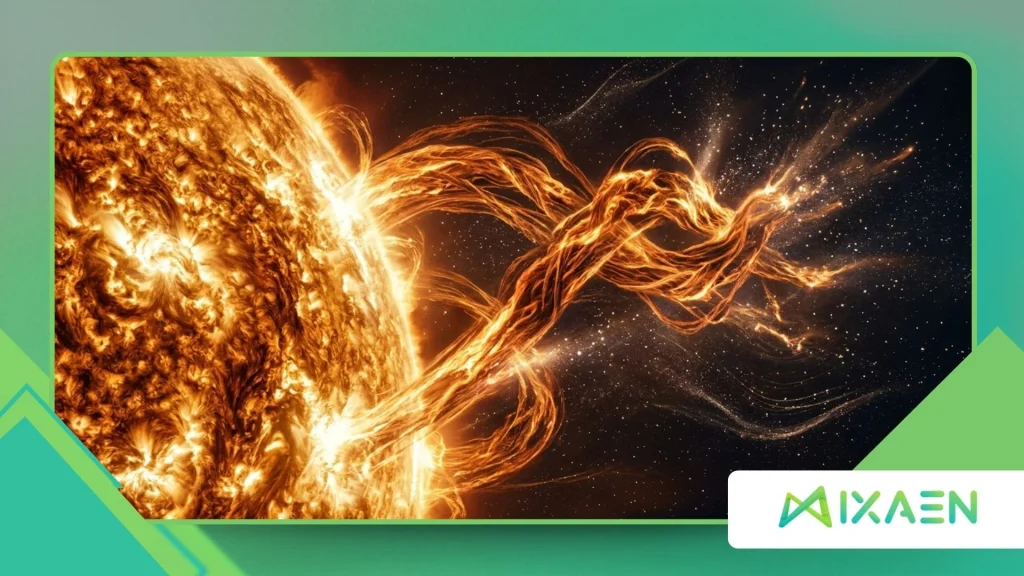
Magnetic fields emerge from the solar interior, stretching through the photosphere and expanding into the vast corona where high-energy plasma accumulates continuously.
Plasma particles become trapped along these closed and open loop structures, creating concentrated corridors of charged energy.
High-resolution imaging from the Solar Dynamics Observatory reveals that differential rotation twists these magnetic lines over multi-day periods.
Consequently, immense mechanical stress builds up until reconnection events release streams of high-speed solar wind into the heliosphere.
Where Are They Located?
Coronal magnetic channels reside primarily within active regions and coronal holes spanning vast latitudinal ranges across the solar disk.
These specific zones exhibit weaker overlying magnetic fields, allowing ionized particles to stream outward with minimal impedance.
Observers note that equatorial boundaries frequently host dense concentrations of these channels, facilitating steady streams of slow solar wind.
Conversely, polar coronal holes feature open magnetic field lines that accelerate fast solar wind streams directly into interplanetary space.
++ How the Sun’s Magnetic Field Shapes the Entire Solar System
Why Do They Matter For Space Weather?
Intense geomagnetic disruptions frequently trace their origins back to instabilities occurring within these localized magnetic pathways.
When solar wind escapes through these conduits, it carries embedded interplanetary magnetic fields toward Earth at supersonic speeds.
Satellites orbiting in the thermosphere experience increased atmospheric drag during these high-velocity solar wind events.
Therefore, monitoring these magnetic highways provides critical lead time for safeguarding vital communication networks and electrical infrastructure.
How Do They Influence Solar Wind Formation?
What Mechanisms Drive Plasma Acceleration?
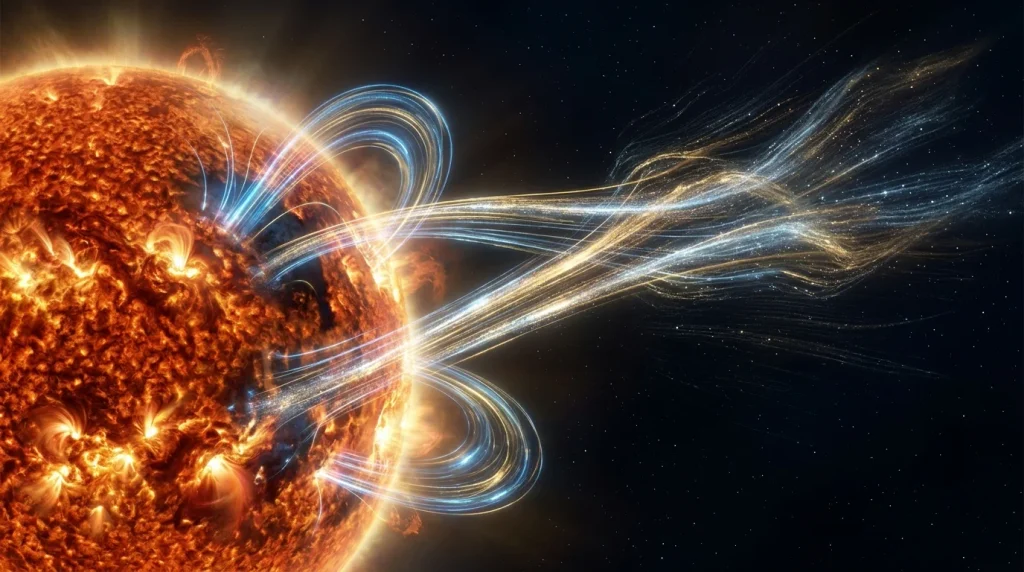
Thermal pressure and magnetohydrodynamic wave turbulence work in tandem to accelerate plasma particles outward from the solar corona.
Within open magnetic channels, Alfven waves propagate upward, transferring momentum directly to electrons and protons.
This continuous energy injection overcomes the sun’s intense gravitational pull, transforming trapped coronal gas into a continuous supersonic particle wind.
Researchers utilize advanced numerical models to simulate how varying magnetic field strengths alter this acceleration profile over time.
Also read: Solar Tornadoes: What They Are and Why They Matter
How Does Magnetic Reconnection Play A Role?
Magnetic reconnection acts as a powerful catalyst, abruptly restructuring coronal magnetic channels and releasing pent-up magnetic energy.
When opposing magnetic field lines collide and snap together, they convert magnetic energy into kinetic energy instantly.
This explosive process heats local plasma to millions of Kelvin while ejecting discrete packets of matter into the solar wind stream.
Recent spectroscopic data confirms that these localized reconnection bursts contribute significantly to the intermittent nature of ambient solar wind.
Read more: The Parker Solar Probe: Flying Into the Heart of Our Star
What Is The Impact On Particle Composition?
The chemical composition of the solar wind reflects the unique magnetic environment from which the plasma originally escaped.
Elements with low first ionization potential are preferentially drawn into coronal magnetic channels through wave-ponderomotive forces.
Consequently, scientists measure distinct abundance ratios in the solar wind to trace specific streams back to their solar source regions.
This compositional fingerprinting helps differentiate between slow wind originating from streamer belts and fast wind from polar holes.
What Are The Recent Discoveries And Data Metrics?
What Did Recent Space Probes Reveal?
Recent close-up passes by solar probes have uncovered complex magnetic switchbacks operating directly within these coronal channels.
These sudden reversals in the magnetic field structure suggest that plasma acceleration is far more dynamic than previously modeled.
Instruments measuring particle velocity distributions have detected localized heating signatures that align perfectly with theoretical magnetic reconnection models.
These empirical findings validate long-standing hypotheses regarding how energy is transferred from the solar corona into the heliosphere.
How Accurate Are Current Forecasting Models?
Modern space weather forecasting models integrate real-time magnetogram data to simulate coronal magnetic field configurations daily.
While predictive accuracy has improved substantially, forecasting the exact arrival time of high-speed streams remains challenging.
Minor fluctuations in coronal magnetic channel topology can alter solar wind velocity vectors significantly before they reach Earth.
Scientists continuously refine these computational algorithms to reduce error margins and improve warning lead times.
What Role Do Empirical Observations Play?
Continuous empirical monitoring ensures that theoretical models remain tethered to actual physical phenomena occurring on the sun.
Ground-based coronagraphs and spaceborne magnetometers provide the continuous data stream required to track solar cycle variations.
By cross-referencing predicted solar wind parameters with actual in-situ measurements, researchers systematically eliminate observational biases.
This rigorous validation process strengthens our overall comprehension of solar-terrestrial physics.
| Observational Parameter | Typical Solar Minimum Value | Typical Solar Maximum Value | Physical Significance |
| Coronal Hole Area | 15% to 20% of solar disk | 5% to 8% of solar disk | Dictates fast solar wind volume |
| Solar Wind Velocity | 650 to 800 kilometers per second | 300 to 450 kilometers per second | Determines geomagnetic impact severity |
| Magnetic Field Strength | 1 to 5 gauss in active regions | 10 to 50 gauss in active regions | Controls plasma confinement capacity |
| Reconnection Frequency | Low, sporadic intervals | High, continuous bursts | Drives heliospheric turbulence levels |
Final Synthesis and Future Outlook
Coronal Magnetic Channels remain pivotal structural elements governing the continuous ejection of plasma into interplanetary space.
Future solar missions will undoubtedly yield even higher-resolution imagery, illuminating the finer details of magnetic reconnection and particle acceleration.
Have you ever experienced a GPS glitch or radio blackout during a severe geomagnetic storm?
Sharing your observations and thoughts in the comments section below helps foster a deeper community dialogue about our dynamic star.
Frequently Asked Questions
What are coronal magnetic channels and why do they matter?
Coronal magnetic channels are specialized plasma pathways formed by magnetic field lines looping through the solar atmosphere.
They matter because they regulate how solar wind particles escape and accelerate into space.
Monitoring these conduits helps scientists anticipate space weather events that impact satellite communications.
Understanding their structure provides vital insights into fundamental solar physics and stellar evolution.
How do solar wind particles accelerate through these channels?
Plasma acceleration relies heavily on a combination of thermal pressure expansion and upward-propagating magnetohydrodynamic wave turbulence.
Alfven waves transfer momentum directly to protons and electrons within the magnetic conduits.
This continuous energy supply successfully overcomes the sun’s immense gravitational attraction. Consequently, trapped coronal gases transform into steady supersonic solar wind streams.
What role does magnetic reconnection play in solar wind formation?
Magnetic reconnection acts as a powerful catalyst that abruptly restructures coronal magnetic channels and releases stored energy.
When opposing magnetic field lines collide, they convert magnetic energy into kinetic energy almost instantaneously.
This explosive process heats local plasma and injects discrete packets of matter into the solar wind. Such localized bursts contribute significantly to the overall variability observed in ambient solar wind.
How do researchers monitor coronal magnetic channels in real time?
Researchers track these magnetic structures using advanced spaceborne instruments aboard missions like the Solar Dynamics Observatory.
These observatories capture high-resolution extreme ultraviolet and magnetogram data across the entire solar disk.
Scientists process this continuous telemetry to map magnetic topologies and model solar wind trajectories daily. This real-time observational capability underpins modern space weather forecasting accuracy.
Why is forecasting solar wind variations important for Earth?
Accurate solar wind forecasting is essential for protecting vital orbital infrastructure, power grids, and communication networks.
High-velocity solar wind streams induce geomagnetic storms that increase atmospheric drag on low-earth-orbit satellites.
Advanced warning allows satellite operators to adjust orbits and power down sensitive electronics during peak activity. Therefore, ongoing research into solar dynamics directly safeguards our increasingly technology-dependent global society.
