
How Exoplanet Interior Models Reveal Hidden Habitability Factors
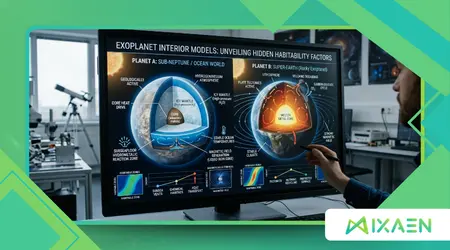
Exoplanet Interior Models represent a revolutionary paradigm shift in how astrophysicists evaluate alien worlds for potential biological activity beyond our solar system.
Stargazers traditionally focused almost exclusively on atmospheric biosignatures, scanning distant starlight for chemical traces like oxygen, water vapor, and methane gas.
Space-based observatories like the James Webb Space Telescope frequently encounter ambiguous atmospheric data that planetary scientists cannot easily interpret without deeper geological context.
This mid-2026 cosmic dispatch explores how planetary density, core thermodynamics, and mantle convection patterns combine to dictate the ultimate survival of alien biospheres.
Hidden Geological Dimensions of Alien Life
- Core Thermodynamics: Analyzing how the cooling rates of alien iron cores generate protective global magnetic shields against stellar radiation.
- Mantle Convection Processes: Understanding the vital role of internal rock movement in recycling carbon and stabilizing long-term surface climates.
- Volatile Gas Budgeting: Exploring how internal pressures dictate the chemical composition of volcanic gases that actively feed alien atmospheres.
- Geomagnetic Defenses: Measuring the structural limits of planetary interiors in shielding liquid water from destructive high-energy stellar winds.
What is a planetary geological simulation and how does it find life?
Utilizing an advanced Exoplanet Interior Models framework allows researchers to determine whether a rocky world possesses the internal volcanic machinery to sustain oceans.
These digital simulations combine basic orbital mechanics with high-pressure thermodynamics to calculate the structural layers of worlds thousands of light-years away.
Think of an alien world as a deep-dish lasagna baking inside a cosmic oven, where the internal layers dictate the surface texture.
Without a churning, molten metal core, a planet cannot generate a magnetic shield, leaving its surface completely exposed to deadly stellar radiation.
How do scientists look inside solid rock?
Astrogeologists map these hidden depths by cross-referencing precise transit data with radical high-pressure mineral physics experiments conducted in terrestrial laboratories.
This process reveals whether a planet contains a liquid iron core capable of driving plate tectonics, which remains essential for life.
++ Why Hycean Exoplanets Are Emerging as Top Life Candidates
Why do surface observations require internal context?
Atmospheric gases alone can easily deceive astronomers, as volcanic activity frequently mimics biological signatures through non-biological chemical outgassing processes.
Simulating the mantle allows scientists to accurately predict baseline volcanic emissions, filtering out geological noise from potential true alien biological signals.
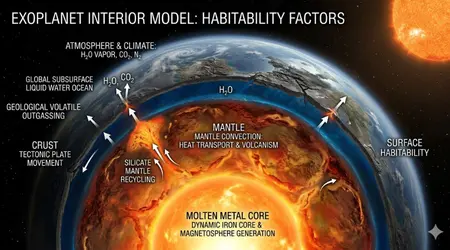
How do internal layers regulate the climate of alien worlds?
A groundbreaking 2026 geophysical research paper published by the Astrobiology Science Consortium confirms that mantle viscosity dictates the longevity of planetary habitability.
Their data indicates that planets with high iron-to-silicate ratios experience prolonged volcanic stability, extending the climate regulation window by two billion years.
This discovery proves that the deep interior acts as a giant thermostat, balancing greenhouse gases over vast geological epochs through tectonic recycling.
Applying modern Exoplanet Interior Models to data from telescopes like TESS allows researchers to eliminate dead worlds before planning expensive atmospheric studies.
Also read: How Artificial Intelligence Is Accelerating the Search for Life
What parameters determine internal planetary heat?
Radioactive isotope decay within the rocky mantle provides the primary thermal engine, driving the slow convective motion of solid silicate rock layers.
The following table summarizes the structural properties and habitability scores of prominent rocky exoplanets analyzed using these advanced internal simulations this year.
Structural Profiles and Habitability Factors of Key Exoplanets (2026)
| Target Planet Designation | Core Mass Fraction | Mantle Convection Speed | Projected Magnetic Field | Calculated Habitability Score |
| TRAPPIST-1e | Thirty-two percent | Optimal movement | Strong geodynamo | High biological potential |
| Kepler-186f | Twenty-eight percent | Slow circulation | Weak magnetic shield | Moderate survival probability |
| LHS 1140b | Forty-one percent | Rapid thermal shifting | Sustained magnetosphere | Excellent surface stability |
| TOI-700d | Twenty-five percent | Sluggish rock displacement | Negligible defense | Low atmospheric preservation |
| SPECULOOS-2c | Thirty-five percent | Standard cyclical flow | Active magnetic core | Promising evolutionary environment |
Why do super-Earths challenge traditional geology?
Massive rocky worlds experience immense internal gravitational compression, which can solidify the mantle and completely paralyze vital tectonic recycling systems.
Understanding these extreme pressure thresholds prevents astronomers from misidentifying massive, stagnant rocky planets as viable candidates for alien life.
How do core dynamics generate protective planetary shields?
Constructing accurate Exoplanet Interior Models helps identify worlds that possess a churning geodynamo, the essential mechanism behind global magnetic field generation.
Consider the rocky world LHS 1140b, where deep simulations indicate a massive, partially molten iron core undergoing intense thermal convection.
This internal churning creates a robust magnetic envelope that deflects high-energy flares from its volatile host star, preserving surface liquid water.
Conversely, a planet like Mars serves as a tragic example of a world whose small core froze prematurely, causing atmospheric stripping.
How does tidal heating alter core behavior?
Planets orbiting close to small M-dwarf stars experience immense gravitational pulling forces that generate massive internal friction and sustained thermal energy.
This tidal flexing keeps the planetary interior molten, extending the lifespan of the magnetic field even when radioactive elements are completely absent.
Read more: The Debate Around Technosignatures: Searching for Alien Technology
What happens when a planet lacks plate tectonics?
Without plate movement, internal heat becomes dangerously trapped, triggering catastrophic global volcanic resurfacing events that completely scorch the planetary crust.
These hostile environments boil away alien oceans, converting potentially promising worlds into suffocating, toxic green-house structures similar to our Venus.
Why does internal geochemistry dictate atmospheric composition?
What is the use of searching for alien oceans if the planetary interior permanently swallows the water supply through chemical reactions?
Advanced Exoplanet Interior Models reveal that high-pressure mineral phases deep within the mantle can permanently trap massive quantities of water.
If a planet retains its water within deep rock structures, its surface will remain a barren, dry desert completely hostile to life.
Geochemical balance determines whether a planet develops a stable nitrogen-rich atmosphere or smothers itself under a crushing layer of carbon dioxide.
How do volcanic gases feed early biospheres?
Active volcanoes act as chemical delivery systems, pumping essential elements like carbon, nitrogen, and sulfur directly into the cooling primitive atmosphere.
Biological entities rely on these volcanic nutrients to establish early metabolic pathways, making active geology a mandatory prerequisite for alien evolution.
How do we identify subterranean water oceans?
Planets with low bulk densities often hide massive global water layers beneath a thin crust of solid silicate rock or compressed ice.
Internal modeling allows us to map these hidden aquatic realms, expanding our search for life to dark, subterranean environments.
Decoding the Complete Planetary Machine
Evaluating the true potential of distant worlds requires us to view geology and astrobiology as a single, fully integrated planetary system.
We have explored how internal mineral physics, core-driven magnetic fields, and mantle convection speeds ultimately control the survival of alien surface life.
An atmosphere is merely the outer skin of a complex, dynamic machine powered by the intense heat of a deep interior.
By mastering these hidden internal variables, humanity can focus its exploration efforts on worlds that possess true, long-term biological resilience.
The journey to find life among the stars depends on our ability to peer deep into the silent stone of distant worlds.
Do you believe the first signs of alien life will come from an ocean world or a tectonic planet? Share your thoughts in the comments!
Frequently Asked Questions
How do scientists measure the mass of a planet thousands of light-years away?
Astronomers calculate planetary mass by observing how much the planet’s gravitational pull causes its host star to wobble during its orbit.
Can a planet sustain life without active plate tectonics?
Life is highly unlikely because plate tectonics recycle vital carbon dioxide, preventing the atmosphere from collapsing or overheating over geological time.
Why are M-dwarf stellar systems dangerous for planetary habitability?
M-dwarf stars frequently emit powerful, violent flares that can easily strip away the atmosphere of a planet lacking a magnetic shield.
How does James Webb data integrate with interior models?
Atmospheric chemical data from the telescope provides the raw material boundary constraints needed to calculate the planet’s total chemical composition.
