
The Puzzle of the Universe’s Symmetry: Too Perfect to Be Accidental?
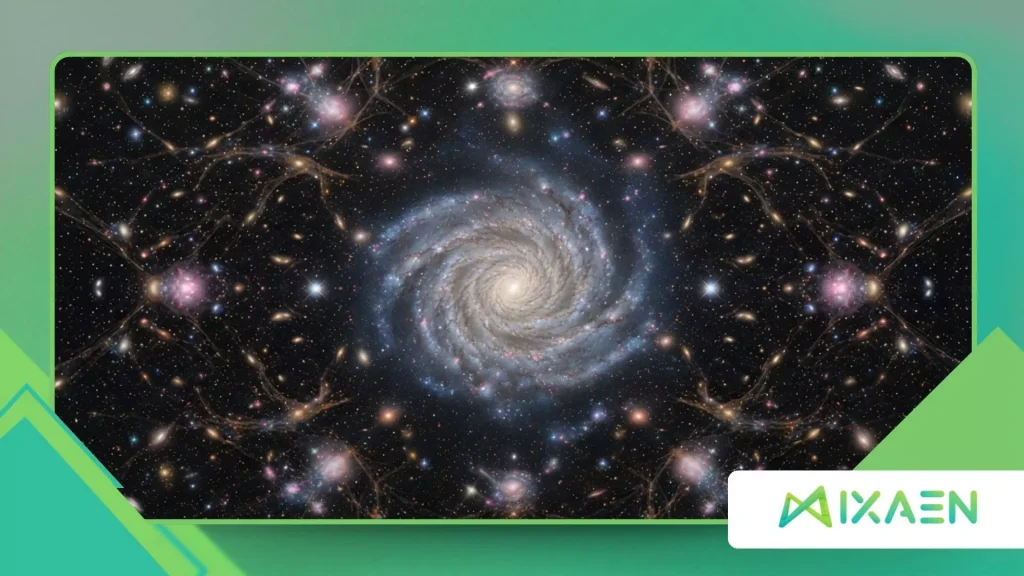
The puzzle of the universe’s symmetry challenges our very existence, forcing astrophysicists to question why everything we see around us even exists today.
Modern cosmology states that the Big Bang should have produced equal amounts of matter and antimatter, leading to an immediate, total annihilation of the cosmos.
Yet, we live in a universe dominated entirely by matter, a profound asymmetry that continues to baffle the scientific community.
As an experienced science columnist, I find this cosmic imbalance to be one of the most thrilling detective stories in modern physics, driving researchers to the absolute limits of known science.
This fundamental mystery does not just intrigue theoretical physicists; it shapes our core understanding of reality and the laws governing the subatomic world.
If the universe had been perfectly symmetrical at its inception, stars, planets, and human life would have been mathematically impossible.
Our current observations in 2026 suggest that a subtle, hidden mechanism tipped the scales in favor of matter during the first crucial moments of cosmic expansion.
To truly grasp how we escaped total erasure, we must dive into the deep anomalies that define our universe.
Quick Navigation
- The Cosmological Dilemma: Understanding Baryon Asymmetry
- The Laws of Physics: CP Violation and the Standard Model
- Modern Experiments: How Scientists Hunt for Answers
- Comparative Analysis: Matter vs. Antimatter Properties
- Frequently Asked Questions: Resolving the Cosmic Paradox
Why Is the Universe Made of Matter?
The universe presents a striking contradiction when we examine its structural composition against the theoretical predictions of early cosmic evolution.
According to standard quantum mechanics, energy converting into mass always generates particles and antiparticles in identical pairs, a rule verified daily in particle accelerators worldwide.
However, looking out into the deep cosmos via space telescopes like James Webb, we see no evidence of massive antimatter galaxies or radiation belts from large-scale annihilation.
This undeniable dominance of matter implies that a tiny, native preference for normal matter existed during the initial cooling phase of the cosmos.
To visualize this, imagine a colossal cosmic lottery where billions of matter and antimatter particles fought a relentless war of mutual destruction.
For every billion pairs that canceled each other out into pure light, one lonely matter particle survived to form the stars we observe today.
Without this minute excess, the universe would be an expanding, dark void filled with nothing but cold, uniform radiation. This profound reality forces us to search for the hidden law that allowed matter to win the ultimate cosmic lottery.
What Is Baryon Asymmetry?
Baryon asymmetry represents the physical imbalance between baryonic matter (like protons and neutrons) and antibaryonic matter throughout the observable fabric of space.
Cosmologists use this specific term to describe the mathematical reality that our universe contains a measurable surplus of matter over antimatter.
The puzzle of the universe’s symmetry deepens when we realize that no current equations can fully explain why this specific surplus favors matter so aggressively.
Our current calculations show that the ratio of baryon excess to cosmic microwave background photons is incredibly small, yet absolutely vital for structural development.
This minute imbalance means the early universe possessed a bias of roughly one extra matter particle for every ten billion antimatter counterparts.
This tiny fractional deviation is the sole reason galaxies managed to coalesce, providing the heavy elements necessary for planetary systems.
++ Why Hypervelocity Stars Escape Galaxies at Impossible Speeds
How Did Matter Survive the Big Bang?
The survival of matter required a rapid departure from thermal equilibrium during the rapid inflation period immediately following the birth of space-time.
During this chaotic epoch, the extreme density and temperature fluctuations allowed unique particle interactions to occur at energies we cannot replicate on Earth.
Physical processes favored the decay of heavy, unstable particles into normal matter slightly more often than into antimatter twins.
As the universe expanded and dropped in temperature, these asymmetric interactions froze into place, permanently setting the chemical balance of the cosmos.
This rapid cooling prevented the newly formed matter from finding antimatter partners, effectively saving it from inevitable, immediate annihilation.
The resulting footprint left behind a physical realm dominated by atoms, giving rise to the complex chemistry of our modern world.
Also read: Cosmic Lithium Problem Defies Big Bang Predictions Today
What Is the Sacchetti-Sakharov Criteria?
In 1967, physicist Andrei Sakharov outlined three essential conditions that must occur simultaneously to generate a permanent matter-antimatter imbalance from an initially neutral state.
First, the universe must experience baryon number violation, meaning processes must exist where the total number of matter particles can actively change.
Second, the laws of physics must violate C (charge) and CP (charge-parity) symmetry, ensuring matter and antimatter behave differently.
“A universe with perfect symmetry would be a universe of pure light, entirely devoid of the complex structures needed to foster life.”
Dr. Elena Rostova, Theoretical Cosmologist
Finally, these unusual interactions must take place outside of thermal equilibrium, preventing the reverse reactions from immediately erasing the newly created matter surplus.
These three strict criteria remain the foundational roadmap for any modern theory attempting to resolve this massive architectural mystery.
Without fulfilling every single one of these conditions, a universe populated by solid matter remains a mathematical impossibility.
How Does CP Violation Break the Balance?
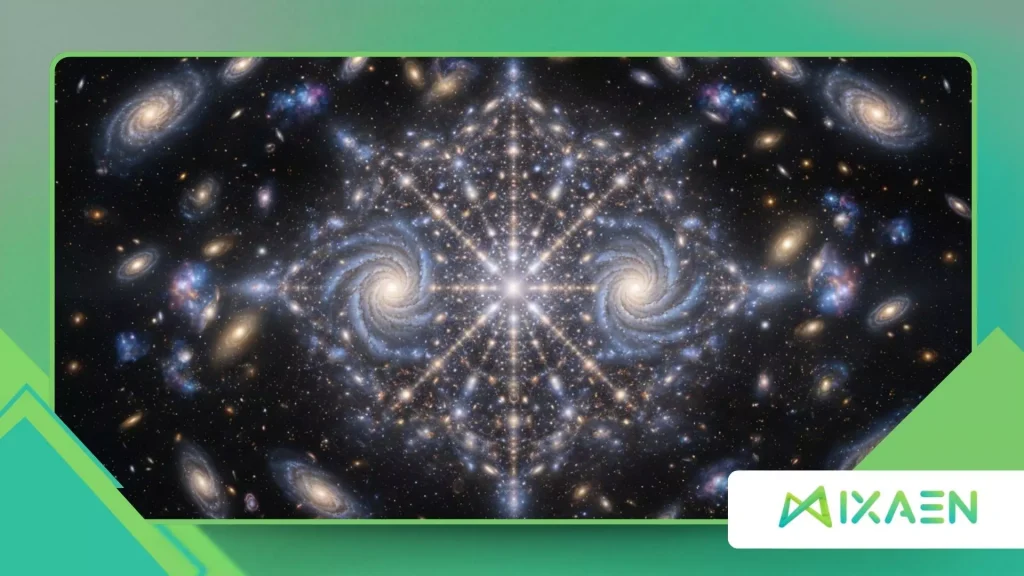
Charge-Parity (CP) violation serves as the primary mechanism that physicists use to explain how nature differentiates between particles and their mirror antiparticles.
Charge conjugation swaps a particle with its opposite charge, while parity inversion flips its spatial coordinates, much like looking into a literal mirror.
If a physical process behaves differently after undergoing both transformations, it actively violates CP symmetry, revealing a fundamental bias in nature.
This structural bias means that the universe does not treat matter and antimatter as identical, inverted twins.
Scientists have observed this exact phenomenon in specific subatomic particles, notably neutral kaons and B-mesons, during high-energy collisions.
While these microscopic discoveries prove that CP violation is real, the measured magnitude of the effect is far too weak to explain the cosmos.
The puzzle of the universe’s symmetry remains unsolved because the Standard Model of physics only accounts for a fraction of the necessary imbalance.
We are left looking for undiscovered particles or new forces that can bridge this massive theoretical gap.
Read omre: Why Extreme Magnetar Flares Produce Unusual Gamma-Ray Signals
Why Do Particles and Antiparticles Differ?
At a fundamental level, particles and antiparticles share identical masses and lifespans, but carry opposite electrical charges, magnetic moments, and quantum numbers.
One would naturally assume that swapping these properties would yield perfectly mirrored behavior across all four fundamental forces of nature.
Yet, weak nuclear interactions stubbornly refuse to follow this rule, displaying a subtle preference for specific directional decays in normal matter.
This behavioral divergence means that an antimatter particle does not decay at the exact same rate as its normal matter counterpart.
This microscopic asymmetry is the smoking gun that proves the universe possesses an inherent preference for one type of matter over another.
Understanding this divergence is the key to unlocking the ancient secrets of our cosmic origin story.
What Have CERN Experiments Revealed?
The Large Hadron Collider (LHC) at CERN has spent years colliding protons at near-light speeds to recreate the extreme energy densities of the early universe.
Recent data from the LHCb experiment has uncovered new instances of CP violation in charm mesons, expanding our limited catalog of asymmetric behaviors.
These highly precise measurements help physicists refine their mathematical models, though they continuously highlight the insufficiency of our current frameworks.
The ongoing experiments act as a reality check for theoretical physics, confirming that our understanding of the subatomic world is still incomplete.
Every collision provides a cleaner look at how nature manipulates the building blocks of matter under extreme environmental stress.
These real-time discoveries keep the global scientific community on the edge of their seats as they hunt for anomalies.
How Does the Standard Model Fail?
The Standard Model of particle physics is incredibly successful at predicting behavior, yet it fails dramatically when explaining the total volume of matter.
When we calculate the total amount of CP violation allowed by the Standard Model, it falls short by a factor of billions.
It simply cannot generate enough matter to match the massive density of galaxies and clusters observed throughout our sky today.
This glaring mathematical shortfall proves that the Standard Model is not the final theory of everything, but rather an incomplete chapter.
Physicists are actively searching for physics beyond the Standard Model, exploring concepts like supersymmetry, dark sectors, and extra spatial dimensions.
Resolving this failure is currently the highest priority for the next generation of deep-space observatories and particle accelerators.
Why Does the Cosmic Balance Seem So Perfect?
When we look at the universe, the precision required to produce our matter-dominated reality seems almost impossibly fine-tuned to the casual observer.
If the initial asymmetry had been slightly larger, the universe would have collapsed into dense black holes before stars could ever ignite.
Conversely, a slightly smaller asymmetry would have resulted in complete annihilation, leaving a cosmos entirely devoid of regular atomic structures.
The puzzle of the universe’s symmetry forces us to consider whether this perfect balance points to deep, undiscovered laws of nature.
To understand this precision, consider a classic architectural analogy: a massive hanging bridge balanced perfectly on a single central needle point.
The slightest vibration or structural deviation in either direction would cause the entire system to collapse into the abyss below.
The universe exists precisely on this metaphorical needle point, maintaining a stable state that allows complexity, chemistry, and life to flourish.
This incredible balance challenges our understanding, driving researchers to look for the hidden framework supporting our reality.
Is Fine-Tuning an Illusion?
Many scientists argue that what we perceive as miraculous fine-tuning might simply be the natural outcome of a broader, self-correcting physical mechanism.
It is entirely possible that the early universe underwent a phase transition that automatically locked the matter-antimatter ratio into its current state.
In this scenario, the seemingly perfect numbers are not an accident, but a mathematical inevitability dictated by a higher law.
Another perspective suggests that we might live in a multiverse where different pockets of space possess entirely different physical constants and symmetries.
We simply happen to find ourselves in a matter-dominated pocket because life cannot physically arise in the sterile, symmetrical alternatives.
This approach reframes the entire mystery, transforming a question of cosmic luck into a simple matter of environmental selection.
What Is the Role of Dark Matter?
Dark matter makes up roughly 85% of the total matter content in the cosmos, yet its true identity remains completely unknown to science.
Some cutting-edge theories suggest that the generation of dark matter is directly linked to the mysterious baryonic asymmetry we observe today.
This concept, known as asymmetric dark matter, proposes that dark matter particles possess their own antiparticles, sharing a mirrored survival story.
If this theoretical link is correct, the survival of dark matter and normal matter happened during the exact same primordial event.
Investigating this connection could provide the missing data needed to solve the puzzle of the universe’s symmetry once and for all.
By studying the invisible scaffolding of galaxies, we might finally uncover the secrets of the visible matter we can touch.
How Do Neutrinos Explain Reality?
Neutrinos are ghostly, nearly massless particles that interact with normal matter almost exclusively through the incredibly weak nuclear force.
Some theoreticians believe that neutrinos might actually be their own antiparticles, a unique classification known as Majorana fermions.
If this hypothesis proves true, it would open up a completely new pathway for generating matter excess through a process called leptogenesis.
Leptogenesis suggests that heavy, right-handed neutrinos decayed asymmetrically in the early universe, creating an initial imbalance in lepton numbers that later converted into matter.
Scientists are currently operating massive underground detectors, like DUNE, to watch for neutrino oscillations that could confirm this behavior.
Finding CP violation in neutrinos could completely rewrite our cosmological models, providing the final piece of our existential puzzle.
Mapping Cosmic Asymmetry
To better understand the profound divergence between the theoretical expectations of a symmetrical universe and the observable reality of our matter-dominated cosmos, we can compare their core characteristics directly.
| Cosmic Characteristic | Theoretical Symmetrical Universe | Our Observable Universe (2026) |
| Primary Composition | Equal mix of matter and antimatter particles | Absolute dominance of baryonic matter |
| Dominant Energy Interaction | Continuous, total particle-antiparticle annihilation | Localized stellar fusion and cosmic expansion |
| Structural Complexity | Uniform cloud of high-energy gamma-ray photons | Complex web of galaxies, stars, and planetary systems |
| CP Violation Requirements | Perfect conservation of charge-parity symmetry | Measured CP violation in subatomic particle decays |
| Capacity for Life | Mathematically zero; no atomic bonds can form | High; abundant elements allow biological evolution |
Resolving the Cosmic Paradox
The puzzle of the universe’s symmetry stands as a monumental testament to the gaps in our current understanding of the cosmos.
Our existence is a beautiful anomaly, a monument built upon a tiny structural glitch that occurred in the earliest moments of time.
As we advance deeper into 2026, our tools are becoming sharp enough to peer directly into the cracks of the Standard Model.
Every new piece of data from deep-space telescopes and subatomic accelerators brings us closer to understanding why we are here.
Ultimately, the study of cosmic asymmetry reminds us that the universe is far more complex than our current textbooks suggest.
The quest to solve this mystery unites astronomers, particle physicists, and philosophers in a shared mission to decode our ultimate origin.
What do you think tipped the scales in favor of matter during the birth of our universe? Share your thoughts and theories in the comments below to join the ongoing scientific conversation!
Frequently Asked Questions
Why didn’t the universe completely annihilate itself?
The universe avoided total self-destruction because a subtle asymmetry disrupted the balance between matter and antimatter during the Big Bang.
This process, known as baryogenesis, ensured that a tiny surplus of matter survived the initial wave of mutual annihilation.
Can we create antimatter in a laboratory setting today?
Yes, scientists routinely produce microscopic amounts of antimatter using high-energy particle accelerators like those located at CERN.
However, creating even a single gram of antimatter using modern technology would require billions of dollars and thousands of years of continuous operation.
Is there an antimatter universe hidden somewhere out there?
While highly unlikely, some early theoretical models suggested that distant regions of space might consist entirely of antimatter galaxies.
However, modern observations show no gamma-ray signatures from the massive border zones where matter and antimatter regions would inevitably collide and annihilate.
