
Why Super-Earth Interiors Matter for Surface Habitability

Super-Earth Interiors dictate the absolute cosmic boundary line between a dead, barren rock and a thriving, biologically active alien world.
Astronomers scanning the deep night sky traditionally focus their massive telescopes on the visible atmospheric chemical compositions of these distant exoplanets.
However, planetary scientists confirm that surface oceans and protective protective gases cannot exist without specific deep subterranean geological mechanisms operating underneath.
Evaluating these massive planets requires us to peer deeply beneath the surface layer to analyze extreme mantle pressures and core temperatures.
Geodynamic models prove that a planet with a mass significantly greater than Earth experiences entirely different thermodynamic cooling patterns over billions of years.
These internal cooling speeds directly alter planetary magnetic fields and control the long-term presence of liquid surface water.
Understanding this hidden relationship helps astrobiologists narrow their search parameters for authentic extraterrestrial biosignatures across our vast galaxy.
If a rocky planet possesses an excessively viscous mantle, it cannot sustain the long-term carbon recycling loops necessary to stabilize surface temperatures.
The deep geology essentially holds the master keys to the evolutionary timeline of any potential alien ecosystem.
Core Planetary Insights
- Geodynamic Engines: Deep mantle convection drives the continuous volcanic outgassing required to form sustainable planetary atmospheres.
- Magnetic Shielding: High-pressure iron-silicate liquid mixtures generate powerful magnetospheres that successfully deflect destructive stellar solar winds.
- Tectonic Recycling: Active structural plate movements balance global surface carbon concentrations over extensive multi-million-year intervals.
What is the Structural Composition of Super-Earth Interiors?
These massive planetary bodies represent rocky worlds scaling between roughly two and ten times the total mass of our own planet.
The structural physics of Super-Earth Interiors involves handling crushing gravitational forces that alter standard crystal structures within deep mantle silicate minerals.
Have you ever wondered how a planet behaves when its internal pressure compresses ordinary rock into highly conductive metallic phases?
Under these extreme subterranean conditions, standard geological assumptions completely disintegrate, forcing researchers to utilize advanced diamond anvil cell laboratory experiments.
The deeper layers compress into dense polymorphs of post-perovskite, which radically alters how efficiently heat travels outward from the liquid core.
This trapped thermal energy determines whether the exoplanet develops active surface tectonic plates or hardens into a single stagnant crustal shell.
Consider a massive industrial blast furnace operating continuously; if the outer insulation layers remain too thick, internal heat spikes to uncontrollable levels.
The deep interior of a massive rocky exoplanet functions like this furnace, where internal mass dictates the entire thermodynamic engine’s operational speed. If the heat cannot escape smoothly, the entire surface becomes a molten wasteland devoid of biological life.
Recent high-pressure laboratory studies confirm that iron-rich mineral blends remain liquid at much higher temperatures under massive gravitational loading.
This physical reality guarantees that larger rocky worlds retain hot, churning planetary cores for significantly longer durations than our solar system’s smaller planets.
Consequently, these worlds can theoretically sustain volcanic activity and atmospheric replenishment across extensive geological epochs.
++ How Planetary Resonance Systems Affect Exoplanet Stability Today
How Does Gravitational Compression Alter Rocks?
The immense weight of the overlying crust forces deep mantle silicate minerals to fuse into hyper-dense crystalline arrangements unknown on Earth’s surface.
These compressed materials conduct thermal energy much faster, altering the traditional convective cycles that move molten material upward toward active volcanic vents.
This physical transformation reshapes how scientists model exoplanetary cooling timelines.
Also read: How Artificial Intelligence Is Accelerating the Search for Life
Why Do Planetary Core Masses Matter?
A massive metallic core provides the heavy gravitational anchor needed to prevent lighter atmospheric gasses from escaping out into the vacuum of space.
Furthermore, the total volume of iron trapped within the core dictates the potential strength of the planet’s internal dynamo engine. This metallic heart must remain fluid to keep the outer crust dynamically active.
Read more: The Debate Around Technosignatures: Searching for Alien Technology
Where Do Silicate Minerals Change Behavior?
Deep within the lower mantle boundary zone, intense atomic compression forces silicates to drop their traditional insulating properties and begin conducting electricity.
This unique transition creates a complex, hybridized core-mantle boundary layer that can deeply influence the orientation of the global magnetic field. This shifting boundary directly controls heat transfer to the upper crust.
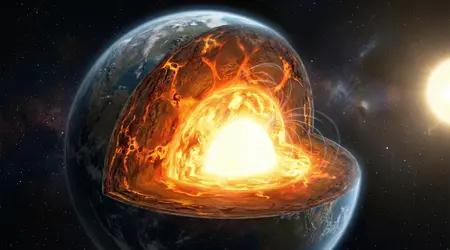
How Do Dynamic Core Processes Generate Magnetic Shields?
Sustaining long-term surface habitability requires an unyielding defense mechanism against the relentless stream of ionizing radiation blasting from host stars.
Evaluating Super-Earth Interiors allows astrophysicists to determine whether a rocky exoplanet possesses a functioning internal dynamo capable of generating a magnetosphere.
Without this protective invisible barrier, high-energy stellar winds will erode any protective atmospheric gas layer within a few hundred million years.
The generation of this magnetic shield depends on rapid, turbulent fluid motion within a highly conductive liquid iron alloy outer core.
On larger worlds, the sheer scale of the metallic core can produce magnetic fields significantly more powerful than Earth’s current shield. This massive protective umbrella allows the planet to safeguard its surface water reserves against solar evaporation.
For example, a planet like LHS 1140 b orbits comfortably within its star’s habitable zone while maintaining a highly massive, dense composition.
This structural density strongly suggests a rich iron core that powers an exceptional magnetic shield, neutralizing intense stellar flares safely above the clouds. This real-world example shows how deep planetary mass directly preserves the integrity of foreign oceans.
However, if the crushing internal pressure forces the core to solidify prematurely into a motionless crystal ball, the dynamo shuts down permanently.
When this protective field collapses, the surface experiences intense cosmic radiation, breaking water molecules apart into hydrogen gas that escapes into space.
Deep structural fluidity remains a non-negotiable requirement for hosting durable, multi-generational biological life forms.
What Drives the Internal Dynamo Engine?
The continuous thermal contrast between the scorching hot inner core and the slightly cooler lower mantle drives rapid fluid convection.
As the planet rotates on its axis, these rising and sinking currents of liquid iron twist into organized, conductive columns. This organized movement generates the vast electrical currents that sustain the global magnetosphere over billions of years.
How Do Stellar Winds Impact Unshielded Planets?
Stars constantly emit high-velocity streams of charged protons and electrons that physically collide with unprotected upper atmospheric gas layers.
Without a robust magnetic shield to deflect these particles around the planet, the stellar wind gradually strips away vital elements like oxygen. This devastating process converts promising ocean worlds into bone-dry deserts.
Can We Detect Exoplanet Magnetic Fields Remotely?
Astronomers use advanced low-frequency radio telescope arrays to listen for specific radio emissions generated when stellar winds collide with exoplanetary magnetospheres.
Measuring the strength of these distant radio signals provides direct, empirical clues regarding the fluid dynamics operating deep within Super-Earth Interiors. This telemetry bridges the gap between deep geology and space observation.
Why Does Mantle Convection Regulate Global Surface Temperatures?
The long-term stability of a planet’s climate relies on an unyielding, cyclical interaction between the interior mantle and the upper atmosphere.
This planetary thermostat operates through the continuous subduction of carbon-rich rocks and the subsequent volcanic outgassing of carbon dioxide gas molecules.
Analyzing Super-Earth Interiors reveals whether a planet can successfully balance this delicate chemical equation across astronomical timescales.
If a planet’s mantle remains highly fluid, it drives rapid crustal recycling that prevents the atmosphere from becoming permanently depleted of greenhouse gases.
Conversely, if the interior turns sluggish, the carbon cycle breaks down, plunging the surface into either an ice age or a runaway greenhouse state. The internal conveyor belt must operate smoothly to keep surface climates stable for life.
To use another explicit example, the volcanic exoplanet planet 55 Cancri e features an incredibly hyper-active mantle that produces massive global lava oceans.
While this specific world remains far too hot for biology, it demonstrates how internal heat transport completely dictates surface conditions. The planet serves as an extreme laboratory for testing our core thermodynamic equations.
Data gathered by the James Webb Space Telescope (JWST) regarding rocky exoplanet atmospheres suggests a strong correlation between mantle activity and atmospheric density.
This mounting evidence reinforces the theory that surface environments are merely the outer expression of deep geological engines. True habitability demands a perfectly balanced volcanic exhaust system working over millions of years.
What is the Stagnant Lid Geological Model?
When a massive exoplanet’s crust becomes too thick and rigid, it locks the entire planet into a single, immovable outer shell.
This stagnant configuration prevents volcanic outgassing and stops carbon from returning to the mantle, causing the surface climate to degrade rapidly.
This geological bottleneck represents a common dead-end for many massive rocky worlds.
How Does Carbon Recycling Stabilize Climates?
Rainwater washes atmospheric carbon dioxide down into surface rocks, which slowly slide back into the hot mantle through active plate subduction zones.
Volcanoes eventually vent this trapped carbon back into the sky, maintaining a stable greenhouse effect that prevents global freezing. This magnificent cycle acts as the primary planetary thermostat across our universe.
How Do Super-Earth Interiors Influence Volcanic Chemistry?
The unique mineral combinations melting within a high-pressure mantle dictate the exact chemical recipe of the gases erupted into the atmosphere.
If the interior contains high concentrations of water-bearing minerals, the resulting volcanic outgassing will naturally create thick, moisture-rich clouds. The deep planetary kitchen determines what ingredients reach the sky.
Geodynamic Comparison of Rocky Planetary Scales
The physical behavior of a rocky world changes drastically as its total mass scales upward from our baseline Earth measurements.
The following table highlights the critical structural differences that shape surface environments across different planetary classifications.
Internal Physics and Surface Habitability Matrix
| Planetary Class | Average Mass Range | Internal Core State | Mantle Convection Style | Magnetosphere Potential | Habitability Horizon |
| Sub-Earth (Mars Scale) | 0.1 – 0.5 Earths | Solidified / Inert | Weak / Dormant | Negligible / Lost | Poor (Atmosphere Escapes) |
| Standard Earth | 1.0 Earth Mass | Liquid Outer Core | Mobile Plate Tectonics | Robust / Stable | Excellent (Balanced Cycles) |
| Moderate Super-Earth | 2.0 – 5.0 Earths | High-Pressure Liquid | Vigorous / Multi-Layered | Highly Powerful | Optimal (Long-Term Shielding) |
| Massive Super-Earth | 6.0 – 10.0 Earths | Semi-Solid Metallic | Sluggish / Stagnant Lid | Variable / Complex | Challenging (Extreme Heat) |
Geodynamic Foundations of Alien Life
The scientific exploration of the cosmos continuously confirms that surface habitability is fundamentally tied to the structural mechanics of Super-Earth Interiors.
The internal distribution of heavy metals, the efficiency of mantle heat convection, and the longevity of liquid cores determine if an atmosphere can endure.
As our telescope networks expand, focusing on deep planetary geodynamics will remain crucial for identifying true Earth twins among the stars.
What are your thoughts on the idea that deep, crushing underground geology entirely shapes the air we would breathe on an alien world? Share your perspectives and astronomical theories in the comments section below!
Frequently Asked Questions
Can an exoplanet lack plate tectonics but remain habitable?
Yes, a planet operating under a stagnant lid model can remain habitable if it maintains steady localized volcanic venting through hotspots, preserving atmospheric density.
How do scientists calculate the internal pressure of a planet light-years away?
Researchers combine the planet’s measured mass and radius to calculate its average density, then apply advanced mineral physics equations to model internal layering.
Why does a massive planet cool down slower than a small planet?
Larger physical spheres possess a lower surface-area-to-volume ratio, which naturally allows them to retain their primordial accretion heat for much longer periods.
