
The Mystery of Odd Radio Circles Expanding Across Deep Space
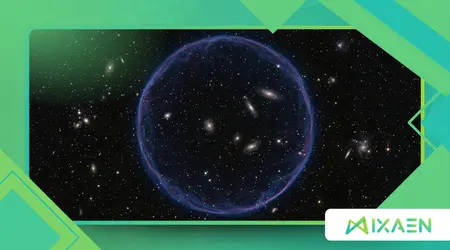
Odd Radio Circles represent one of the most baffling discoveries in modern astronomy, challenging our current understanding of how galaxies evolve and interact with space.
These spectral, ring-like structures were first detected using the ASKAP radio telescope, appearing as faint, ghostly circles that dwarf entire galactic systems in scale.
Scientists are currently racing to decode these signals as more examples emerge from deep space surveys in early 2026.
While they are invisible to optical telescopes, their radio signatures suggest massive energetic events that occurred millions of light-years away from our own Milky Way.
Essential Points of Interest
- Defining the physical characteristics of these massive radio-emissions.
- Analyzing the leading theories involving galactic winds and black holes.
- Exploring how new telescope arrays are mapping these circles today.
- Understanding the scale of these phenomena relative to known galaxies.
What defines these massive celestial structures?
The discovery of Odd Radio Circles has forced a rewrite of cosmic mapping because these rings do not emit light, X-rays, or infrared radiation.
They appear exclusively in radio wavelengths, often perfectly centered around a distant elliptical galaxy, acting like a cosmic fingerprint of a past explosion.
These circles are truly gargantuan, often spanning about one million light-years in diameter, which is roughly ten times the width of our entire galaxy.
Their symmetrical shape suggests a singular, incredibly powerful outward expansion of shockwaves that have traveled through the intergalactic medium for eons.
How were they first identified?
Initial detections occurred during the Evolutionary Map of the Universe survey, where automated software flagged unusual circular artifacts that looked like glitches.
Astronomers quickly realized these were real physical objects after confirming the data with other international radio observatories like the MeerKAT in South Africa.
Since then, each new detection has provided more clarity on their structure, showing a bright outer rim with a much fainter interior region.
This indicates that we are likely looking at a spherical shell of electrons being accelerated by magnetic fields at nearly the speed of light.
++ Why Large-Scale Structures Seem Too Ordered to Be Random Alone
Why are they invisible to the naked eye?
These structures consist of synchrotron radiation, which occurs when electrons spiral around magnetic field lines at extreme velocities across the deep vacuum.
Because the gas involved is so incredibly diffused, it does not glow in the visible spectrum that our eyes or traditional cameras can detect.
Imagine trying to see a faint puff of smoke in a dark room using only a flashlight; you might miss it entirely.
However, with the right specialized equipment, the radio “glow” becomes as clear as a neon sign in the desert, revealing a hidden skeleton of the universe.
What causes the expansion of these rings?
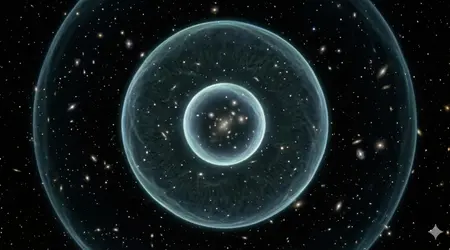
A prominent theory suggests that Odd Radio Circles are the result of massive “galactic winds” caused by a sudden burst of star formation.
When millions of stars explode as supernovae in a short window, they create a collective pressure that pushes gas out of the galaxy.
Alternatively, some researchers argue that these rings are shockwaves from mergers between supermassive black holes located at the centers of distant galaxies.
Such a cataclysmic event would release a tidal wave of energy, rippling through space and creating the circular boundaries we observe from Earth today.
Also read: Could Dark Energy Be Linked to a Force We Haven’t Discovered?
Can black hole activity explain the symmetry?
Active galactic nuclei often blast jets of particles into space, but these are typically seen as long, straight beams rather than perfect circles.
However, if a jet is pointed directly at us, or if it flickers out quickly, it might leave behind a shell-like remnant that appears circular from our perspective.
Current observations in 2026 support the idea of a “starburst” followed by a period of quiet, allowing the shell to expand undisturbed.
This suggests that the galaxies in the center of these circles were once much more chaotic and violent than they appear to be now.
Read more: Why the Universe Seems Too Ordered to Be Random
Is the intergalactic medium influencing their shape?
The space between galaxies is not empty but filled with a very thin plasma that can shape the expansion of radio-emitting particles.
If the surrounding medium is uniform, the shockwave remains a perfect circle; if it hits a denser cloud, the ring becomes distorted or broken.
Think of it like a ripple in a perfectly still pond versus a ripple in a moving stream.
The perfection of many Odd Radio Circles tells us that the space around these galaxies is surprisingly empty and calm, allowing the energy to spread evenly.
How do we measure such vast distances?
Astronomers use the redshift of the central galaxy to determine that these Odd Radio Circles are located billions of light-years away from us.
By calculating how much the light has stretched, they can estimate the age of the structure and the total energy required to create it.
A recent study published in Nature (2024) utilizing the MeerKAT telescope confirmed that the energy required to create one circle is equivalent to billions of suns.
This data proves that we are witnessing the aftereffects of the most powerful events in the history of the local universe.
What tools are used in 2026?
The Square Kilometre Array (SKA) has become the primary tool for investigating these mysteries, providing resolution levels previously thought impossible for radio astronomy.
This global project allows scientists to see the fine details of the magnetic fields that keep the electrons trapped within the circular shell.
These tools allow us to “see” the magnetic scaffolding of the universe, providing a map of forces that are otherwise completely invisible.
By layering radio data over optical images, we can see exactly how the central galaxy interacts with its expanding ghost-like halo.
Statistics of Radio Circle Observations
| Property | Average Value | Comparison |
| Diameter | 1 Million Light-Years | 10x the Milky Way |
| Radio Frequency | 0.8 – 1.4 GHz | Standard Radio Band |
| Central Object | Elliptical Galaxy | Older, massive galaxies |
| Energy Output | Joules | Billions of Supernovae |
| Age of Remnant | ~1 Billion Years | 1/14th age of Universe |
The Future of Deep Space Mapping
Understanding the Odd Radio Circles is like finding a giant fossil in the middle of a desert; it tells a story of a lost era.
These rings are essentially the “smoke” from a galactic gun that was fired millions of years ago, offering clues about how galaxies grow.
By studying these structures, we gain insights into the “feedback” mechanisms that prevent galaxies from growing too large.
Without these massive outflows of gas, galaxies might consume all their fuel too quickly, leaving the universe a much darker and less diverse place than it is today.
As we continue to peer into the darkness, we may find that the universe is far more “circular” than we ever dared to imagine.
Every new discovery of an Odd Radio Circle brings us closer to understanding the violent, energetic heart of the cosmos that beats far beyond our own stars.
Could these circles be the final remnants of a galactic “scream” that we are only now starting to hear? Share your experience in the comments!
Frequently Asked Questions
What is the difference between an ORC and a supernova remnant?
A supernova remnant is much smaller and usually found within a galaxy, whereas an ORC is larger than the galaxy itself and exists in intergalactic space.
Are Odd Radio Circles dangerous to Earth?
No, these structures are located billions of light-years away and consist of very low-density particles that have no physical impact on our solar system.
How many Odd Radio Circles have been found so far?
As of early 2026, fewer than 10 confirmed examples have been identified, making them one of the rarest astronomical phenomena ever recorded.
Can I see an Odd Radio Circle with a backyard telescope?
Unfortunately, no. They are invisible to optical light and require massive professional radio telescope arrays to be detected and imaged.
Do these circles ever stop expanding?
They eventually dissipate as the energy of the electrons fades and the magnetic fields weaken, blending back into the general background noise of the universe.
