
Why the Amaterasu Particle Breaks Limits of Cosmic Ray Physics
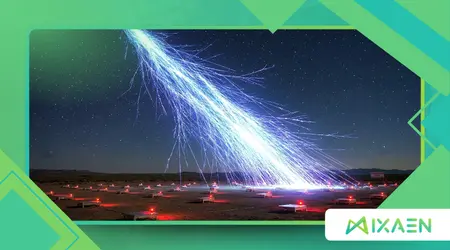
Amaterasu Particle research has pushed the boundaries of modern astrophysics, presenting a mystery that defies our current understanding of high-energy cosmic phenomena.
This ultra-high-energy cosmic ray, detected by the Telescope Array in Utah, carries energy levels so extreme that they challenge the standard model of physics.
Scientists remain baffled by its origin because the particle appears to have arrived from the Local Void, an empty region of space.
Such a powerful arrival suggests that either our maps of the universe are incomplete or that entirely new physical laws are at play.
Cosmic Mystery Navigator
- Energy Extremes: Understanding the unprecedented power level of the detected particle.
- The Void Mystery: Why the arrival direction points to an empty region of space.
- GZK Limit: Exploring the theoretical boundary that this particle seemingly ignored.
- Detection Technology: How the Telescope Array captures these rare, invisible events.
Why does this discovery challenge the GZK limit?
The Amaterasu Particle possesses an energy level of approximately 244 exa-electron volts, making it one of the most powerful particles ever recorded.
This energy exceeds the Greisen-Zatsepin-Kuzmin (GZK) limit, which should theoretically prevent such particles from traveling long distances through space.
According to the GZK limit, high-energy particles should lose energy as they interact with the cosmic microwave background radiation.
However, this specific particle arrived with its energy intact, suggesting it originated much closer to Earth than previously thought possible for such power.
What is the GZK cutoff?
This theoretical limit acts as a cosmic speed bump, slowing down ultra-high-energy particles as they traverse the vast distances between galaxies.
It dictates that any particle with energy over a certain threshold should eventually slow down due to constant radiation friction.
If a particle ignores this limit, it implies the source must be within our “cosmic neighborhood.”
Yet, when we look in that direction, we see absolutely nothing that could produce such a massive amount of energy.
++ The Mystery of Odd Radio Circles Expanding Across Deep Space
How does the Local Void complicate the source?
The arrival direction of the Amaterasu Particle points directly toward the Local Void, a vast expanse containing very few galaxies or stars.
Traditional sources like active galactic nuclei or supernovae are notably absent from this specific region of our night sky.
Astronomers face a paradox: the particle is too energetic to come from far away, but there is no nearby source to send it.
Could there be invisible magnetic fields or unknown celestial bodies hiding in the darkness of the void?
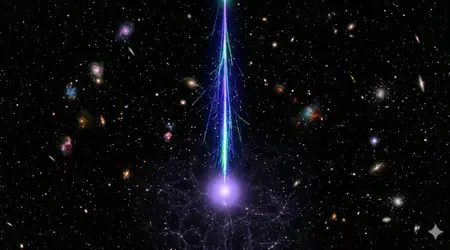
How do we detect such rare cosmic events?
Detection of the Amaterasu Particle required the Telescope Array, a massive grid of surface detectors covering hundreds of square kilometers in Utah.
When a cosmic ray hits our atmosphere, it creates a shower of secondary particles that the sensors track with precision.
By analyzing the timing and density of this particle shower, scientists can reconstruct the original energy and direction of the primary ray.
This technology allows us to “see” invisible messengers from the deepest parts of our universe without traditional telescopes.
Also read: Why Some Stars Die Quietly Without Going Supernova
What happens during a particle shower?
A single high-energy particle strikes an atmospheric atom, triggering a cascade that spreads out like an invisible umbrella over the desert floor.
This event happens in nanoseconds, requiring extremely fast electronics to record the data accurately for further scientific analysis.
These showers provide a fingerprint of the original cosmic ray’s mass and speed.
Without this indirect method, detecting a single subatomic particle in the vastness of space would be an impossible task for modern science.
Read more: Could Dark Energy Be Linked to a Force We Haven’t Discovered?
Why is the Telescope Array located in Utah?
The high altitude and clear, dry air of the Utah desert provide the perfect environment for minimizing interference with sensitive light detectors.
This isolation ensures that the signals recorded are truly cosmic in origin rather than terrestrial noise from human cities.
Vast open spaces allow the array to spread its sensors far apart, increasing the chances of catching rare, high-energy events.
The Amaterasu Particle is so rare that we might only see such an event once every few decades.
What are the implications for future physics?
Investigating the Amaterasu Particle forces us to reconsider the possibility of “New Physics” beyond the standard models currently taught in universities.
If these particles aren’t coming from known sources, they might be products of decaying dark matter or cosmic strings.
Every time we discover a limit-breaking event, we are forced to rewrite the textbooks regarding the fundamental forces of nature.
This particle isn’t just a tiny piece of matter; it is a signal that our understanding of reality is incomplete.
Could dark matter be the source?
Some theorists suggest that heavy dark matter particles might decay in the galactic halo, producing these ultra-high-energy rays without a visible source.
This would explain why the arrival direction appears empty while the energy remains so incredibly high.
If this is true, the Amaterasu Particle could be our first direct clue into the nature of the dark universe.
We are essentially looking for a ghost that leaves a very physical and energetic footprint in our atmosphere.
How does this impact our view of the universe?
The existence of such energy levels makes our sun look like a dim candle in a hurricane of cosmic power.
It reminds us that the universe is a violent, high-energy environment where the rules of the laboratory don’t always apply.
Are we simply missing the “engines” of the universe because they operate on principles we haven’t discovered yet?
This question drives the next generation of researchers to build even larger arrays and more sensitive instruments.
Record-Breaking Cosmic Ray Comparison
| Particle Name | Energy Level (EeV) | Discovery Year | Direction Source |
| Oh-My-God Particle | 320 EeV | 1991 | Unknown |
| Amaterasu Particle | 244 EeV | 2021 (Announced 2023/24) | Local Void |
| Typical Proton (LHC) | 0.000013 EeV | 2012 | Particle Accelerator |
| Solar Cosmic Ray | 0.00000001 EeV | Constant | The Sun |
| GZK Cutoff Limit | ~50 EeV | Theoretical | Boundary |
Final Reflections on the Unknown
The mystery of the Amaterasu Particle highlights how little we truly know about the high-energy frontier of our cosmos.
We have explored the way it defies the GZK limit and the strange emptiness of its origin in the Local Void. By utilizing the Telescope Array, we have captured a glimpse of a power that dwarfs anything humans can create.
This discovery is a call to action for scientists to look deeper into the “empty” spaces of our universe.
As we continue to monitor the skies in 2026, each new detection brings us closer to understanding the hidden mechanics of space.
Whether it is a product of dark matter or a flaw in our physics, this particle remains a profound cosmic messenger.
The universe is speaking to us in a language of extreme energy; we only need to keep building the ears to hear it.
Do you think the void is truly empty, or is it filled with invisible forces we have yet to name? Share your thoughts in the comments!
Common Inquiries
Is the Amaterasu Particle dangerous to humans on Earth?
No, these particles are extremely rare and collide with atmospheric atoms miles above our heads. The resulting shower of secondary particles is harmless by the time it reaches the ground level where we live.
How did the particle get its name?
It is named after the sun goddess in Japanese mythology, Amaterasu, reflecting its high energy and the Japanese leadership in the Telescope Array collaboration.
Why can’t we just use a regular telescope to see the source?
Cosmic rays are charged particles, not light, so they don’t produce a standard image. Furthermore, if the source is invisible or non-luminous, like dark matter, a traditional telescope would see nothing at all.
Could this particle be proof of aliens?
There is no evidence suggesting a technological origin. The energy levels required are so vast that they point toward extreme natural phenomena rather than artificial signals.
How many of these particles hit Earth?
Ultra-high-energy particles like this are incredibly rare, hitting a square kilometer of Earth perhaps only once every century.
