
The Enigma of Axion Stars Hidden Inside Dark Matter Halos
The Enigma of Axion Stars Hidden Inside Dark Matter Halos represents one of the most profound challenges for modern astrophysics as we navigate the year 2026.
Scientists now suspect these invisible celestial bodies act as the dense architectural anchors for the sprawling dark matter structures that dictate galactic formation.
Understanding these quantum objects requires us to look beyond traditional light-based telescopes and into the realm of ultra-light particle physics.
This cosmic detective work aims to resolve why the vast majority of our universe’s mass remains completely undetectable to the naked eye.
Cosmic Discovery Points
- Quantum Condensates: How billions of axions cluster together to form a singular, giant wave-like structure known as a Bose-Einstein Condensate.
- Gravitational Anomalies: The subtle ways these dense cores influence the rotation of stars and the bending of distant starlight.
- Radio Signatures: Potential methods for detecting axion stars when they interact with the intense magnetic fields of neutron stars.
- Galactic Evolution: The theory that these hidden cores determined where the first stars ignited after the Big Bang.
What are axion stars and how do they form?
The Enigma of Axion Stars Hidden Inside Dark Matter Halos begins with a hypothetical subatomic particle called the axion, which is incredibly light.
When these particles lose enough energy, they settle into a low-energy state, bunching together until they create a massive, stable sphere of density.
Think of an axion star as a cosmic ghost; it has mass and gravity, but light passes through it without a single ripple.
Unlike a sun made of burning gas, these stars are held together by quantum pressure, resisting the urge to collapse into black holes.
How does the Bose-Einstein Condensate work?
At extreme temperatures near absolute zero, particles lose their individual identities and begin to overlap, acting as one giant “super-atom.”
In the vacuum of space, axions perform this transition, forming a core that can be as small as a city or as large as a solar system.
This collective behavior allows the axion star to maintain a perfectly spherical shape despite being made of nearly weightless components.
It is this unique quantum stability that allows them to hide so effectively within the much larger, diffuse clouds of dark matter.
++ The Puzzle of Galactic Gamma-Ray Excess at the Milky Way Core
Why do they prefer the centers of halos?
Gravity naturally pulls the densest materials toward the center of a system, much like how sediment settles at the bottom of a lake.
Dark matter halos provide the gravitational well where these axions can congregate and eventually condense into their stellar form.
By sitting at the very heart of a galaxy, these stars act as a “gravitational anchor” for visible matter.
Could it be that the very existence of our Milky Way was dictated by a hidden quantum heart we cannot see?
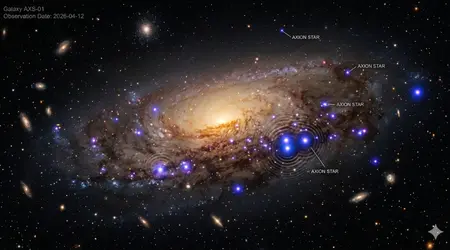
Why is it so difficult to detect these invisible giants?
Researchers struggling with the Enigma of Axion Stars Hidden Inside Dark Matter Halos face the problem that axions do not reflect or emit photons.
We are essentially trying to map the wind by watching how the trees move, looking for gravitational “wobbles” in visible star clusters.
Current missions in 2026 utilize gravitational lensing, where astronomers observe the way an invisible mass warps the light from a galaxy behind it.
If a “clump” is too dense to be a standard gas cloud, it becomes a prime candidate for an axion star.
Also read: Why the Universe Keeps Producing Anomalies We Can’t Classify
What role do neutron stars play in detection?
When a hidden axion star passes through the powerful magnetic field of a rotating neutron star, it may convert into detectable radio waves.
This rare interaction, known as the Primakoff effect, creates a specific frequency “glow” that tells us an axion core is present.
Radio telescopes across the globe are currently scanning for these fleeting signals, hoping to catch the exact moment of conversion.
These bursts of energy are our only direct window into a world that usually remains completely silent and dark.
Read more: How Can We Be Sure the Universe Is Only Four Dimensions?
How does the “Clumpy” dark matter theory help?
Recent simulations suggest that dark matter isn’t a smooth fog, but rather a “clumpy” soup filled with these dense axion nodules.
By studying the precise orbits of satellites around our galaxy, we can find areas where extra mass seems to be tugging on their paths.
Data from the Gaia mission suggests that several “invisible disturbances” exist in our local neighborhood, pointing toward nearby axion concentrations.
Each small gravitational tug provides another piece of the puzzle, slowly revealing the invisible architecture of the local cosmos.
How do these stars impact the future of physics?
Solving the Enigma of Axion Stars Hidden Inside Dark Matter Halos would finally bridge the gap between quantum mechanics and general relativity.
If axions exist, they prove that the universe is made of a “dark sector” that obeys entirely different rules than the atoms we know.
According to a study published in Nature Astronomy in late 2025, the presence of axion stars could explain why some dwarf galaxies lack traditional centers.
These findings suggest that dark matter is much more active and dynamic than we previously assumed in our theoretical models.
Why is the mass of the axion so important?
The weight of a single axion determines how large or small an axion star can actually become before it becomes unstable.
If the particle is too heavy, the star would collapse; if it is too light, it would simply evaporate into space.
Finding the exact “sweet spot” for this mass allows physicists to rule out other dark matter candidates, like WIMPs (Weakly Interacting Massive Particles).
This narrowing of the field is essential for building the next generation of particle detectors in laboratories deep underground.
What is the “Exploding” axion star theory?
Under certain conditions, an axion star might reach a critical mass and undergo a “Bosenova,” a quantum explosion that releases a burst of energy.
Unlike a supernova, this event would be invisible to optical telescopes but would create a massive ripple in the fabric of spacetime.
Detecting these ripples with gravitational wave observatories could provide the “smoking gun” evidence for the axion’s existence.
Is the universe’s background noise actually the sound of invisible stars collapsing and reforming in the dark?
Comparison of Dark Matter Candidates (2026 Status)
| Feature | Axion Stars | WIMPs | Primordial Black Holes |
| Detection Method | Radio conversion/Lensing | Underground detectors | Microlensing events |
| Mass Range | Ultra-light (sub-eV) | Heavy (GeV to TeV) | Planetary to Stellar mass |
| Structure | Quantum Condensate | Particle Cloud | Singular Point Mass |
| Stability | Depends on Axion mass | Highly stable | Evaporates via Hawking radiation |
| Cosmic Abundance | High (Predicted) | Unconfirmed | Low (Limited by data) |
Mapping the Invisible Sky
We have explored how the Enigma of Axion Stars Hidden Inside Dark Matter Halos challenges our understanding of the very fabric of space and time.
These quantum giants hide in plain sight, using gravity as their only language while remaining silent to our traditional sensors.
By combining radio astronomy with the study of neutron star magnets, we are finally beginning to see the shadows of these invisible neighbors.
The discovery of even one axion star would revolutionize our view of the Big Bang and the ultimate fate of the universe.
We are no longer just looking at the stars; we are learning to see the darkness between them.
Do you believe that the most important parts of our universe will always remain invisible to the human eye? Share your experience in the comments!
Frequent Questions
Can an axion star turn into a black hole?
Yes, if an axion star accumulates enough mass through mergers or by attracting nearby dark matter, it can exceed its stable limit.
At this point, quantum pressure fails, and the entire structure collapses into a traditional black hole, releasing a distinct gravitational wave signal.
Is our sun surrounded by axion stars?
While the sun sits within a large dark matter halo, axion stars are typically much smaller and would likely be scattered throughout the galaxy.
It is possible that a small axion core exists within our solar system, but its gravitational pull would be too faint to notice easily.
What is the difference between a WIMP and an Axion?
WIMPs are heavy particles that act like tiny billiard balls, while axions are ultra-light and act more like a continuous, flowing fluid.
The Enigma of Axion Stars Hidden Inside Dark Matter Halos is unique to axions because only they can “condense” into a single quantum object.
How long does an axion star last?
Most axion stars are theoretically stable for longer than the current age of the universe, provided they don’t interact with other massive objects.
They do not “burn out” like our sun because they do not rely on nuclear fusion for their internal support.
Can we harvest energy from an axion star?
In 2026, this remains purely in the realm of science fiction, as we haven’t even confirmed their existence with 100% certainty yet.
However, the theoretical energy density within an axion star is immense, which fascinates physicists looking at the extreme limits of energy conversion.
