
How Ultra-Energetic Cosmic Rays Travel Across Empty Space
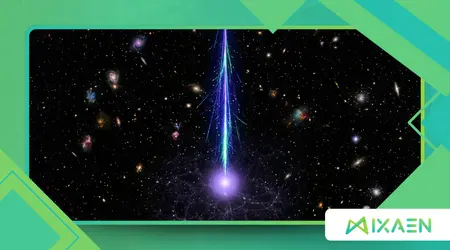
Ultra-Energetic Cosmic Rays represent the most profound challenge to our understanding of the universe, carrying kinetic energy that defies conventional laws of physics.
These invisible messengers travel across the vast, lonely stretches of intergalactic space, reaching Earth with the impact of a fast-pitched baseball packed into a single subatomic particle.
Scientists remain baffled by how these particles maintain such velocity without losing energy to the cosmic microwave background.
Every detection provides a snapshot of high-energy processes occurring millions of light-years away. Can we truly comprehend the sheer power required to launch these projectiles across the dark, cold vacuum of the cosmos?
Navigation of the Cosmic Void
- Origin Points: Investigating the colossal celestial engines, such as active galactic nuclei and black holes, that propel these mysterious particles toward our galaxy.
- The GZK Limit: Analyzing why energy loss should stop these rays and how they manage to bypass these theoretical barriers against all odds.
- Detection Methods: Examining how the Pierre Auger Observatory and Telescope Array utilize Earth’s atmosphere to catch these fleeting, high-energy intergalactic travelers.
- Future Research: Exploring how upcoming satellite missions in 2026 aim to pinpoint the specific coordinates of these violent, high-energy cosmic events.
What powers these messengers across the universe?
Deep within distant galaxies, massive black holes act as cosmic slingshots for Ultra-Energetic Cosmic Rays, accelerating them to nearly the speed of light.
These regions generate magnetic fields so intense that they can bend the path of protons and nuclei before flinging them into the void.
Astrophysicists argue that only the most violent events, like the birth of a black hole, can produce such extremes.
This process turns the empty space between galaxies into a high-stakes highway for particles that shouldn’t logically survive the journey.
Do active galactic nuclei drive them?
Supermassive black holes at the center of active galaxies emit powerful jets of plasma that stretch across thousands of light-years.
These jets serve as the primary candidates for the birthplaces of Ultra-Energetic Cosmic Rays, providing the necessary acceleration distance.
Magnetic turbulence within these jets boosts particle energy to levels billions of times higher than the Large Hadron Collider.
This localized chaos creates a launchpad for particles that will eventually cross the vast emptiness to reach our detectors.
++ The Enigma of Axion Stars Hidden Inside Dark Matter Halos
Can gamma-ray bursts be the cause?
Gamma-ray bursts release more energy in seconds than our sun will in its entire ten-billion-year lifespan.
These cataclysmic explosions create shockwaves that might also generate Ultra-Energetic Cosmic Rays, sending them screaming through the intergalactic medium.
If a burst occurs in a nearby galaxy, we might see a sudden influx of these particles. Such events provide a rare opportunity to study the mechanics of extreme acceleration in real-time across the vast cosmic distance.
How do they survive the intergalactic journey?
Intergalactic space is not truly empty, but filled with a faint glow of radiation called the cosmic microwave background.
Ultra-Energetic Cosmic Rays constantly collide with these photons, a process that should theoretically drain their energy over long distances.
This phenomenon, known as the GZK cutoff, suggests we should never see particles with energies above a certain threshold from distant sources.
Yet, we keep detecting them, implying that their sources are closer than we ever dared to imagine.
Also read: The Mystery of Objects That Appear Older Than the Universe
Is the GZK limit truly a barrier?
The GZK limit acts like a cosmic speed bump that slows down high-energy particles as they interact with ancient light.
For Ultra-Energetic Cosmic Rays, this interaction usually results in the production of pions, which saps the particle’s momentum.
However, recent data from the Pierre Auger Observatory in 2026 indicates a slight deviation in these energy patterns.
This suggests either a flaw in our particle physics models or a hidden local source for these rays.
Read more: Why the Universe Keeps Producing Anomalies We Can’t Classify
Does the vacuum offer any protection?
A vacuum provides very few obstacles, allowing these rays to travel in nearly straight lines across millions of light-years.
Small magnetic fields in deep space can slightly deflect Ultra-Energetic Cosmic Rays, making it difficult to trace them back.
Think of these particles as bullets fired through a foggy forest; the fog is the radiation, and the trees are the magnetic fields. The fact they arrive at all proves their initial energy was truly mind-boggling.
Why are these rays hitting Earth now?
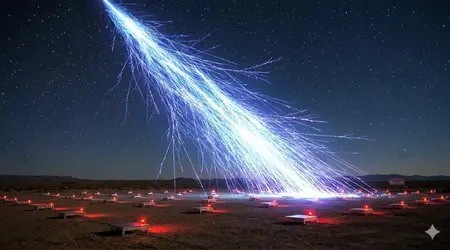
Our atmosphere acts as a giant detection screen, where a single incoming particle triggers a massive cascade of secondary debris.
In late 2025, researchers identified a record-breaking event nicknamed “The Amaterasu Particle,” which arrived from a seemingly empty region of space.
This discovery highlights that Ultra-Energetic Cosmic Rays may originate from “voids” where we see no visible galaxies or stars.
This raises the haunting question: are there invisible structures in the universe capable of producing such terrifying power?
How does the Pierre Auger Observatory work?
The Pierre Auger Observatory uses 1,600 water tanks spread across the Argentine pampa to catch the “showering” effect of these rays.
When Ultra-Energetic Cosmic Rays hit air molecules, they create billions of secondary particles that the tanks detect via light flashes.
This network allows scientists to reconstruct the energy and direction of the original particle with incredible precision.
By analyzing these showers, we can determine if the original ray was a simple proton or a heavier iron nucleus.
What is the significance of the 2026 data?
Newly calibrated sensors in 2026 have confirmed that the arrival directions of these particles correlate with specific star-forming galaxies.
This suggests that Ultra-Energetic Cosmic Rays are not just random noise, but signatures of intense stellar birth and death.
Understanding these patterns helps us map the magnetic “weather” of the universe. It turns our planet into a massive telescope, looking at the most energetic corners of existence through the lens of a single particle.
Cosmic Ray Energy Comparison
| Particle Source | Energy Level (eV) | Velocity (% of c) | Origin |
| Solar Wind | 10 to 100 | 0.002% | The Sun |
| Large Hadron Collider | 6.5 Trillion | 99.9999991% | Human Made |
| Galactic Cosmic Rays | 1 Billion to 10 PeV | 99.9% | Milky Way Supernovae |
| Ultra-Energetic Cosmic Rays | Above 10^18 | 99.9999999999% | Extragalactic / Voids |
Final Thoughts on the Intergalactic Mystery
The study of these rays forces us to confront the limits of human technology and theoretical physics.
As we track these particles through the void, we realize that the universe operates on a scale far beyond our daily experience.
These rays are more than just radiation; they are the last echoes of the most violent events in the history of the cosmos.
If we can solve the mystery of their origin, we might unlock new ways to understand gravity, magnetism, and the fabric of space-time itself.
The journey of a single particle across the dark reflects our own quest for knowledge in an infinite, often silent universe. We are finally beginning to hear what the deep space is trying to tell us.
What do you think lies in the “voids” that could launch such energy toward us? Share your experience or theories in the comments below, and let’s discuss these cosmic anomalies together!
Frequently Asked Questions
Are cosmic rays dangerous to humans on Earth?
No, because our thick atmosphere and magnetic field deflect or absorb the vast majority of this radiation before it reaches the ground.
However, they do pose a significant risk to astronauts in deep space or on the moon who lack this natural protection.
Can we see cosmic rays with the naked eye?
Usually, no, but astronauts have reported seeing “flashes” of light when cosmic rays pass through their eyeballs.
On Earth, we only see the effects through sophisticated detectors that capture the secondary particles produced in the atmosphere.
Why is it called the Amaterasu Particle?
It was named after the sun goddess in Japanese mythology because it is one of the most energetic particles ever detected in human history.
Its origin remains one of the greatest mysteries in modern astrophysics as of 2026.
Do cosmic rays affect our electronic devices?
Yes, they can occasionally cause “bit flips” in computer memory, leading to minor software glitches or system crashes.
Engineers design critical systems, especially in satellites and airplanes, with special shielding to prevent these cosmic-induced errors.
Will we ever find the exact source of these rays?
With the expansion of the Telescope Array and the Pierre Auger Observatory, we are getting closer every day.
The goal is to eventually create a “map” of the high-energy universe, much like we have for visible light and radio waves.
