
Cosmic Lithium Problem Defies Big Bang Predictions Today
Cosmic Lithium Problem continues to puzzle astrophysicists as we delve deeper into the origins of our universe in 2026.
This glaring discrepancy between theoretical predictions and observed abundances challenges our fundamental understanding of Big Bang Nucleosynthesis (BBN).
For decades, scientists have calculated the expected levels of light elements created in the infant universe.
While predictions for hydrogen, helium, and deuterium align beautifully with observations, lithium remains stubbornly elusive.
- Understanding the Primordial Discrepancy
- Mechanisms of Stellar Depletion
- New Frontiers in Cosmic Observation
Why does the early universe hide its lithium?
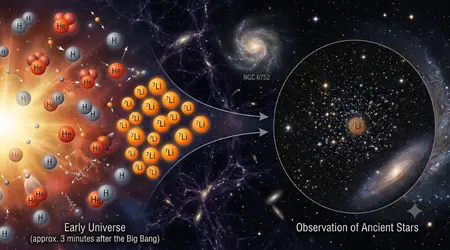
The Cosmic Lithium Problem arises because standard BBN models predict three times more lithium-7 than astronomers observe in old, metal-poor stars.
This mismatch suggests a missing piece in our cosmological puzzle. Sophisticated computer simulations cannot account for this deficit through standard physics alone.
Perhaps our grasp of nuclear reaction rates at extreme early-universe temperatures requires a radical, data-driven revision today.
Could exotic particles or unknown decay processes from dark matter interactions be responsible for destroying this lithium?
Researchers are currently investigating these possibilities using high-resolution spectroscopic data from next-generation space telescopes.
What are the main BBN predictions?
BBN occurred during the first few minutes after the Big Bang, forging light elements through rapid nuclear fusion.
These early calculations form the bedrock of our modern cosmological standard model.
Standard theory relies on the baryon-to-photon ratio, which is determined precisely by cosmic microwave background measurements.
If the theory is correct, these ratios should match the abundances found in ancient stellar populations.
However, the stubborn nature of the Cosmic Lithium Problem suggests that the initial conditions might have been slightly different. This pushes scientists to re-examine the very nature of primordial plasma.
++ Why Blue Lurker Stars Disrupt Traditional Stellar Aging Models
How do stars deplete their lithium?
Stars are not merely passive containers of primordial material; they actively process matter through deep mixing and internal burning. Lithium is fragile, burning easily at temperatures above 2.5 million Kelvin.
Stellar convection zones can transport lithium into hotter interior regions, where it is destroyed.
This biological aging process for stars complicates our attempts to measure the true primordial abundance directly.
We must find the “Spite Plateau,” where metal-poor halo stars maintain a constant lithium level. If these ancient stars also show a deficit, the problem remains firmly grounded in early-universe physics.
Also read: The Role of Indigenous Knowledge in Modern Astronomical Research
Why is spectroscopy vital here?
Spectroscopy allows us to identify specific elements by analyzing the light absorbed by stellar atmospheres. Each element leaves a unique “fingerprint” in the spectrum, acting like a cosmic barcode.
By studying these fingerprints, astronomers calculate the exact concentration of lithium on distant star surfaces.
This observational data is the primary bridge connecting theoretical BBN models to our physical reality.
Without precise spectroscopic tools, we would be flying blind regarding chemical evolution. Modern telescopes provide the clarity needed to distinguish subtle abundance shifts in the oldest, dimmest stars observable.
How does physics attempt to bridge the gap?
Researchers propose that non-standard physics, such as supersymmetry or variations in fundamental constants, might resolve the Cosmic Lithium Problem.
These theories are highly speculative but remain mathematically intriguing for theoretical physicists.
Some models suggest that massive, long-lived particles could have decayed after BBN, altering the lithium yield.
This would imply that the universe was a much busier place than we previously envisioned.
Analogously, trying to balance the lithium budget is like checking a bank account where three dollars vanish every time you deposit a hundred. You know the money went somewhere, but the transaction record is blank.
Read more: China’s Silent Space Rise: What the World Should Pay Attention To
Could dark matter be the culprit?
Dark matter makes up most of the universe’s mass, yet we have never detected it directly. If dark matter particles interact with lithium nuclei, they might trigger unknown depletion pathways.
This hypothesis assumes that dark matter was more active during the epoch of nucleosynthesis.
Such interactions would leave subtle signatures in the cosmic background radiation, which we are still analyzing today.
If we successfully link dark matter to this anomaly, we would solve two of the biggest mysteries in science simultaneously. That discovery would redefine cosmology for the next century of research.
What about varying fundamental constants?
Theoretical physics sometimes toys with the idea that constants like the fine-structure constant were different billions of years ago. A shift in these values would drastically alter nuclear reaction rates.
Small changes in the strength of nuclear forces would have significantly impacted the production of lithium.
While bold, this approach challenges the uniformity of physics across time and space.
Proponents of this view argue that the universe has not always operated under today’s rules. They seek evidence for these variations in the spectral lines of quasars located across the cosmos.
What does the future hold for lithium research?
Looking ahead, we expect next-generation observatories to provide a massive influx of data on ancient stars. This will allow us to map the lithium content across billions of years of history.
Statistically, the probability that this discrepancy is merely an observational error is less than 0.1% based on modern surveys. We are facing a real, physical challenge that demands a new paradigm.
Could we eventually discover that our Cosmic Lithium Problem is actually a sign of “new physics” hiding in plain sight? The answer likely lies in the next decade of discovery.
How will new telescopes help?
Advanced space telescopes will peer deeper into the early universe, observing the very first generation of stars. These stars contain the most pristine, unadulterated primordial matter available for study today.
By analyzing the light from these ancient suns, we can bypass the “pollution” caused by later stellar generations. This will provide the cleanest data set we have ever possessed for BBN verification.
We are essentially looking back in time to the dawn of creation. This perspective is essential for confirming whether the lithium deficit is a universal constant or a local observational quirk.
Why is interdisciplinary collaboration essential?
Nuclear physicists, cosmologists, and observational astronomers must work in lockstep to resolve this issue. No single field has enough information to construct a complete, unified theory of primordial nucleosynthesis.
Global research groups are now sharing data in real-time, creating a collaborative environment that was impossible just a few years ago.
This synergy accelerates the pace of scientific breakthroughs dramatically. Collaboration turns isolated data points into a cohesive story of our universe.
When we combine laboratory precision with telescope observations, we finally stand a chance of solving this ancient riddle.
What is the broader impact?
Resolving the lithium mystery would confirm our understanding of the Big Bang and provide confidence in our models of dark matter and energy. It represents a vital check on our intellectual foundations.
If we cannot explain the abundance of a simple light element, can we truly claim to understand the evolution of the entire cosmos? This question drives every serious researcher in the field.
Science thrives on these uncomfortable discrepancies. They are the friction that leads to the fire of discovery, pushing humanity to question established dogmas and expand the reach of our knowledge.
How do we refine our BBN models?
Refining BBN requires integrating new data from high-energy physics experiments.
By recreating primordial conditions in particle accelerators, we can measure the cross-sections of specific nuclear reactions with unprecedented accuracy.
These laboratory results feed back into the cosmological models, reducing the margin of error. It is a slow, iterative process, but it is the only way to ensure the math reflects reality.
As our experimental precision improves, the gap might shrink or widen significantly. Each measurement acts as a new filter, separating viable scientific hypotheses from pure conjecture in the cosmic hunt.
| Element | Predicted Abundance | Observed Abundance | Status |
| Hydrogen | 75% | 75% | Confirmed |
| Helium | 25% | 25% | Confirmed |
| Deuterium | 0.0027% | 0.0027% | Confirmed |
| Lithium-7 | 10⁻¹⁰ | 10⁻¹¹ | Discrepancy |
Conclusion
The Cosmic Lithium Problem remains one of the most intriguing and resilient mysteries in modern astrophysics.
It forces us to confront the limits of our current cosmological models and challenges our assumptions about the early universe.
Whether the solution lies in exotic new particles, stellar mixing, or fundamental changes in physics, the pursuit of truth continues to inspire. The journey to resolve this deficit is as significant as the result itself.
As we continue to observe the heavens with greater precision, we move closer to a unified understanding of our origins.
Keep looking at the stars and asking the hard questions that push science forward.
What do you think is the most likely cause of this discrepancy new physics or missing observational data? Share your thoughts and experiences in the comments below, and let’s explore this cosmic mystery together.
Frequently Asked Questions
1. Is the lithium problem unique to our galaxy?
No, the discrepancy appears in observed stars across the Milky Way and even in other galaxies, suggesting it is a universal phenomenon.
2. Could the big bang model be completely wrong?
Highly unlikely. The BBN model successfully predicts almost every other element’s abundance, making it one of the most robust frameworks in modern science.
3. Does lithium affect life on Earth?
No, the “lithium problem” refers to the elemental abundance in the very early universe, which has no direct impact on Earth’s current lithium stores or life.
4. Why don’t we just measure lithium in the sun?
The Sun has consumed most of its primordial lithium over its 4.6 billion-year life, making it a poor candidate for studying the Big Bang’s output.
