
Why Blue Lurker Stars Disrupt Traditional Stellar Aging Models

Blue Lurker Stars challenge the fundamental principles of stellar evolution, forcing astrophysicists to rewrite baseline timelines for cosmic cluster decay.
These bizarre objects look perfectly normal on standard Hertzsprung-Russell diagrams but hide a chaotic history of stellar theft.
Observing ancient star groups reveals a profound anomaly where specific stellar bodies appear younger than their actual surrounding environments.
Recent deep-space spectroscopic observations show that these stellar anomalies maintain hyper-velocity rotation rates that completely contradict traditional nuclear fuel consumption mathematics.
Inside This Analysis
- The Illusion of Youth in Old Clusters
- Mechanisms behind Stellar Rejuvenation
- How Observational Anomalies Rewrite Astronomy
- Frequently Asked Questions
Why Do These Cosmic Anomalies Defy Standard Astronomical Timelines?
Standard stellar models dictate that stars of identical age within a closed cluster must mature at a predictable, uniform rate.
Mass determines a star’s ultimate lifespan, with heavier objects burning through their internal hydrogen reserves much faster than smaller entities.
How can a single star look energetic and vibrant while its precise biological siblings have already decayed into cold white dwarfs?
This profound paradox shatters the traditional assumption that star clusters represent simple, isolated populations growing old in perfect lockstep.
A landmark study published by the Gaia data consortium revealed that nearly 10% of old open clusters contain stellar anomalies.
This statistical reality confirms that traditional modeling fails to account for hidden kinetic interactions that artificially alter visible stellar profiles.
Astronomers cataloging these phenomena realized that Blue Lurker Stars deliberately hide their advanced chronological age by maintaining low-intensity magnetic profiles.
This clever cosmic camouflage allows them to blend in seamlessly with younger stellar generations, distorting deep-space distance calculations.
What Is the Core Paradox of Disproportionate Rejuvenation?
The core paradox centers on thermal output mismatch where an object displays extreme blue ultraviolet signatures inside ancient galactic structures.
According to established astrophysics, these intense energetic wavelengths should have disappeared from the target cluster billions of years ago.
Instead, these stellar entities remain brilliantly illuminated, mimicking the physical characteristics of newborn hot stars while sitting in cosmic graveyards.
This structural inconsistency proves that our current understanding of thermodynamic decay in closed systems remains dangerously incomplete.
++ Why Artemis II Mission Signals a New Era of Lunar Exploration
How Do Chromospheric Features Mask True Stellar Maturity?
A star’s outer atmospheric layer often acts as a deceptive veil, hiding internal chemical compositions from standard optical telescope sweeps.
These anomalies possess outer envelopes enriched with fresh hydrogen, giving the illusion of a pristine, unburned core structure.
Spectroscopic analysis must look beneath this outer layer to evaluate actual core helium density and rotational velocity variations accurately.
Relying solely on surface coloration leads to massive errors when determining the true chronological age of distant star groups.
Also read: The Role of Indigenous Knowledge in Modern Astronomical Research
Why Do Closed Star Clusters Violate Uniform Aging Principles?
Closed star clusters were long considered perfect cosmic laboratories because their constituent bodies all condensed from the same molecular cloud.
This shared origin implies identical chemical baselines, making any sudden divergence in lifecycle progression highly anomalous for researchers.
The presence of rejuvenated stars proves that localized environments experience dramatic dynamic disturbances long after the initial formation phase.
Internal kinetic energy distribution within these clusters is far more chaotic than early mathematical simulations ever anticipated.
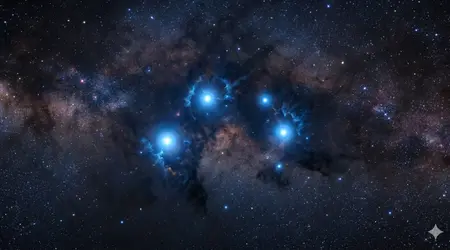
What Precise Structural Mechanisms Drive This Deceptive Stellar Youth?
The secret to this unnatural longevity lies in binary system mechanics, where a smaller star actively cannibalizes its aging companion.
This process of mass transfer injects fresh hydrogen into the predator star, reigniting its core nuclear furnace unexpectedly.
This structural feeding frenzy creates a rejuvenated object that looks young but contains an ancient, highly dense core structure. The donor star eventually shrinks into an obscured white dwarf, leaving the predator looking entirely isolated to distant observers.
Because the thief star gains mass without increasing its core age, Blue Lurker Stars disrupt traditional models by skipping normal evolutionary steps.
This unique mass-gaining trajectory creates a separate class of stellar bodies that require entirely distinct evolutionary tracking systems.
Read more: China’s Silent Space Rise: What the World Should Pay Attention To
How Does Binary Mass Transfer Trigger Core Reignition?
When an aging star expands into its red giant phase, its outer layers cross the gravitational threshold known as the Roche lobe. The smaller companion star rapidly vacuums up this loose plasma, pulling millions of tons of fresh fuel into its own gravity well.
This sudden influx of matter increases core pressure, accelerating hydrogen fusion rates and shifting the star’s color spectrum toward intense blue.
The star essentially receives a massive cosmic blood transfusion that masks its true historical timeline from earthbound observers.
What Role Does Tidal Synchronization Play in Star Deception?
As the two binary components orbit closely, intense gravitational tidal forces lock their rotation periods into a synchronized cosmic dance.
This tidal locking channels kinetic energy into the predator’s core, altering normal magnetic braking mechanisms that slow down older stars.
Maintaining high rotation speeds allows the star to mix its internal elements more efficiently than isolated, solitary stellar bodies. This continuous internal churning ensures a steady supply of fuel to the core, prolonging the deceptive youthful phase.
How Do Stellar Collisions Produce Identical Spectral Signatures?
In ultra-dense cluster cores, stars occasionally collide directly rather than slowly exchanging mass over millions of fiscal cosmic cycles.
These violent impacts merge two distinct masses into a single, highly turbulent entity possessing immense thermal energy reserves.
The resulting hyper-dense object burns with the exact same blue intensity as a standard binary mass thief, further complicating demographic surveys.
Disentangling collision products from slow mass-transfer systems requires advanced gravitational wave detection models.
How Are Specialized Observation Methods Exposing These Camouflaged Objects?
Exposing these stellar actors requires analyzing specific chemical signatures, like anomalous barium or carbon abundances, left by the consumed companion.
Standard telescopes cannot easily detect these subtle chemical fingerprints, requiring the use of high-resolution ultraviolet spectrographs instead.
As researchers refine these detection techniques, they discover that Blue Lurker Stars are far more common than previously estimated. This realization forces a complete re-evaluation of how we measure the structural lifespan of entire star clusters.
Incorrectly estimating cluster age distorts our broader understanding of galactic evolution timelines and dark matter distribution models.
Accurately identifying these cosmic anomalies is essential for maintaining the absolute integrity of our modern cosmological frameworks.
What Spectral Biomarkers Reveal Hidden Vampire Behavior?
The most effective way to identify a stellar thief is searching for excessive lithium, barium, or carbon-14 isotopes on its surface.
These heavy elements are forged deep inside older stars and could only appear on a smaller star via direct atmospheric contamination.
Detecting these specific atomic signatures provides undeniable proof that the target star has engaged in destructive mass-vampirism.
This chemical forensics approach allows astronomers to confidently separate naturally young stars from ancient, rejuvenated impostors.
How Does High-Resolution Ultraviolet Spectroscopy Change the Game?
Ultraviolet spectroscopy allows researchers to isolate the incredibly hot signatures produced by the tiny, dying companion stars hidden in orbit.
Because these white dwarf remnants glow intensely in the UV spectrum, they instantly betray the primary star’s dual nature.
Ground-based optical telescopes miss these faint signals due to atmospheric distortion, making space-based observatories absolutely vital for accurate identification. This specialized technology has successfully unmasked thousands of cosmic impostors across our home galaxy.
Why Must Distance Calculation Models Adjust for Stellar Anomalies?
Cosmologists use star clusters as reliable distance markers because their predictable light output helps calculate vast interstellar gaps accurately.
If a cluster contains hidden, hyper-bright rejuvenated stars, the entire structure appears closer to Earth than it actually is.
Correcting for this luminous distortion requires rewriting the baseline algorithms used to map the expansion rate of our universe. Eliminating these measurement errors ensures that our global maps of deep space remain structurally sound and reliable.
Mapping Stellar Disruption Frameworks
The comprehensive data grid below differentiates standard stellar lifecycle pathways from the anomalous progression observed in rejuvenated systems.
Recognizing these distinct operational metrics allows astrophysicists to categorize Blue Lurker Stars without compromising broader cluster dating methodologies.
| Evolution Metric | Standard Solitary Star Lifecycle | Blue Lurker Star Lifecycle Framework |
| Fuel Sourcing | Internal primordial hydrogen reserves | External mass acquisition via binary cannibalism |
| Rotational Profile | Gradually slows down via magnetic braking | Sustains high velocity through tidal synchronization |
| Core Composition | Linear accumulation of inert helium ash | Stratified core mixing driven by structural mergers |
| Spectral Appearance | Shifts predictably from blue to red over time | Reverts back to vibrant blue wavelengths mid-life |
Paradigm Shifts in Stellar Chronology
Unraveling the mystery of these deceptive stellar bodies proves that cosmic aging is far more fluid than early models suggested.
The discovery of Blue Lurker Stars forces modern astronomy to abandon rigid, isolated lifecycle tracking in favor of dynamic, interaction-based models.
By identifying the hidden mechanisms of stellar rejuvenation, scientists protect the absolute veracity of broader galactic evolution timelines.
Adapting our astronomical frameworks ensures that our journey into the cosmic unknown remains grounded in true empirical fact. Share your experience in the comments below to join this fascinating scientific exploration.
Frequently Asked Questions
Are blue lurkers the same as blue stragglers?
They share similar binary mass-transfer origins, but blue lurkers maintain much lower magnetic profiles, making them harder to detect using standard telescopes.
How common are these rejuvenated stars in our galaxy?
Recent high-resolution space surveys indicate that approximately 10% of stars in older open clusters display signs of deceptive mass rejuvenation.
Can our Sun ever transform into an anomalous blue star?
No, our Sun is a solitary star lacking a close binary companion, meaning it cannot cannibalize external mass to alter its lifecycle.
