
Why Hypervelocity Stars Escape Galaxies at Impossible Speeds
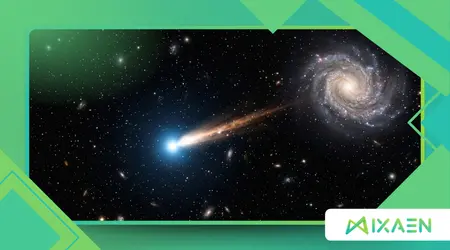
Hypervelocity Stars represent one of the most staggering kinetic anomalies ever documented by modern astrophysicists within our expanding universe.
These cosmic outcasts move at such extreme velocities that they actively break free from the intense gravitational clutches of their parent galaxies.
As astronomical data streams continuously update our sky surveys in 2026, instruments like the Gaia space observatory reveal fresh details about these stellar runaways.
Understanding how a massive celestial body achieves such staggering momentum requires examining violent cosmic interactions that stretch our understanding of physics.
Key Takeaways
- Extreme Velocity: These stellar anomalies travel at speeds exceeding 1 to 2 million miles per hour.
- The Slingshot Effect: Ultimate propulsion typically happens during near-miss encounters with supermassive black holes.
- Intergalactic Travelers: These objects are destined to spend eternity crossing the lonely, dark voids between distant galaxies.
What Triggers the Eviction of a Star from its Galaxy?
How Does the Hills Mechanism Exploit Binary Systems?
Most stars in the cosmos travel in pairs, locked in a permanent orbital dance around a shared center of mass.
When one of these binary systems drifts too close to a supermassive black hole, intense gravitational tidal forces violently tear the stellar partners apart.
One stellar companion inevitably loses its orbital energy, plunging directly into the gravitational abyss of the black hole’s event horizon.
Consequently, the remaining partner absorbs that excess kinetic energy, getting thrown outward like a stone fired from a high-velocity slingshot.
Why Does Sagittarius A* Act as a Cosmic Particle Accelerator?
The supermassive black hole at the center of the Milky Way, Sagittarius A*, serves as the primary engine for these extreme stellar evictions.
Its immense gravitational field accelerates nearby matter to relativistic speeds, creating a chaotic environment where orbital paths twist violently.
Imagine a spinning playground roundabout rotating at blistering speeds; trying to grab it can suddenly fling you across the park with incredible force.
That violent playground physics mirrors the raw gravitational mechanics reshaping our core galactic neighborhood.
++ Cosmic Lithium Problem Defies Big Bang Predictions Today
What Role Do Supernova Explosions Play in Secondary Kickbacks?
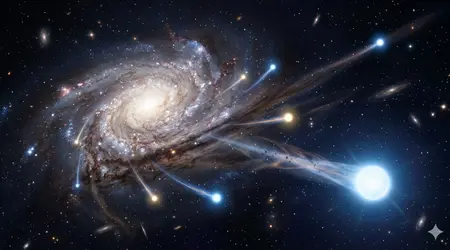
Not all cosmic outcasts owe their incredible speed to a close encounter with a central supermassive black hole.
If a tight binary pairing contains an unstable star that suddenly undergoes a asymmetric supernova explosion, the companion experiences a massive physical jolt.
The surviving stellar body inherits the orbital velocity it possessed during the tight pairing, amplified by the explosive force of the detonation.
While these runaways rarely match the speed of black hole evictions, they still attain enough velocity to cross immense structural galactic thresholds.
How Do Astronomers Identify and Track These Celestial Outcasts?
How Does Gaia Space Observatory Data Transform Stellar Tracking?
The European Space Agency’s ongoing Gaia mission provides astrometric data that allows scientists to track stellar movements with unprecedented precision.
By measuring precise tridimensional velocities, researchers isolate specific trajectories that point directly backward to our energetic galactic core.
Astronomers filter out normal halo objects to pinpoint true hypervelocity stars, map out their exact flight paths, and calculate their escape trajectories.
These continuous data streams allow real-time modeling of stellar kinematics, reshaping how we study the outermost boundaries of the Milky Way.
Also read: Why Extreme Magnetar Flares Produce Unusual Gamma-Ray Signals
Why Does High-Resolution Spectroscopy Reveal Stellar Chemistry?
Spectroscopic analysis allows astrophysicists to break down the light profiles of these speeding objects to determine their true structural origins.
A star ejected from the galactic center will display a high concentration of heavy metals, matching the chemical signature of the core.
Finding a young, metal-rich star traveling at extreme speeds through the ancient, metal-poor outer halo confirms an exotic, energetic origin story.
These chemical fingerprints prevent researchers from confusing real intergalactic travelers with old, fast-moving native halo stars.
Read more: Why Blue Lurker Stars Disrupt Traditional Stellar Aging Models
What Can We Learn From Travel Times Across Galactic Arms?
Calculating the velocity and current position of an object allows scientists to reliably back-date the exact moment of its stellar eviction.
This mathematical timeline reveals historical periods of heightened activity around our central supermassive black hole millions of years ago.
For instance, identifying a cluster of hypervelocity stars with identical flight timelines suggests a massive structural disruption occurred in the past.
This forensic astronomy helps map the historical behavior of a black hole that otherwise remains dark, quiet, and hidden from view.
What Is the Ultimate Fate of Intergalactic Runaways?
Why Is Overcoming Dark Matter Halos an Incredible Feat?
Galaxies remain bound together by massive, invisible cocoons of dark matter that exert an immense gravitational pull on everything inside.
Escaping a galaxy requires a star to possess enough kinetic energy to completely overcome this invisible, heavy structural drag.
Most stellar objects lack the speed required to pierce this hidden barrier, remaining perpetually trapped within the local galactic ecosystem.
True hypervelocity stars possess the overwhelming momentum necessary to slice through this dark matter envelope, heading toward absolute cosmic freedom.
How Does the Intergalactic Void Alter Stellar Evolution?
Once an object clears the outermost fringes of its home galaxy, it enters the completely barren, cold expanses of intergalactic space.
Deprived of the protective galactic magnetic fields and gas clouds, the star travels completely isolated through the deep cosmic dark.
This lonely journey does not alter the internal nuclear fusion processing occurring safely deep within the core of the star.
It will continue burning its hydrogen fuel predictably, shining brightly in total isolation while its home galaxy fades into a distant blur.
What Happens When These Wandering Stars Approach Other Galaxies?
After traveling across millions of light-years of empty space, an isolated star can eventually stumble into the gravitational field of a neighboring galaxy.
Captured by this new host, the rogue object becomes an exotic, immigrant inhabitant within a completely foreign astronomical ecosystem.
This cross-pollination of stellar material provides vital clues about how galaxies interact over vast evolutionary timelines. According to a recent
Harvard-Smithsonian astrophysical study, a small percentage of stars in the outer fringes of the Andromeda galaxy actually originated here in the Milky Way.
Stellar Kinematics and Speed Thresholds
The technical data below contrasts the behavioral profiles of various stellar velocity categories mapped by astronomers.
| Stellar Classification | Velocity Range (mph) | Primary Acceleration Mechanism | Galactic Escape Status |
| Standard Disc Star | 450,000 – 550,000 | Normal Galactic Rotation | Securely Bound |
| Runaway Star | 600,000 – 900,000 | Asymmetric Supernova Kick | Rarely Escapes |
| Hypervelocity Star | 1,500,000 – 2,500,000+ | Hills Mechanism (Black Hole) | Confirmed Escape |
| Hyper-Runaway | 1,200,000 – 1,800,000 | Dynamical Cluster Interactions | Occasional Escape |
Seeking Absolute Cosmic Freedom
Reflecting on the mechanics of hypervelocity stars forces us to appreciate the terrifying, magnificent scale of kinetic energy active within our universe.
These celestial bodies serve as glowing testaments to the incredible power wielded by supermassive black holes at the heart of galaxies.
As our telescopes probe deeper into the dark voids during 2026, we discover that the space between galaxies is far from empty.
These rogue travelers reshape our understanding of cosmic boundaries, proving that even the gravity of an entire galaxy can be overcome.
Do you find the idea of lonely stars traveling across the intergalactic void beautiful or terrifying? Share your thoughts and join the discussion in the comments below!
Frequently Asked Questions
What is the fastest hypervelocity star ever discovered?
The star S5-HVS1 holds the record, clocked traveling at an astonishing 3.9 million miles per hour relative to our galactic core.
Can planets survive the violent ejection process alongside their host star?
Gas giants in tight orbits can occasionally survive the eviction mechanics, traveling into intergalactic space as highly exotic rogue planets.
Will our Sun ever become a hypervelocity star?
No, our Sun sits in a stable, circular orbit far from the chaotic gravitational environment of the central supermassive black hole.
How many hypervelocity stars have astronomers found so far?
Astronomers have confirmed several dozen true hypervelocity candidates, though models suggest thousands more exist deep within our galactic halo.
