
The Role of Imagination in Understanding the Cosmos

The role of imagination in understanding the cosmos serves as the primary bridge between raw mathematical data and the profound mysteries of quantum mechanics and astrophysics.
Anúncios
While telescopes capture photons and equations map spacetime geometry, human creativity constructs the conceptual frameworks that make these observations intelligible.
Historically, every major paradigm shift from Copernican heliocentrism to Einsteinian relativity began not with a new tool, but with a bold mental leap that defied contemporary logic.
In this contemporary era of deep-space exploration, our reliance on cognitive simulation has grown exponentially as we face phenomena that elude direct human perception.
As we venture further into the anomalies of the cosmic web, theoretical physics increasingly demands a symbiotic relationship between rigorous empirical validation and speculative visualization.
We cannot physically touch a black hole event horizon, nor can we visually experience the eleven dimensions proposed by M-theory.
Consequently, the mind functions as a specialized laboratory where thought experiments precede physical confirmation, transforming abstract equations into tangible cosmic architecture.
By analyzing how speculative thinking shapes astronomical discovery, we reveal that science is not merely a collection of cold facts, but an active, imaginative interpretation of reality.
Overview of Exploration
- The Conceptual Foundation: How creative thought experiments shape modern astrophysical paradigms.
- Technological Syntheses: The intersection of advanced human visualization, mathematics, and artificial intelligence.
- Empirical Realities: Historical and modern case studies verifying speculative cosmic theories.
- Comparative Insights: A structured data overview mapping human cognition against observational tools.
Why Is Imagination Critical for Modern Astrophysics?
Human sensory organs evolved to navigate a medium-sized world at low velocities, leaving us ill-equipped to intuitively grasp the macro and micro scales of the universe.
The role of imagination in understanding the cosmos becomes vital because it allows scientists to transcend these biological limitations and model environments characterized by extreme gravity, absolute zero temperatures, and warped spacetime.
Consider an analogy: just as a skilled cartographer visualizes a three-dimensional mountain range while looking at flat contour lines, an astrophysicist uses imaginative cognitive modeling to transform flat spectral lines into dynamic, exploding supernovas.
Without this internalized creative rendering, the vast streams of data returned by modern space observatories would remain an indecipherable, chaotic avalanche of binary code.
Furthermore, this cognitive capacity acts as the ultimate catalyst for hypothesis generation, ensuring that empirical research does not stall in the face of incomplete observational data.
When mathematical models produce singular results such as the infinite density at the center of a black hole logic alone often reaches a conceptual dead end.
It is creative intuition that proposes radical alternatives, such as wormholes, holographic universes, or cosmic inflation, which experimentalists later attempt to verify using advanced instrumentation.
By daring to conceptualize what cannot yet be seen, theoretical physicists establish the intellectual coordinates that guide the deployment of billion-dollar space telescopes and particle accelerators.
What Is the Cosmic Horizon of Thought Experiments?
The historical trajectory of physics proves that groundbreaking discoveries almost universally originate within the bounds of structured, highly disciplined imagination rather than accidental observation.
Albert Einstein famously revolutionized our understanding of gravity not by staring through a telescope, but by imagining himself chasing a beam of light and riding in a falling elevator.
These structured mental simulations allowed him to bypass the observational limitations of the early 20th century, culminating in the General Theory of Relativity.
His mental leaps demonstrated that disciplined creative speculation is a precise, indispensable instrument capable of revealing fundamental truths about the universe long before technology can physically confirm them.
++ Why False Vacuum Decay Could Redefine Cosmic Stability
How Do Scientists Visualize Unseen Dimensions?
In the current landscape of quantum cosmology, researchers frequently grapple with concepts like string theory, which posits the existence of extra spatial dimensions tightly curled beyond our microscopic vision.
To comprehend these hidden structures, physicists rely on complex geometric metaphors, visualizing Calabi-Yau manifolds through advanced computer graphics paired with intense mental projection.
This process requires a sophisticated cognitive flexibility, allowing scientists to manipulate multi-dimensional equations by translating them into dynamic, evolving spatial mental models.
This creative visualization bridges the immense chasm between cold algebraic expressions and the physical reality they attempt to describe, turning abstract math into intuitive maps.
Also read: Why Conformal Cyclic Cosmology Still Divides Physicists
Why Do We Need Metaphors to Comprehend Dark Matter?
Dark matter and dark energy collectively constitute roughly 95% of the mass-energy content of the universe, yet they remain entirely invisible to our current suite of electromagnetic detectors.
To investigate this invisible empire, the role of imagination in understanding the cosmos manifests through the creation of elaborate explanatory models, such as treating the cosmic web as a vast scaffold of invisible scaffolding holding galaxies together.
These metaphors are not merely simplistic teaching aids; they are active cognitive tools that dictate how astronomers analyze gravitational lensing patterns and cosmic microwave background radiation.
By imaginatively projecting properties onto the unseen, scientists create testable frameworks that slowly bring the dark universe into the light of empirical verification.
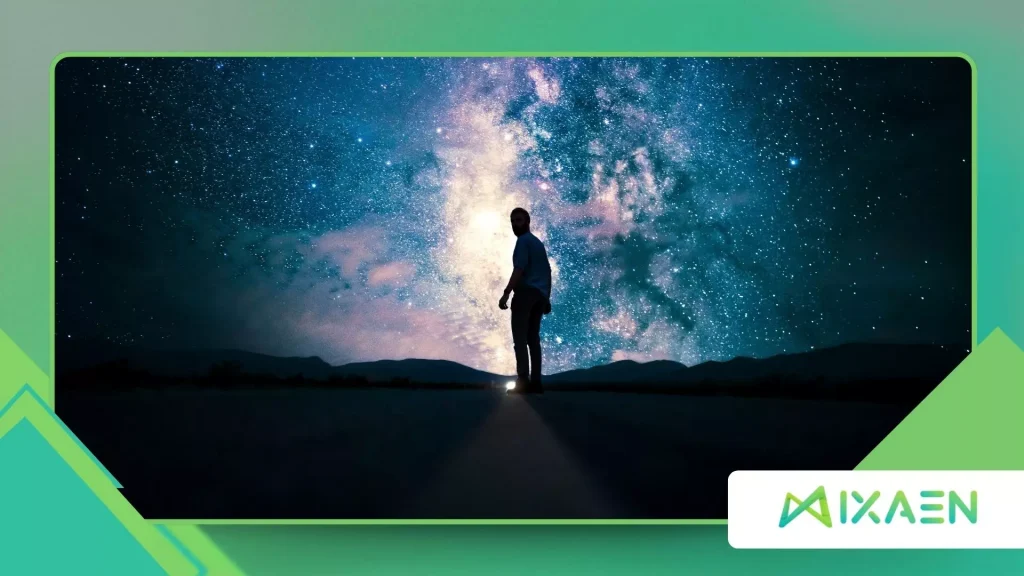
How Does Creative Speculation Shape Empirical Discovery?
The transition from a wild speculative idea to an established scientific fact requires a rigorous dialectic process where imagination proposes a reality and empirical methodology tests it.
This relationship prevents science from degenerating into unconstrained science fiction while ensuring it does not ossify into rigid, uncreative dogmatism.
A prime historical example is the prediction of gravitational waves; they were imagined as ripples in the fabric of spacetime in 1916, yet it took a century of technological advancement before the LIGO detectors confirmed their physical existence.
This reveals that the role of imagination in understanding the cosmos is a long-term investment, establishing conceptual benchmarks that inspire generations of experimental scientists to build the tools necessary for validation.
In our current era, this speculative framework is driving the search for biosignatures on exoplanets orbiting distant stars millions of light-years away.
Since we cannot travel to these worlds, astrobiologists must imaginatively construct potential alien ecosystems based on alternative biochemistry, such as silicon-based life or methane-dependent metabolic pathways.
These creative exercises dictate the specific wavelengths of light that space telescopes search for when analyzing the atmospheric composition of transiting planets.
By intellectually mapping out diverse, hypothetical cosmic realities beforehand, researchers maximize the utility of their observation time, ensuring that when we finally discover alien life, we possess the conceptual framework required to recognize it.
Read more: Can Logic Fully Explain the Cosmos?
What Role Does Mathematical Beauty Play?
Philosopher of science Henri Poincaré noted that scientists do not study nature merely because it is useful; they study it because they take pleasure in its profound beauty.
This aesthetic drive is deeply tied to imagination, as theoretical physicists often prioritize equations that exhibit symmetry, elegance, and simplicity, believing the universe inherently reflects these qualities.
When Dirac formulated his relativistic wave equation, his commitment to mathematical elegance led him to predict the existence of antimatter, an entirely unknown concept at the time.
This demonstrates that an imaginative pursuit of mathematical harmony can serve as a highly reliable compass, guiding researchers directly toward genuine, verifiable physical phenomena.
How Do Anomaly Interpretations Spark New Theories?
When astronomical observations contradict established theories, the initial reaction of the scientific community is often to dismiss the data as an instrumental error or a minor anomaly.
However, imaginative minds view these discrepancies as doorways to entirely new physical laws, using creative deduction to reframe the problem from an unorthodox perspective.
The discovery of the accelerating expansion of the universe in the late 1990s shattered the consensus that gravity would eventually slow cosmic growth, forcing a radical reimagining of cosmic forces.
It was an imaginative leap that resurrected Einstein’s discarded cosmological constant, transforming a historical mathematical footnote into the foundational pillar of modern dark energy research.
Why Are Sci-Fi Concepts Becoming Genuine Science?
Concepts once confined to the realms of speculative science fiction, such as Alcubierre warp drives, parallel universes, and terraforming Mars, are increasingly being debated within mainstream academic physics journals.
This migration demonstrates that the boundaries between creative fiction and empirical science are highly porous, with imaginative storytelling often serving as a safe, low-stakes sandbox for testing radical hypotheses.
As technological capabilities expand, scientists routinely revisit these speculative narratives, extracting core conceptual mechanics and translating them into rigorous, peer-reviewed mathematical frameworks.
This ongoing cross-pollination proves that a culturally rich, creative imagination is a vital resource for driving forward-thinking scientific innovation and cosmic discovery.
What Is the Future of Cosmic Interpretation?
As we advance deeper into the 21st century, the nature of cosmological investigation is undergoing a profound transformation due to the integration of artificial intelligence and deep learning algorithms.
These computational systems can analyze petabytes of astronomical data at speeds unattainable by humans, identifying subtle correlations and anomalies across millions of galaxies simultaneously.
However, AI lacks the capacity for genuine conceptual innovation; it can optimize existing equations, but it cannot experience the intuitive leaps necessary to invent entirely new paradigms.
Consequently, the role of imagination in understanding the cosmos will increasingly focus on guiding, interpreting, and contextualizing the raw computational outputs generated by advanced machine intelligences.
This future symbiosis will create a new paradigm where AI manages the empirical synthesis while human imagination provides the philosophical oversight and creative direction.
For example, an AI might detect a strange pattern in gravitational wave data, but it requires a human mind to imaginatively link that pattern to a novel theory of quantum gravity.
This cooperative dynamic ensures that astrophysics remains a deeply human endeavor, rooted in our innate curiosity and capacity for metaphor.
As we stand on the precipice of discovering the true nature of dark matter or detecting the first signs of extraterrestrial intelligence, our ultimate tool remains our creative consciousness.
Conceptual Paradigms Matrix
The following data table illustrates how different observational frameworks require varying degrees of imaginative modeling to translate raw data into validated physical concepts.
| Phenomenon / Concept | Primary Observational Tool | Core Imaginative Framework Required | Empirical Validation Status |
| Black Hole Event Horizons | Event Horizon Telescope (EHT) | Interferometry data synthesis & relativistic lensing visualization | Confirmed via direct imaging (2019) |
| Gravitational Waves | LIGO / Virgo Interfereometers | Spacetime fabric warping and acoustic cosmic translation | Confirmed via binary mergers (2015) |
| Exoplanetary Atmospheres | James Webb Space Telescope (JWST) | Biosignature modeling & chemical equilibrium simulations | Ongoing active empirical collection |
| Dark Matter Halos | Weak Gravitational Lensing Arrays | Invisible gravitational scaffolding & mass distribution mapping | Indirectly verified via galactic rotation |
| Quantum Multiverse | Cosmic Microwave Background (CMB) | Infinite inflationary bubbles & cosmic bruising mapping | Purely theoretical / Mathematical modeling |
How Will Quantum Computing Change Our Visualizations?
The advent of functional quantum computing promises to revolutionize cosmological simulations, allowing us to model the exact quantum states of the early universe with perfect precision.
To utilize this immense power, physicists will need to develop entirely new imaginative vocabularies, as quantum mechanics operates on principles of superposition and entanglement that directly contradict our daily classical experiences.
Human researchers will be challenged to imaginatively inhabit a quantum reality, training their minds to think in probabilities rather than certainties.
This cognitive evolution will alter our relationship with physics, turning abstract mathematical probabilities into an interactive, visual medium for cosmic exploration.
What Are the Limits of Purely Empirical Space Science?
Relying exclusively on empirical data without a corresponding development in creative theoretical modeling risks stalling scientific progress, turning astrophysics into a passive cataloging of cosmic objects.
Without bold, imaginative frameworks to challenge existing dogmas, we risk misinterpreting new data by forcing it into outdated conceptual boxes that limit our understanding.
History shows that when data collection outpaces creative theorizing, science enters a period of stagnation, accumulating facts without achieving a deeper, unified comprehension of the underlying reality.
Therefore, maintaining a vibrant, unconstrained imagination is essential to ensure that our interpretation of the universe grows alongside our technological capacity to view it.
Why Must Philosophy and Physics Re-align?
As modern cosmology pushes into the realms of the infinite, the eternal, and the multi-dimensional, the line separating theoretical physics from metaphysics becomes increasingly blurred.
This convergence requires physicists to reclaim their historical role as natural philosophers, using disciplined imagination to address profound existential questions regarding the origin and ultimate fate of existence.
By integrating philosophical rigor with mathematical precision, scientists can avoid the traps of sterile reductionism and construct holistic worldviews that resonate with human experience.
Ultimately, this interdisciplinary imaginative alliance ensures that our quest to understand the universe remains meaningful, inspiring, and deeply connected to our collective cultural journey.
Conclusion
Our journey through the infinite expanses of space and time demonstrates that the role of imagination in understanding the cosmos is not a luxury, but an absolute necessity for scientific advancement.
From Einstein’s imaginary elevator rides to modern multidimensional superstring visualizations, creative cognition transforms abstract cosmic anomalies into coherent, testable physical laws.
As we deploy increasingly powerful technologies to peer into the dark corners of reality, our success will depend entirely on our willingness to dream beyond our current sensory boundaries.
By balancing rigorous empirical verification with bold, disciplined intuition, humanity will continue to unravel the profound mysteries of our vast, beautiful, and enigmatic universe.
What are your thoughts on how human creativity shapes our understanding of the universe?
Do you believe artificial intelligence will ever develop its own form of scientific imagination? Share your thoughts and experiences in the comments section below to join the conversation.
Frequently Asked Questions
What is a historical example of imagination leading to a major cosmic discovery?
Albert Einstein’s development of the General Theory of Relativity is the premier example.
By imaginatively visualizing a person falling from a roof and realizing they wouldn’t feel their own weight, he bypassed contemporary observational limits to redefine gravity as the curvature of spacetime.
How does imagination differ from unscientific fantasy in cosmology?
Scientific imagination is strictly bounded by mathematical consistency and existing empirical laws.
While fantasy can ignore the rules of reality entirely, a valid cosmological thought experiment must provide a logical, testable pathway that can eventually be verified or disproven by observation.
Can artificial intelligence replace human imagination in astrophysics?
No. While AI excels at processing immense datasets, identifying subtle patterns, and optimizing complex equations, it cannot perform the intuitive leaps required to invent entirely new conceptual paradigms.
AI lacks the conscious metaphor-making and existential curiosity that drive genuine human creativity.
