
Why Low-Energy Lunar Transfers Are Changing Mission Design
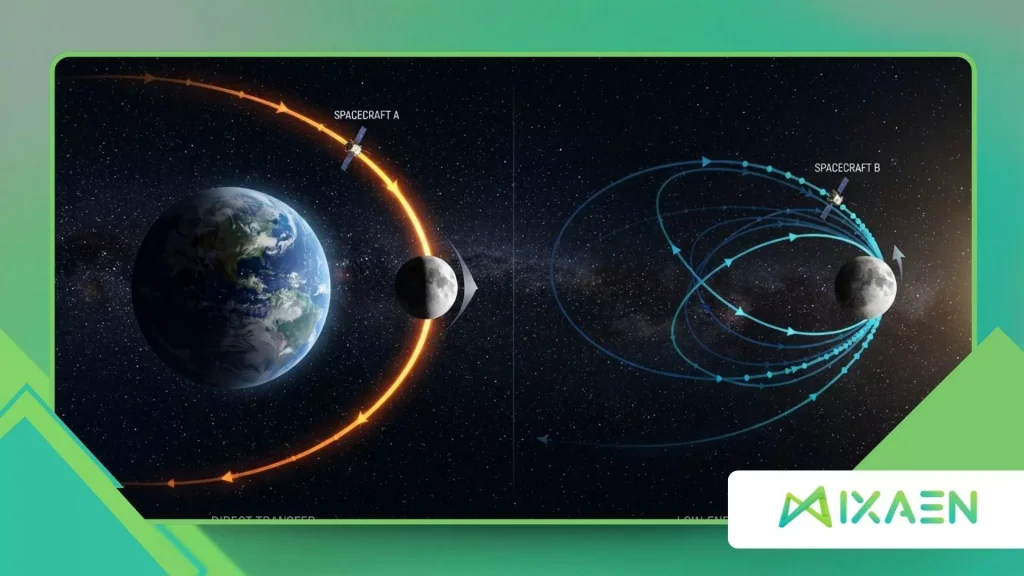
Low-Energy Lunar Transfers represent a monumental paradigm shift in deep space exploration, fundamentally altering how agencies and commercial firms navigate the cosmos.
Anúncios
As orbital mechanics evolved beyond the rigid, fast-paced trajectories of the Apollo era, mission planners discovered that patience yields unprecedented efficiency in fuel consumption.
This revolutionary approach leverages the complex gravitational interplay between the Earth, Moon, and Sun, effectively turning the solar system’s natural forces into a cosmic highway.
By utilizing these delicate gravitational boundary zones, modern spacecraft dramatically reduce the fuel mass required for insertion into lunar orbit, allowing engineers to allocate precious weight to advanced scientific payloads and next-generation instruments instead.
Aerospace engineering stands at a crossroads where economic viability dictates the scope of cosmic ambition, making these specialized trajectories an indispensable asset for sustained operations.
Traditional methods demand massive, high-thrust engine burns that limit the size and capability of the vehicles we can send to the lunar surface.
By contrast, adapting to these low-thrust, high-efficiency pathways unlocks the potential for smaller launch vehicles to deliver complex infrastructure directly into the cis-lunar environment.
As we transition from temporary scientific visits to permanent settlements, understanding the mechanics of these orbital pathways becomes essential for sustaining an enduring human presence on the Moon.
Overview of the Discussion
- Mechanics and Evolution: Demystifying the gravitational science and historical breakthroughs behind ballistically optimized trajectories.
- Strategic and Financial Benefits: Analyzing mass optimization, payload capacity gains, and the stark contrast with conventional Apollo-style paths.
- Operational Execution and Outlook: Examining real-world mission timelines, structural design impacts, and the future framework of cis-lunar logistics.
What Are Low-Energy Lunar Transfers and How Did They Evolve?
What is the mathematical origin of these trajectories?
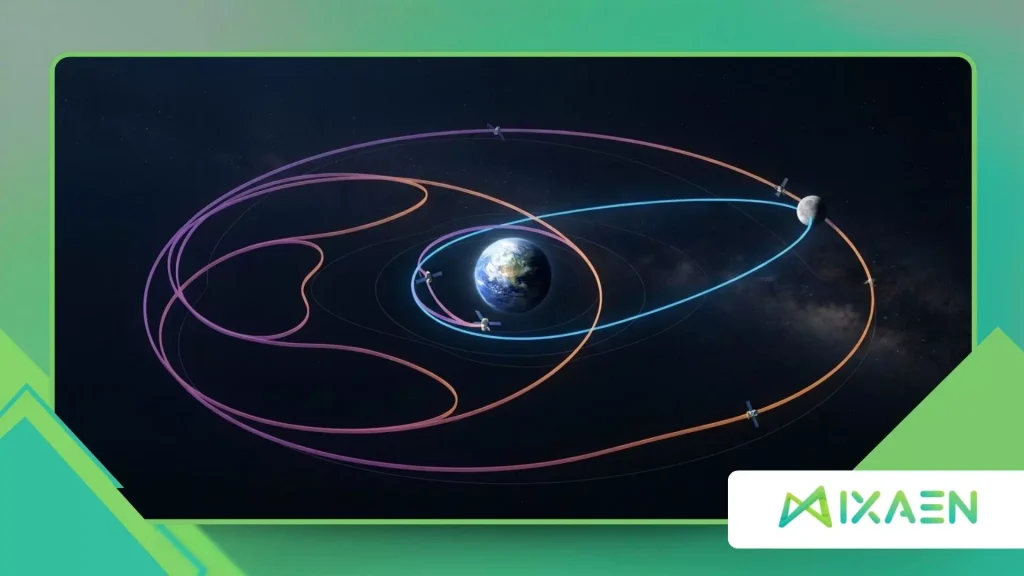
The mathematical foundation of this orbital technique traces back to the restricted three-body problem, which analyzes the motion of a spacecraft under the gravitational influence of two massive celestial bodies.
Unlike classical Keplerian trajectories that rely strictly on two-body mechanics, these pathways operate within the chaotic boundaries where the gravitational pull of the Earth, Moon, and Sun balance out perfectly.
Mathematicians discovered that by targeting specific invariant manifolds associated with Lagrange points, a spacecraft can essentially coast along natural gravity currents with minimal propulsion.
How did the Hiten mission prove this concept?
The practical validation of this orbital theory occurred unexpectedly in 1991 when the Japanese spacecraft Hiten faced a severe fuel shortage that threatened to ruin its lunar objectives.
American mathematician Edward Belbruno designed a radical, chaotic trajectory that guided the crippled probe through a distant Earth-Sun Lagrange point before capturing it into lunar orbit using virtually zero fuel.
This historic milestone proved that space agencies could utilize the Sun’s tidal gravitational forces to alter a spacecraft’s orbital energy, permanently changing the landscape of deep space navigation.
++ Why Reusable Spacecraft Systems Redefine Exploration Costs
Why do we call them ballistic capture pathways?
Engineers frequently refer to these routes as ballistic capture pathways because the spacecraft approaches the Moon at a very low relative velocity, allowing lunar gravity to naturally ensnare the vehicle.
Conventional missions require a massive, high-risk braking burn to prevent the spacecraft from flying past its target into deep space.
Ballistic capture eliminates the catastrophic risk of a failed insertion burn, as the spacecraft gently eases into a stable orbit without needing a massive expenditure of onboard propellant.
Why Are Low-Energy Lunar Transfers Transforming Modern Mission Budgets?
How do they maximize payload capacity?
Every kilogram of fuel saved during transit translates directly into an extra kilogram of scientific instruments, life support systems, or habitat infrastructure sent to the lunar surface.
By integrating a low-energy lunar transfers strategy, aerospace engineers can design lighter propulsion modules, which fundamentally alters the mass-to-payload ratio in favor of long-term scientific discovery.
This shift allows universities, smaller nations, and private startups to launch highly sophisticated, heavy-instrument suites that were previously restricted to major geopolitical superpowers.
Also read: What We’ve Learned from Landing Rovers on Other Planets
What makes the financial contrast with Apollo so drastic?
The Apollo program prioritized speed, utilizing direct Hohmann transfers that reached the Moon in just three days but required immense, expensive Saturn V rockets to push past Earth’s gravity.
Modern commercial spaceflight operates under strict financial constraints, where reducing launch vehicle size or expanding payload volume determines the commercial viability of a venture.
Trading travel time for financial efficiency allows contemporary operations to execute multiple cargo launches for a fraction of the cost of a single mid-century crewed mission.
Read more: Reimagining the Hubble: How It Changed the Way We See Space
How does fuel mass optimization impact launch vehicle choice?
When the requirement for heavy transit fuel drops, mission designers can shift their payloads from heavy-lift, highly expensive rockets to smaller, mass-produced commercial launch vehicles.
This flexibility democratizes access to the Moon, fostering a competitive commercial ecosystem where multiple private providers vie for logistics contracts.
Consequently, the entire supply chain of space exploration shifts from rare, government-funded spectacles to a reliable, iterative, and market-driven transportation network.
How Do Space Agencies Manage the Extended Timelines of Modern Trajectories?
What is the operational impact of a 90-day transit?
The primary trade-off of using a low-energy lunar transfers approach is the extended transit time, which typically requires between 90 and 120 days compared to a direct three-day flight.
For robotic cargo haulers, fuel depots, and structural components, this extended timeline poses little issue, as these passive payloads do not require life support or rapid deployment.
Mission control teams must adapt to managing prolonged, low-maintenance voyages, scheduling launches months ahead to ensure resources arrive precisely when human crews need them.
How do engineers protect electronics during long exposures?
Spending months navigating the deep space environment exposes delicate spacecraft components to prolonged solar radiation and cosmic rays outside the protective shield of Earth’s magnetosphere.
Engineers mitigate these environmental hazards by developing robust radiation shielding, redundant computational architectures, and highly resilient solar arrays capable of enduring long-term exposure.
This extended timeline requires meticulous thermal management systems to keep onboard electronics operational during the long, cold transit through the Earth-Sun Lagrange points.
Why is this method ideal for uncrewed logistics?
Uncrewed infrastructure missions constitute the backbone of future lunar bases, requiring the regular transport of water, oxygen, building materials, and scientific rovers.
Because these materials do not degrade over time, utilizing slower, ultra-efficient pathways represents the most logical economic choice for building cis-lunar supply chains.
Operating these slow-moving cargo fleets ensures a steady stream of supplies arrives at the Moon, mirroring the efficient, low-cost maritime shipping lanes used on Earth.
What Practical Examples Demonstrate the Success of These Transfers?
How did South Korea’s Danuri mission succeed?
A brilliant modern example of this strategy in action is South Korea’s Korea Pathfinder Lunar Orbiter, widely known as Danuri, which launched successfully in late 2022.
By utilizing a low-energy lunar transfers trajectory that traveled nearly 1.5 million kilometers away from Earth toward the Sun, the spacecraft looped back to achieve a flawless lunar capture.
This tactical maneuver saved Danuri an estimated 25% of its total propellant budget, extending its operational lifespan and allowing it to conduct high-resolution imagery of dark polar craters.
What did NASA’s CAPSTONE mission achieve?
NASA’s CAPSTONE CubeSat provided another textbook demonstration by testing the unique Near-Rectilinear Halo Orbit intended for the future Artemis Gateway space station.
The tiny, microwave-oven-sized spacecraft utilized a ballistic transfer to reach its highly complex destination orbit with minimal fuel expenditure.
CAPSTONE proved that even miniaturized, low-cost satellites can successfully navigate deep space independently if they utilize the natural gravitational currents provided by the three-body problem framework.
How does the ocean current analogy apply here?
To understand this concept intuitively, think of a traditional space mission as a high-speed, gas-guzzling speedboat forcing its way directly across a turbulent, open ocean against the wind.
In contrast, using a low-energy lunar transfers pathway is akin to a sophisticated sailboat mapping out and riding deep ocean currents to reach a distant port with minimal engine use.
While the sailboat takes considerably longer to arrive, it expends almost no fuel, arriving at its destination safely while carrying a vastly superior amount of cargo.
The table below highlights the operational trade-offs between traditional high-thrust methods and modern low-energy gravitational trajectories:
| Performance Metric | Traditional Direct Transfers (Apollo Style) | Low-Energy Lunar Transfers (Ballistic) |
| Average Transit Duration | 3 to 5 Days | 90 to 120 Days |
| Propellant Mass Required | Extremely High (Heavy Insertion Burn) | Exceptionally Low (Natural Ballistic Capture) |
| Payload Capacity Ratio | Restrictive / Mass-Constrained | Maximized / Optimized for Instruments |
| Primary Risk Factor | High-Stakes Insertion Burn Failure | Prolonged Deep-Space Radiation Exposure |
| Ideal Mission Profiles | Human Crew / Time-Sensitive Cargo | Robotic Probes / Infrastructure Logistics |
A New Era of Cis-Lunar Infrastructure and Logistics
The strategic implementation of low-energy lunar transfers reshapes the economics of space exploration, laying the groundwork for an enduring presence beyond Earth orbit.
By prioritizing fuel efficiency over transit speed, space programs can maximize payload capacity, diversify launch options, and drastically reduce overall mission costs.
As international agencies and private enterprises collaborate to construct permanent lunar habitats, these optimized gravitational pathways will serve as the primary shipping lanes for the upcoming cis-lunar economy.
What aspect of this celestial logistics network do you think will impact commercial spaceflight the most? Share your thoughts and experiences in the comments section below!
Frequently Asked Questions
Can human crews safely use low-energy lunar transfers?
Human crews cannot safely utilize these specific trajectories because the 90-to-120-day transit time drastically increases their exposure to dangerous deep-space cosmic radiation.
Additionally, carrying the extensive life support systems, food, water, and oxygen required to sustain astronauts for several months would completely erase the fuel-saving advantages that these pathways provide.
Therefore, these slow, efficient routes remain strictly reserved for robotic science missions, heavy cargo transport, and long-term infrastructure deployment.
How do these transfers differ from standard gravity assists?
Standard gravity assists involve a spacecraft flying closely past a moving planet or moon to rapidly steal a portion of its orbital velocity, instantly slinging the vehicle toward a distant target.
A low-energy ballistic transfer operates far more subtly, guiding the spacecraft into delicate gravitational boundary zones where the opposing pulls of the Earth, Sun, and Moon cancel out.
Instead of a single high-speed slingshot event, the spacecraft gently drifts along these natural equilibrium lines over an extended period.
What happens if a spacecraft misses its ballistic capture window?
If a spacecraft encounters a navigation error and misses its precise ballistic capture window, it will safely drift past the Moon along its established manifold rather than colliding with the lunar surface.
Because these trajectories operate at very low relative velocities, engineers usually have ample time to calculate minor trajectory correction maneuvers using the spacecraft’s backup thrusters.
The vehicle can then be guided back into an alternative gravitational pathway for a successful capture during a subsequent orbital pass.
