
Why Weyl Curvature Hypothesis Matters for Cosmic Entropy
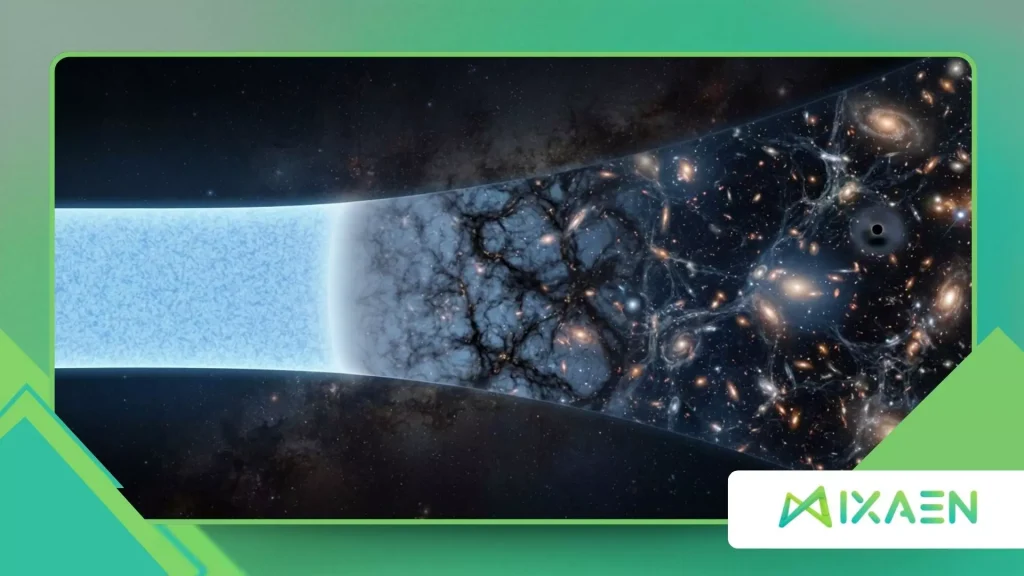
Weyl curvature hypothesis provides a profound theoretical framework explaining why our universe began in an astonishingly ordered low-entropy state.
Roger Penrose proposed this brilliant cosmological concept to solve a glaring contradiction between general relativity and the second law of thermodynamics.
Without assuming this initial geometric constraint, modern physics cannot account for the orderly arrow of time that governs every thermodynamic process.
Cosmologists continue to study these gravitational foundations to understand how spacetime curvature dictates cosmic evolution.
Physical reality demands an explanation for why the early universe possessed immense thermal potential while remaining geometrically smooth and homogeneous.
Gravitational degrees of freedom were tightly constrained at the Big Bang, preventing immediate runaway gravitational collapse into chaotic singularities everywhere.
Think of this initial condition as a tightly wound clock spring releasing energy in an orderly, unidirectional sequence over billions of years. Are you ready to explore the deep geometric secrets underlying the arrow of time?
Exploring Cosmological Foundations
- Unpacking the thermodynamic arrow of time through initial geometric boundary conditions.
- Distinguishing between matter entropy and gravitational spacetime curvature components.
- Evaluating Roger Penrose’s original cosmological arguments for initial smoothness.
- Connecting quantum gravity theories with large-scale macroscopic thermodynamic behavior.
What Is the Weyl Curvature Hypothesis and How Does It Function?
Weyl curvature hypothesis dictates that the Weyl conformal curvature tensor must vanish at any initial cosmological singularity like the Big Bang.
While Ricci curvature handles matter and energy density directly, Weyl curvature governs tidal forces and gravitational wave propagation across empty space.
By forcing this specific tensor to zero initially, theorists eliminate chaotic gravitational clumping at the cosmic dawn.
Imagine a pristine glass window before it shatters into thousands of irreversible, disordered fragments across the floor.
This specialized geometric constraint ensures that gravitational degrees of freedom start at absolute zero, leaving maximum room for future entropy growth.
As matter clumped together over eons to form stars and galaxies, gravitational entropy increased massively across the expanding universe.
Researchers use sophisticated mathematical models to test how this initial boundary condition shapes cosmic microwave background radiation patterns today.
Nature preserves these ancient signatures within the very fabric of spacetime geometry.
How Does Ricci Curvature Differ From Weyl Curvature?
Ricci curvature responds locally to matter and energy distributions described by Einstein’s field equations of general relativity.
Weyl curvature, conversely, describes free gravitational fields that propagate independently through vacuum space without requiring immediate matter sources.
Understanding this distinction allows physicists to separate local thermodynamic entropy from large-scale gravitational degrees of freedom effectively.
++ Why False Vacuum Decay Could Redefine Cosmic Stability
Why Must Initial Gravitational Entropy Remain Low?
Standard thermodynamic laws demand that isolated systems evolve from ordered states toward maximum disorder over extended chronological timelines.
If gravitational entropy had started at maximum capacity during the Big Bang, stars could never have formed.
Low initial gravitational entropy acts as the foundational engine driving all stellar nucleosynthesis and cosmic evolution.
Also read: Why Conformal Cyclic Cosmology Still Divides Physicists
How Do Singularities Relate to Conformal Geometry?
Mathematical formulations of gravitational singularities often involve infinite densities that break down standard physical predictive frameworks completely.
Conformal rescaling techniques allow theoretical physicists to analyze the boundary structures of spacetime without encountering catastrophic mathematical infinities.
This geometric tool provides critical insights into the primordial state of our expanding universe.
Why Is This Geometric Constraint Crucial for Thermodynamics?
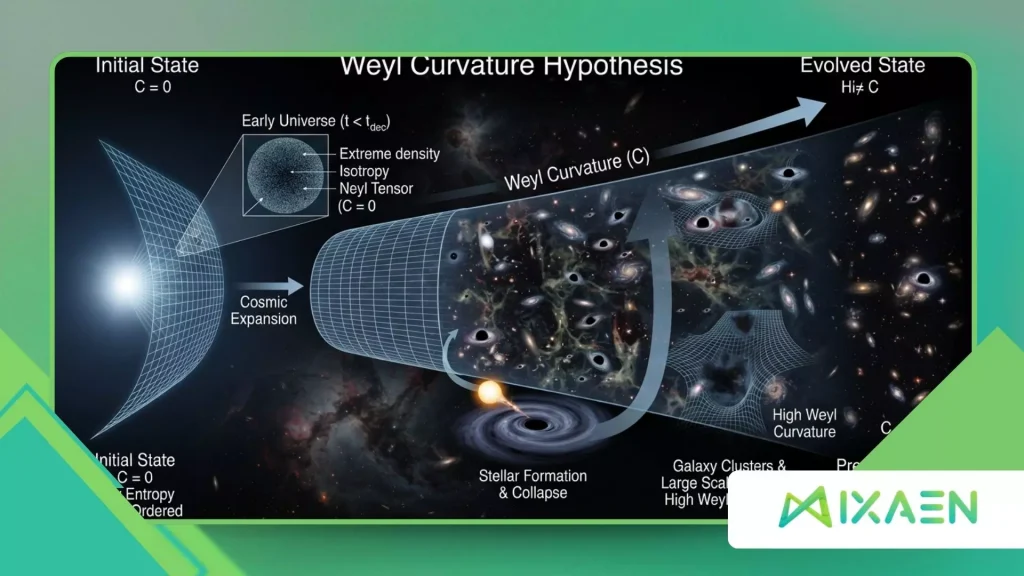
The weyl curvature hypothesis bridges the gap between irreversible thermodynamic processes and reversible microscopic laws of fundamental quantum mechanics.
Physicists have long puzzled over why macroscopic systems obey strict temporal directionality while fundamental particle equations remain completely time-symmetric.
Gravitational fields provide the missing link, acting as a massive sink for relentless entropy generation across cosmic history.
Consider how a melting ice cube increases total system disorder while following strict physical conservation laws.
Empirical astrophysical data from modern cosmological surveys confirm that large-scale structures continue to concentrate gravitational potential energy successfully.
According to research analyses published by theoretical physics institutes, stellar collapse into black holes represents the ultimate driver of gravitational entropy growth.
Without initial geometric constraints, this thermodynamic trajectory would lack a coherent baseline for measuring cumulative disorder. The universe remains a finely tuned thermodynamic engine operating under strict geometric rules.
Read more: Can Logic Fully Explain the Cosmos?
How Do Black Holes Maximize Gravitational Entropy?
Black holes represent the most efficient entropy generators in the cosmos, possessing thermodynamic entropy proportional to their event horizon surface area.
As stars collapse into black holes, they convert matter organization into immense gravitational entropy stores. This process accounts for the vast majority of entropy generated throughout cosmic history.
What Role Does Expansion Play in Entropy?
Cosmic expansion stretches spatial geometry, continuously increasing the maximum possible entropy ceiling available for the universe to occupy.
This expanding capacity prevents thermal equilibrium, allowing complex structures like galaxies, stars, and living organisms to persist.
Space itself grows larger, accommodating higher total disorder without collapsing into a uniform thermal bath.
Can Quantum Gravity Resolve Cosmological Singularities?
Loop quantum gravity and string theory attempt to replace classical gravitational singularities with quantumbounce scenarios that avoid infinite density breakdowns.
These advanced frameworks incorporate boundary conditions similar to Penrose’s original geometric proposals into microscopic spacetime equations.
Unifying quantum mechanics with general relativity remains the ultimate goal of modern theoretical physics.
How Do Modern Cosmologists Test These Theoretical Models?
Evaluating the weyl curvature hypothesis requires examining subtle anomalies hidden within cosmic microwave background radiation and large-scale galactic filament distributions.
Observational astronomers analyze temperature fluctuations mapped by space observatories to detect primordial signatures left behind by early cosmic expansion phases.
Any deviation from expected smoothness provides crucial empirical data for refining theoretical models of quantum cosmology.
Science advances by constantly comparing elegant mathematical hypotheses against rigorous observational reality.
Think of modern cosmological telescopes as time machines capturing ancient photons emitted when the universe was barely a fraction of its current age.
These precise measurements help theorists constrain competing models of quantum gravity and early universe inflation mechanisms.
Every verified observation brings humanity closer to understanding the true origin of time’s relentless forward march. What other hidden geometric laws might govern the ultimate destiny of our expanding cosmos?
What Do Cosmic Microwave Background Anomalies Reveal?
Precise measurements of cosmic background radiation reveal slight temperature variations that reflect primordial density perturbations from the early universe.
Researchers scrutinize these patterns for clues regarding initial spacetime smoothness and inflationary dynamics. These ancient photons serve as our clearest window into primordial physics.
How Do Galaxy Surveys Map Spacetime Structure?
Large-scale redshift surveys map the three-dimensional distribution of millions of galaxies across observable space with astonishing precision.
Analyzing these vast cosmic webs helps scientists understand how gravitational clustering drives macroscopic entropy changes over billions of years.
Structure formation mirrors the thermodynamic evolution of the entire universe.
Why Do Alternative Theories Challenge Standard Models?
Cyclic universe models and bouncing cosmology frameworks propose alternatives to standard Big Bang singularity paradigms to explain initial low entropy.
These competing theories attempt to bypass the need for absolute boundary conditions by proposing eternal cosmological regeneration cycles.
Vigorous debate among theoretical physicists drives continuous refinement of our cosmological models.
Comparative Matrix of Cosmological Entropy Theories
The structured table below contrasts the mechanisms and assumptions of primary theoretical frameworks addressing cosmic entropy origins.
| Theoretical Framework | Primary Entropy Driver | Initial State Assumption | Key Mathematical Tool |
| Penrose Conformal Proposal | Gravitational clumping and black holes | Vanishing initial Weyl curvature | Conformal spacetime rescaling |
| Standard Inflationary Model | Quantum field vacuum energy decay | High temperature, flat spatial geometry | Scalar field inflation equations |
| Cyclic Universe Scenarios | Successive cosmic contraction phases | Periodic entropy reset mechanisms | M-theory brane collision dynamics |
Final Reflections on Cosmic Order and Time
Grasping the weyl curvature hypothesis illuminates the delicate geometric balance that allows an ordered, life-sustaining universe to exist.
By constraining primordial gravitational degrees of freedom, nature established an enduring thermodynamic arrow of time that governs every physical process.
Continued collaboration between observational astronomers and theoretical physicists will eventually validate these profound cosmic foundations.
Audit your understanding of space and time by pondering how geometry shapes our daily reality.
How does the unidirectional flow of time influence your personal perspective on the universe? Share your insights in the comments below!
Frequently Asked Questions
What happens if Weyl curvature is not zero at the Big Bang?
If initial Weyl curvature were unconstrained and chaotic, the early universe would have immediately collapsed into massive primordial black holes.
No stable stars, galaxies, or complex chemistry could have formed, rendering life entirely impossible.
How does gravitational entropy differ from thermodynamic heat?
Thermodynamic heat entropy measures microscopic molecular disorder within matter systems, whereas gravitational entropy measures the spatial clumping and geometric complexity of spacetime.
Black holes represent the ultimate maximum manifestation of gravitational entropy storage.
Can the arrow of time ever reverse in our universe?
Current astrophysical observations indicate that cosmic expansion is accelerating due to dark energy, meaning the universe will likely continue expanding indefinitely.
Consequently, global thermodynamic entropy will keep increasing until all usable energy eventually dissipates.
