
Why Coronal Streamers Reveal Hidden Solar Plasma Structures
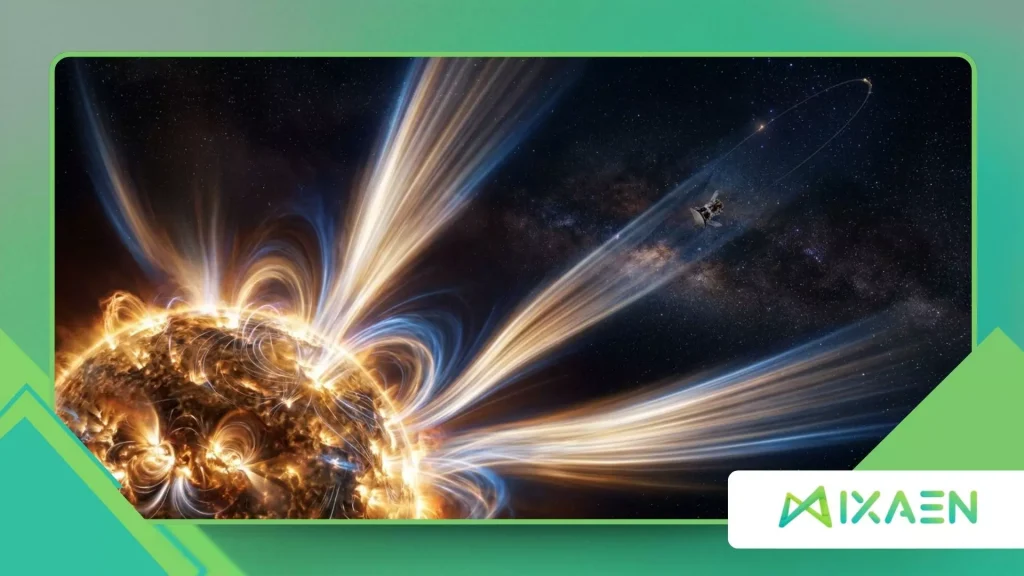
Coronal Streamers bridge the fiery solar atmosphere and interplanetary space, offering astrophysicists unprecedented observational windows into complex magnetic plasma dynamics.
Modern space-based solar observatories track these colossal helmet-shaped structures as they stretch millions of kilometers outward into the solar wind.
Recent telemetry data from Parker Solar Probe missions confirms that these radiant rays trace active magnetic loops anchoring dense ionized gas.
Astrological researchers utilize these luminous formations to decode coronal heating mechanisms and predict catastrophic space weather events.
Investigating these magnificent solar phenomena requires advanced coronagraph imaging, magnetohydrodynamic computer simulations, and real-time satellite telemetry tracking.
Solar physicists track plasma density variations inside these streamers to evaluate how stellar wind accelerates across the heliosphere.
Imagine these cosmic curtains as glowing magnetic highways guiding high-energy particles through the vacuum of space. Are you ready to explore how solar streamers reveal hidden plasma secrets?
Navigating Solar Plasma Dynamics
- Examining helmet streamer morphology and closed magnetic field loop containment.
- Evaluating solar wind acceleration zones and high-speed particle stream interactions.
- Analyzing spacecraft coronagraph data from NASA and ESA solar missions.
- Predicting geomagnetic storms triggered by streamer blowout mass ejections.
What Are Coronal Streamers and How Do They Form?
Coronal Streamers manifest as large, bright, helmet-like structures arching gracefully above regions of intense magnetic activity on the sun’s surface.
These brilliant plasma formations develop where closed magnetic loops trap dense solar material, preventing it from escaping into the solar wind immediately.
Think of these magnetic traps as colossal glowing domes keeping superheated ions suspended high above the photosphere.
Observational data compiled by NASA’s Solar Dynamics Observatory reveals that these structures extend several solar radii outward into space.
Solar physicists categorize these luminous arches into sharp peak configurations and broader helmet bases during active solar cycle phases.
Magnetic field lines converge near the top of the helmet, pinching outward to form slender ray-like conduits where plasma escapes slowly.
When magnetic reconnection occurs inside these bases, massive plasma blobs detach and travel outward into the heliosphere.
Understanding this genesis helps researchers forecast geomagnetic disturbances impacting Earth’s power grids.
Why Do Magnetic Loops Trap Dense Plasma?
Intense magnetic fields exert inward Lorentz forces that confine charged solar particles within closed loops against thermal expansion pressure.
This containment density creates the high optical brightness observed by space coronagraphs during total solar eclipses.
++ How the Sun’s Magnetic Field Shapes the Entire Solar System
How Do Streamer Stems Feed Solar Wind?
The pinched apex of a helmet structure allows confined plasma to leak steadily into interplanetary space along open magnetic field lines.
This steady outflow contributes significantly to the slow component of the solar wind.
Also read: Solar Tornadoes: What They Are and Why They Matter
What Role Do Active Regions Play in Formation?
Underlying sunspot groups and magnetic active regions supply the continuous thermal energy and magnetic flux required to sustain streamer growth.
Without continuous magnetic replenishment, these structures rapidly dissipate.
Why Are Streamers Crucial for Mapping Invisible Magnetic Fields?
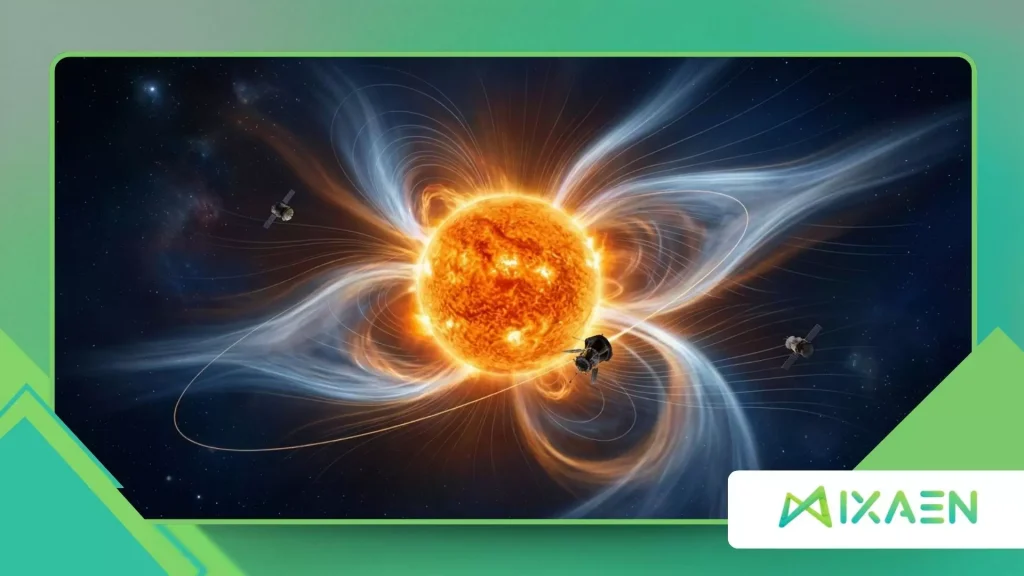
Coronal Streamers act as natural glowing tracers, illuminating invisible magnetic field lines that would otherwise remain completely undetectable in space.
Because ionized plasma particles spiral tightly around magnetic flux tubes, their radiant emission visually outlines complex coronal architecture.
Imagine pouring fluorescent dye into a rushing river to instantly reveal invisible underwater currents and whirlpools.
Advanced polarimetric measurements allow astronomers to reconstruct three-dimensional magnetic topology from these luminous plasma pathways.
Astrophysical data published in the Journal of Geophysical Research demonstrates that streamer density profiles correlate directly with underlying photospheric magnetic strength.
When spacecraft measure electron scattering within these bright rays, researchers calculate local magnetic field vectors with remarkable precision.
This diagnostic capability transforms ephemeral solar light into quantitative physical data regarding stellar magnetism. Every streamer observation refines our theoretical models of stellar atmospheres.
Read more: The Parker Solar Probe: Flying Into the Heart of Our Star
How Does Thomson Scattering Reveal Plasma Density?
Free electrons inside the streamer scatter white light emitted from the solar photosphere toward orbiting coronagraph lenses.
Measuring the polarization of this scattered light yields exact electron density distributions along the line of sight.
Why Is Three-Dimensional Reconstruction Necessary?
Two-dimensional coronagraph images flatten complex coronal structures, hiding overlapping loops and intersecting plasma sheets from direct view.
Utilizing stereoscopic data from multiple spacecraft solves this spatial ambiguity effectively.
What Do Streamer Cavities Tell Us About Eruptions?
Dark cavities frequently form beneath bright streamer helmets, signaling the accumulation of magnetic flux ropes preparing for coronal mass ejections.
Spotting these cavities provides critical early warning for space weather forecasting.
How Do Streamer Blowouts Trigger Interplanetary Space Weather?
Coronal Streamers occasionally destabilize during solar activity peaks, resulting in colossal eruptions known as streamer blowouts that hurl plasma across the solar system.
Unlike explosive flares, these slow-evolving blowouts release massive volumes of trapped stellar material into interplanetary space over several hours.
Think of these events as massive volcanic eruptions on the sun, sending shockwaves through the inner solar system’s magnetic fabric.
Monitoring these releases helps agencies protect vulnerable orbital satellites and communication networks.
Space weather telemetry confirms that streamer blowouts drive ambient solar wind variations and can intensify geomagnetic storms upon reaching Earth’s magnetosphere.
When these plasma structures interact with Earth’s magnetic shield, they generate dazzling auroral displays across polar skies.
Comprehensive tracking by modern coronagraph networks ensures continuous situational awareness for global technological infrastructure.
Proactive monitoring mitigates potential disruptions to high-frequency radio communications.
What Triggers the Collapse of Helmet Streamers?
Destabilization occurs when accumulating magnetic pressure overcomes the stabilizing tension of closed arch loops, forcing an open-field reconnection.
This abrupt structural failure releases the trapped plasma reservoir instantly.
How Do Interplanetary Shocks Form During Eruptions?
Outflowing plasma accelerates faster than the local magnetohydrodynamic wave speed, generating powerful shock fronts that propagate through the solar wind.
These shocks accelerate energetic particles across interplanetary distances.
What Impacts Do Streamer Ejections Have on Satellites?
Encountering high-density plasma clouds increases atmospheric drag on low-Earth-orbit satellites and induces electrical charging on solar panels.
Operators utilize advance telemetry warnings to safe-guard sensitive spacecraft components.
Solar Plasma Structure Comparison Matrix
The structured table below contrasts quiet-sun plasma domains with active coronal streamer characteristics.
| Plasma Feature | Quiet Solar Corona | Coronal Streamers |
| Magnetic Topology | Open magnetic field lines (Coronal holes) | Closed magnetic loops with open tips |
| Plasma Density | Extremely low particle concentration | High electron and ion density |
| Visual Appearance | Dark, uniform regions in extreme ultraviolet | Bright, helmet-shaped rays and arches |
| Solar Wind Contribution | High-speed continuous particle streams | Steady slow-speed particle outflow |
Advancing Stellar Physics Through Coronal Insights
Coronal Streamers remain indispensable observational tools for modern astrophysicists seeking to understand the hidden magnetic machinery powering our nearest star.
By analyzing the luminous plasma trapped within these majestic helmet structures, humanity gains vital insights into stellar evolution and space weather dynamics.
Continuing space missions will undoubtedly uncover even deeper secrets hidden within the sun’s dynamic atmosphere.
Take a moment to ponder the immense forces shaping our cosmic neighborhood this week. How does solar activity influence technological life on Earth? Share your perspective in the comments below!
Frequently Asked Questions
What causes the bright helmet shape of coronal streamers?
The distinctive helmet shape results from closed magnetic loops trapping dense solar plasma near the base, while upper field lines pinch into a narrow ray extending outward.
Can coronal streamers be seen with the naked eye from Earth?
Yes, observers can witness coronal streamers directly during a total solar eclipse, appearing as pearly-white luminous rays stretching outward from the eclipsed solar disk.
How do spacecraft study coronal streamers without melting?
Spacecraft like the Parker Solar Probe utilize advanced heat shields and specialized orbits to approach the sun while capturing high-resolution coronagraph images from safe distances.
What is the difference between a solar flare and a streamer blowout?
Solar flares are sudden, high-energy explosions of electromagnetic radiation, whereas streamer blowouts are massive, gradual ejections of trapped thermal plasma and magnetic fields.
Why are coronal streamers important for modern technology?
Monitoring streamer blowouts helps scientists predict geomagnetic storms that can disrupt satellite operations, GPS navigation systems, and terrestrial power grids.
