
How Topological Defects Could Reveal Early Universe Physics
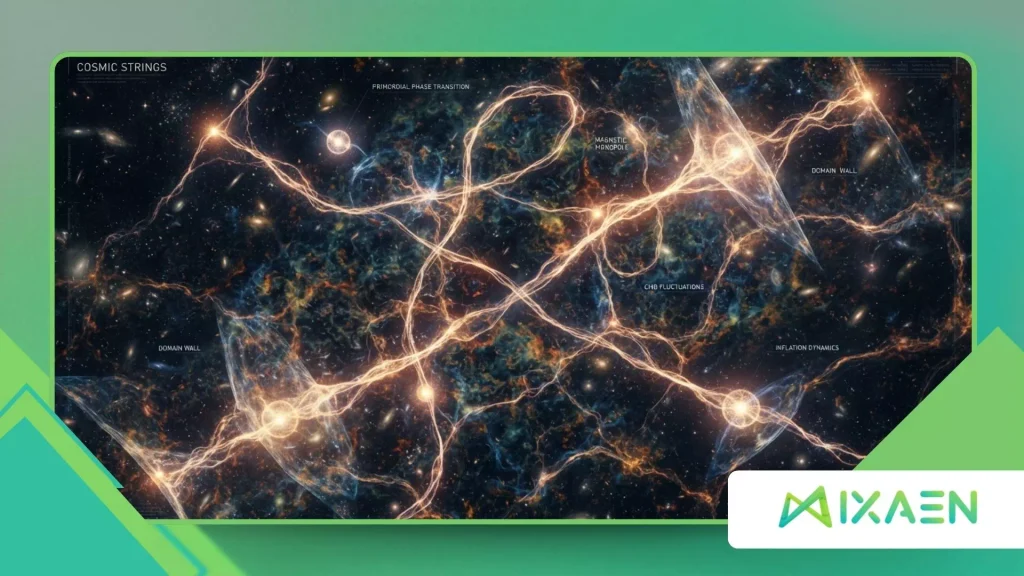
Topological defects remnants from primordial cosmic phase transitions offer physicists unprecedented windows into the high-energy physics of the early universe.
Cosmologists investigate these hypothetical field configurations to decode inflation dynamics and grand unification theories.
Modern detectors scan gravitational wave backgrounds for distinct signatures left by ancient cosmic strings and monopoles.
Advanced theoretical models suggest these relics bridge quantum mechanics and large-scale gravitational phenomena uniquely.
Deciphering these cosmic scars requires rigorous mathematical frameworks and state-of-the-art observational astrophysics.
Researchers examine how symmetry-breaking events during the Big Bang forged persistent topological anomalies across spacetime.
Consider how cracks form in rapidly cooling glass; similar phase transitions sculpted the nascent universe. Are you ready to explore how microscopic field anomalies reveal macroscopic cosmic origins?
Mapping Primordial Phase Transitions and Relics
- Investigating cosmic string networks and magnetic monopole signatures in gravitational wave data.
- Analyzing symmetry-breaking mechanisms that govern early universe cosmology and field theory.
- Evaluating pulsar timing array anomalies as detectors for ancient topological structures.
- Correlating theoretical vacuum expectations with modern high-energy astrophysics observations.
What Are Topological Defects in Cosmology?
Topological defects represent stable energy concentrations trapped in non-trivial configurations following cosmic phase transitions.
Field theory models indicate that rapid cooling during the early universe caused distinct spatial regions to choose independent vacuum states.
When these domains collided, unbroken symmetry lines or points became permanently locked into spacetime.
Theoretical physicists categorize these stable remnants into domain walls, cosmic strings, monopoles, and textures.
Advanced cosmological simulations demonstrate how these energetic structures evolve across expanding spatial dimensions over billions of years.
Observational programs rely on precise calculations to differentiate primordial defect signatures from standard astrophysical noise sources.
Modern research confirms that studying these relics refines our understanding of quantum field fluctuations. Every detected anomaly brings humanity closer to mapping absolute cosmic genesis.
How Do Phase Transitions Form Defects?
Cosmic cooling forces scalar fields to settle into lowest-energy vacuum states across disconnected spatial pockets.
Mismatches at domain boundaries trap high energy density, creating persistent topological anomalies.
++ Why False Vacuum Decay Could Redefine Cosmic Stability
What Role Do Symmetries Play?
Spontaneous symmetry breaking dictates the specific type of defect formed during cosmological cooling epochs.
Grand Unified Theories utilize these symmetry transitions to explain fundamental particle physics.
Also read: Why Conformal Cyclic Cosmology Still Divides Physicists
Why Are Monopoles Significant?
Magnetic monopoles represent isolated magnetic charge configurations predicted by unified field theories.
Detecting their relics would validate core assumptions regarding early universe inflation.
Read more: Can Logic Fully Explain the Cosmos?
How Do Cosmic Strings Behave?
Cosmic strings are ultra-dense, one-dimensional spatial folds possessing immense gravitational pull.
Their continuous vibration emits distinct gravitational wave patterns detectable by modern instruments.
How Can Gravitational Waves Detect Ancient Relics?
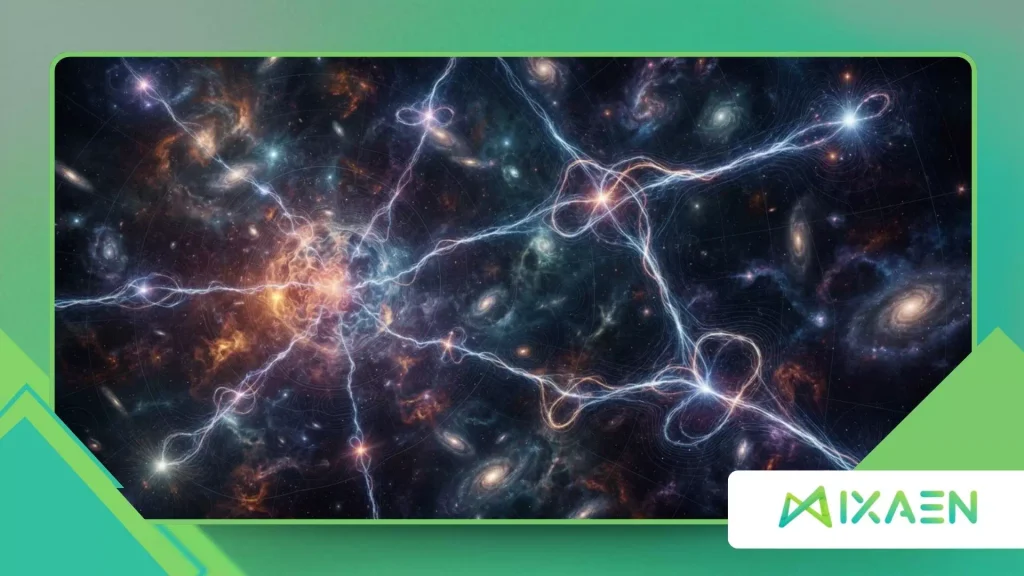
Topological defects generate stochastic gravitational wave backgrounds through dynamic oscillations and string loop collapses.
Pulsar timing arrays monitor millisecond pulsar signals to detect minute spatial stretching caused by passing gravitational waves.
Astrophysical data from international collaborations indicate that continuous gravitational wave signatures match theoretical defect models.
Researchers isolate these primordial signals from stellar binary noise using advanced digital filtering algorithms.
Listening to the symphony of the early universe requires unprecedented instrumental precision and data analysis power.
Observatories measure nanohertz gravitational waves to reconstruct the violent expansion dynamics of the primordial cosmos.
This methodology bypasses electromagnetic observation limits, peering directly into opaque cosmic epochs.
Gravitational wave astronomy transforms invisible theoretical anomalies into measurable astrophysical data.
What Are Pulsar Timing Arrays?
Pulsar timing arrays monitor network rotations of ultra-stable neutron stars across the galaxy. Passing gravitational waves alter photon arrival times, revealing hidden cosmic string activities.
How Do String Loops Oscillate?
Stretching and snapping cosmic string loops radiate intense gravitational energy across vast cosmological distances. This persistent radiation creates a detectable background hum in modern detectors.
Why Is Nanohertz Frequency Crucial?
Nanohertz gravitational waves correspond to supermassive cosmic structures and primordial defect networks operating on universal scales.
This frequency band captures events from early cosmological epochs.
Can Interferometers Spot Defects?
Space-based laser interferometers complement pulsar arrays by targeting higher frequency gravitational wave bands.
These instruments constrain cosmic string tension parameters with high accuracy.
What Do Current Astrophysics Observations Reveal?
Topological defects remain central to ongoing debates regarding cosmic inflation and dark matter generation mechanisms.
Recent data analyses from global cosmological surveys constrain maximum string tension limits significantly.
European researchers published findings showing no direct anomaly clashes within current pulsar sensitivity thresholds.
These empirical constraints help theorists refine Grand Unified Theory parameters for future experimentation.
Scientific rigor demands that every theoretical model withstand rigorous empirical testing against live observational data.
Modern astrophysics labs combine particle accelerator physics with cosmological sky surveys for holistic validation.
Interdisciplinary collaboration accelerates breakthroughs in understanding fundamental spacetime structures and quantum gravity.
Empirical verification separates viable cosmological hypotheses from speculative mathematical models.
What Limits Do Surveys Impose?
Recent observational campaigns set strict upper bounds on cosmic string tension values. These constraints eliminate several extreme theoretical models of early universe inflation.
How Do Accelerators Help?
High-energy particle colliders simulate conditions approaching primordial phase transition temperatures. Results calibrate theoretical equations governing topological field stability.
Why Is Interdisciplinary Research Vital?
Combining quantum field theory with observational astronomy bridges microscopic and macroscopic physics seamlessly. This synergy drives modern breakthroughs in cosmological research.
What Lies Ahead for Detectors?
Next-generation space telescopes and enhanced radio arrays promise unprecedented sensitivity improvements. These upgrades will soon resolve ambiguous gravitational wave signals definitively.
Topological Defect Verification Metrics
The structured table below compares traditional cosmological models with modern topological defect detection methodologies across key research dimensions.
| Research Dimension | Standard Inflation Model | Topological Defect Framework |
| Primary Focus | Exponential spatial expansion rates | Symmetry-breaking field remnants |
| Detection Medium | Cosmic microwave background polarization | Pulsar timing gravitational waves |
| Energy Scale | High-energy inflationary epochs | Post-inflationary phase transitions |
| Empirical Status | Widely validated by CMB data | Actively tested via nanohertz arrays |
Synthesizing Cosmic Evolution Through Relic Analysis
Topological defects provide essential empirical anchors for unraveling the deepest mysteries of early universe physics.
Continued technological advancements in gravitational wave detection bring humanity closer to validating grand unification theories.
By examining these primordial spacetime remnants, science decodes the fundamental rules governing existence.
What cosmic secrets will next-generation detectors uncover in the expanding universe? Share your perspective in the comments below!
Frequently Asked Questions
What are topological defects in modern physics?
Topological defects are stable energy concentrations formed when fields settle into non-trivial vacuum states during early universe phase transitions.
How do cosmic strings emit gravitational waves?
Cosmic strings oscillate, cross, and loop, releasing persistent gravitational radiation that creates detectable signals across space.
Can pulsar timing arrays detect primordial anomalies?
Yes, pulsar timing arrays monitor neutron star signals to identify minute spatial distortions caused by passing gravitational waves from defects.
Why are magnetic monopoles important to cosmology?
Magnetic monopoles validate Grand Unified Theories by explaining fundamental charge quantization and early universe symmetry-breaking phenomena.
How do researchers constrain string tension limits?
Astrophysicists analyze cosmic microwave background data and pulsar timing arrays to set empirical upper limits on cosmic string energy density.
