
How High-Redshift Quasars Challenge Modern Cosmological Timelines
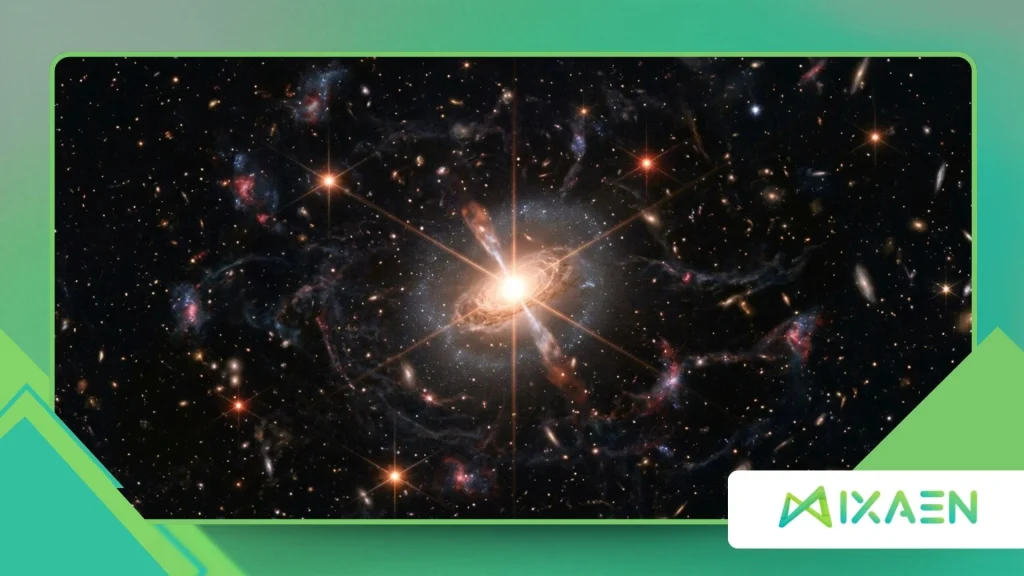
High-Redshift Quasars challenge the foundational pillars of modern astrophysics, forcing a radical reexamination of how quickly supermassive black holes and ancient galaxies could assemble after the Big Bang.
Modern cosmology relies heavily on the standard Lambda-CDM model to map the expansion and structural evolution of the universe over billions of years.
Yet, recent deep-space observations have uncovered colossal celestial objects shining brightly when the cosmos was merely a fraction of its current age.
These anomalies push theoretical models to their absolute limits, creating an intense debate within the scientific community regarding the true age and developmental timeline of our universe.
This analytical report explores the core anomalies of ancient active galactic nuclei, structured around key investigative dimensions:
- Understanding the redshift phenomenon and observational mechanics
- Evaluating supermassive black hole growth constraints versus standard models
- Analyzing alternative theoretical frameworks and future cosmological horizons
What is the Redshift Phenomenon and Why Does It Matter?
How Does Cosmological Expansion Stretch Light Waves?
Cosmological redshift occurs as light traveling across vast cosmic distances stretches alongside the expanding fabric of spacetime itself.
When photons emitted by ancient luminous sources traverse the universe, their wavelengths elongate toward the infrared spectrum.
Astronomers measure this shift using the variable z, which quantifies how much a celestial object’s light has been stretched before reaching terrestrial instruments.
Analyzing these stretched light signatures allows astrophysicists to peer backward in time, capturing snapshots of epochs that existed mere hundreds of millions of years following the primordial creation event.
Why Do Ancient Quasars Defy Standard Formation Models?
The discovery of ultra-distant active galactic nuclei with immense masses presents a severe chronological paradox for modern researchers.
According to standard theoretical frameworks, forming supermassive black holes containing billions of solar masses requires continuous, stable matter accretion over many billions of years.
However, identifying these mature systems at extreme distances implies they matured at an impossibly accelerated pace.
This temporal squeeze suggests that either our understanding of early stellar physics is fundamentally incomplete or the universe permitted rapid mass aggregation mechanisms that current physics fails to explain.
++ Could Cosmic Rays Be Messengers from Another Dimension?
How Do Supermassive Black Holes Grow So Fast?
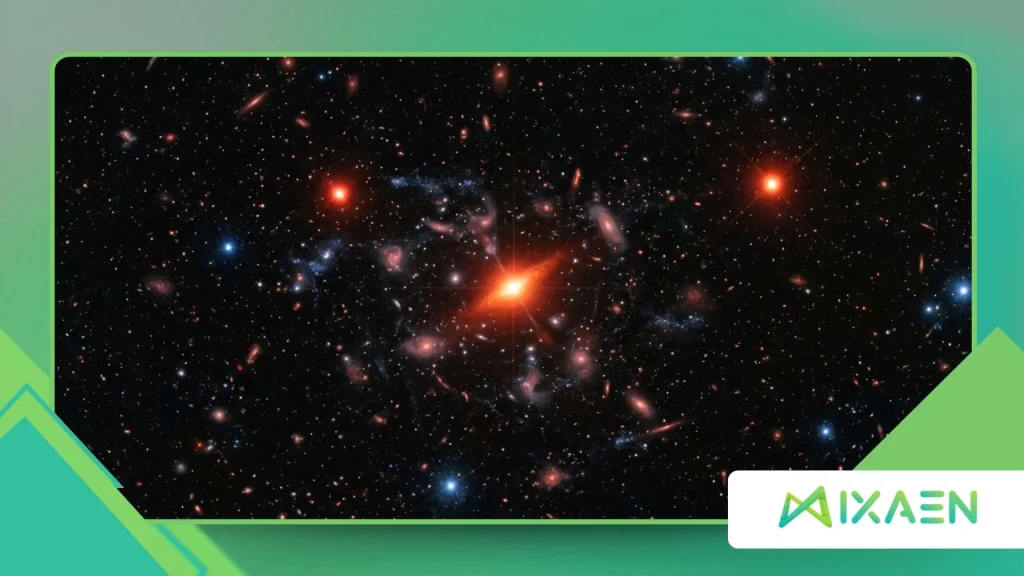
What Are the Limits of Eddington-Limited Accestion?
Standard accretion physics dictates a strict upper boundary known as the Eddington limit, which restricts how rapidly a gravitational sink can pull in surrounding gas.
If matter falls inward too quickly, outward radiation pressure typically blows away the remaining fuel supply, halting further growth.
Despite this physical barrier, ancient active galactic nuclei exhibit masses that far exceed standard theoretical predictions for their respective cosmic ages.
Solving this paradox requires exploring whether primordial gas clouds collapsed directly into massive seeds rather than starting from standard stellar remnants.
Also read: The Most Powerful Explosion Ever Detected: Still No Clear Explanation
Could Massive Primordial Seeds Solve the Chronological Gap?
Astrophysicists increasingly investigate the heavy seed hypothesis, proposing that initial black hole progenitors formed with masses hundreds or thousands of times greater than typical collapsed stars.
By bypassing the slow initial growth phases, these colossal seeds could theoretically reach supermassive proportions within the tight windows allowed by early cosmic epochs.
Nevertheless, capturing direct observational evidence of these elusive intermediate seeds remains one of the most demanding challenges in observational astronomy today.
Read omre: Why Extreme Magnetar Flares Produce Unusual Gamma-Ray Signals
What Are the Implications for Modern Cosmological Timelines?
How Do James Webb Observations Refine Our Cosmic History?
The deployment and ongoing operation of advanced infrared observatories have revolutionized our capacity to survey the deepest reaches of space.
Instruments optimized for capturing faint infrared signals have successfully identified complex structures that standard cosmological timelines predicted should not exist.
For instance, high-resolution spectral analyses from recent space telescope campaigns reveal active systems operating at unprecedented distances, prompting theorists to recalibrate mathematical models of early structure formation.
Are Alternative Cosmological Frameworks Gaining Traction?
Faced with persistent chronological discrepancies, some theoretical physicists explore alternative cosmological models that alter the expansion rate or energy density parameters of the early universe.
While the standard paradigm remains widely accepted, these alternative frameworks attempt to reconcile the unexpected abundance of massive ancient structures without breaking fundamental physical laws.
Rigorous testing against incoming observational data will ultimately determine whether our current timeline requires minor adjustments or a total paradigm shift.
| Observational Parameter | Standard Theoretical Expectation | Modern Infrared Observatory Findings | Cosmological Impact |
| Earliest Massive Quasars | Rare or nonexistent within the first billion years | Abundant massive active nuclei detected at high redshift | Forces revision of mass assembly rates |
| Black Hole Seed Mass | Formed from light stellar collapses (10 solar masses) | Requires heavy seed progenitors (10⁴ a 10⁵ solar masses) | Challenges conventional stellar evolution models |
| Expansion Timeline | Gradual hierarchical structure formation over 13.8 billion years | Accelerated maturation of cosmic webs and luminous galaxies | Highlights potential gaps in early universe physics |
Exploring Cosmic Horizons
The relentless pursuit of deep-space truths continues to push human ingenuity toward unprecedented intellectual frontiers.
As next-generation instruments refine our measurements, High-Redshift Quasars serve as ultimate testaments to the complexity of the cosmos.
We stand on the precipice of potentially rewriting foundational chapters of astrophysics, proving that our quest to understand the universe is as dynamic as the expanding space we study.
Share your perspective on these cosmic anomalies in the comments below.
Frequently Asked Questions
What defines an ancient active galactic nucleus in modern astronomy?
An ancient active galactic nucleus represents a compact region at the center of a primordial galaxy featuring a supermassive black hole fueled by intense matter accretion.
These systems shine with extreme luminosity across the electromagnetic spectrum, allowing telescopes to detect them from billions of light-years away.
Why do astronomers rely on infrared technology for deep space studies?
Infrared capabilities are essential because the expansion of the universe stretches the wavelength of ancient light waves as they travel across space.
This cosmological redshift shifts visible ultraviolet light into the infrared spectrum by the time it reaches terrestrial instruments, requiring specialized optical sensors.
How do these distant objects challenge the standard cosmological model?
They challenge existing frameworks by exhibiting massive structures and black hole masses that appear far too mature for the brief time elapsed since the Big Bang.
Standard growth equations struggle to account for how such colossal masses accumulated so rapidly in the early universe.
What is the heavy seed hypothesis in black hole evolution?
The heavy seed hypothesis proposes that initial black hole progenitors bypassed typical stellar collapse stages by forming directly from massive primordial gas clouds.
This theoretical pathway provides a viable mechanism for producing large initial masses capable of growing into supermassive giants early on.
How are modern space telescopes transforming our view of cosmic history?
Advanced spaceborne observatories provide unprecedented sensitivity and high-resolution imaging, uncovering faint, distant galaxies and quasars previously hidden from view.
These sharp observations supply vital empirical data that forces theorists to refine models of early cosmic evolution.
