
How Quantum Equivalence Tests Probe Gravity at the Atomic Scale
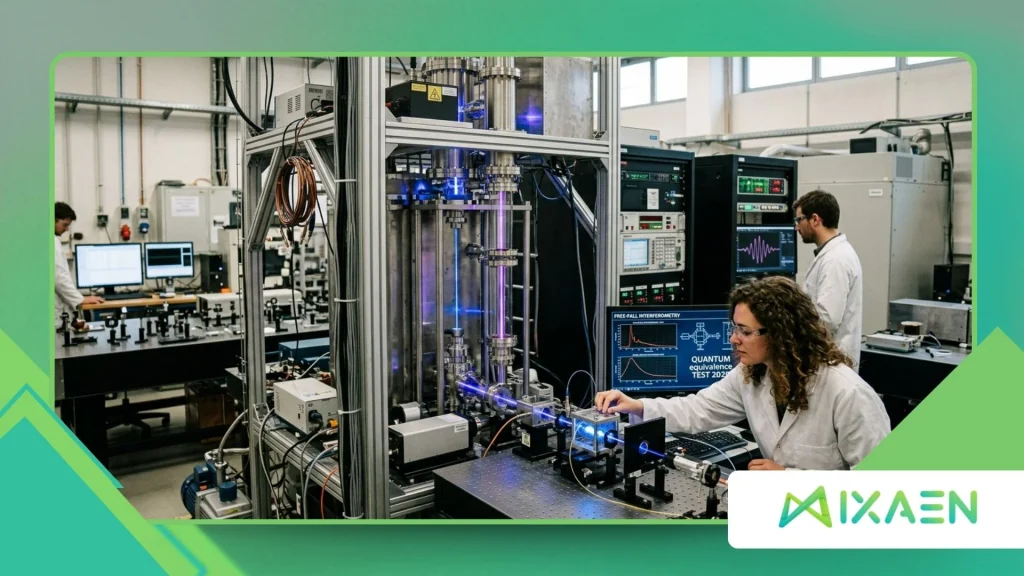
Quantum Equivalence Tests represent the cutting-edge intersection of modern physics, uniting the long-standing principles of general relativity with the chaotic, discrete domain of quantum mechanics.
As researchers worldwide push experimental boundaries in 2026, probing how gravity behaves at the atomic and subatomic scales has transformed from pure theoretical conjecture into rigorous empirical science.
Interferometry advancements and ultra-cold atomic clock experiments now allow physicists to test the universality of free fall for quantum particles with unprecedented precision, challenging our conventional understanding of spacetime curvature.
Quick Navigation Through the Quantum Realm
- Understanding the core principles behind atomic-scale gravitational tests
- Exploring modern interferometer setups and ultra-cold atom experiments
- Analyzing implications for unified physics and future cosmological models
What Are Quantum Equivalence Tests?
How Do Atomic Systems Probe Gravity?
Quantum Equivalence Tests investigate whether different quantum masses fall at the identical rate in a gravitational field. Traditional physics relies heavily on macroscopic objects like Galileo’s spheres or torsion balances.
Modern atomic physics translates these classic principles down to the microscopic realm using matter waves. Bose-Einstein condensates chilled to microkelvin temperatures serve as pristine test masses.
These ultra-cold clouds allow physicists to track quantum trajectories with astonishing accuracy.
Researchers manipulate atomic states to reveal subtle deviations from classical expectations. Consequently, these experiments push the limits of our empirical frameworks.
Why Is the Equivalence Principle Crucial?
The Einstein Equivalence Principle forms the cornerstone of modern gravitational theory. Proving its validity at the quantum level remains a monumental challenge for contemporary science.
General relativity treats gravity as a smooth geometric property of spacetime. Conversely, quantum mechanics views reality through discrete packets of energy and probabilistic states.
When gravity operates on microscopic scales, quantum fluctuations might disrupt smooth spacetime geometry. Detecting minute violations could unveil the elusive theory of quantum gravity.
Thus, every precise measurement acts as a vital sanity check for fundamental physics.
++ Why Quantum Reference Frames Could Redefine Observation
What Role Do Matter Waves Play?
Matter waves provide the primary mechanism for detecting gravitational effects on atoms. Louis de Broglie established that every particle exhibits wave-like properties proportional to its momentum.
By splitting and recombining atomic wave packets in an interferometer, scientists create quantum interference patterns. Any external gravitational acceleration alters the phase of these matter waves.
Measuring these phase shifts precisely quantifies the gravitational force experienced by the atom. This technique bypasses traditional mechanical constraints, offering a cleaner look at fundamental interactions.
Also read: Why Conformal Cyclic Cosmology Still Divides Physicists
How Do Modern Interferometers Operate?
What Technologies Drive High-Precision Measurements?
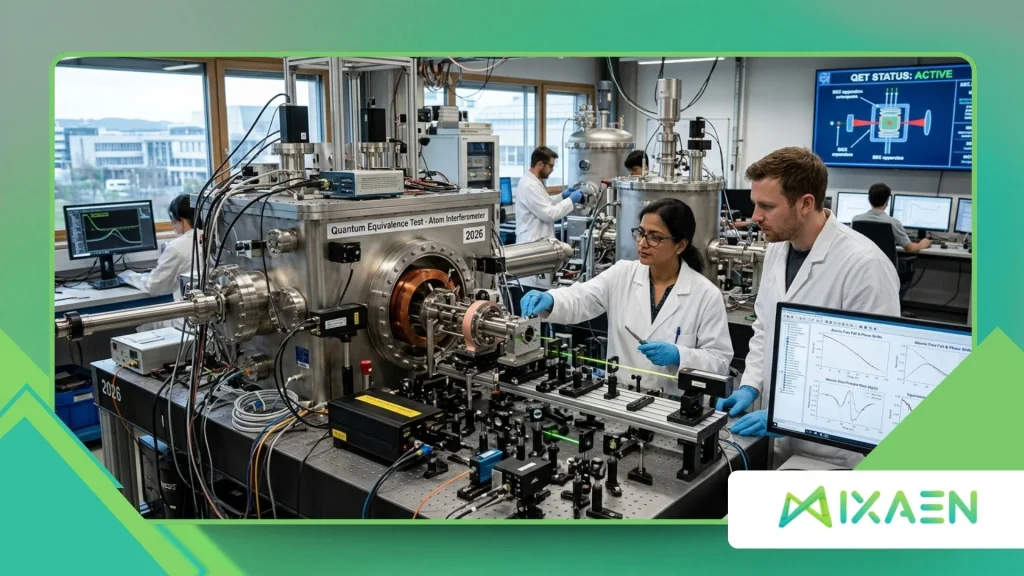
Advanced atom interferometers utilize lasers to manipulate ultra-cold atoms with extreme finesse.
Raman transitions stimulate atoms into distinct momentum states, effectively acting as mirrors and beam splitters for matter waves.
In 2026, space-based missions and underground laboratories provide isolated environments free from seismic noise.
These setups extend free-fall times, allowing quantum states to interact with gravity over longer durations. Improved laser stability and magnetic shielding eliminate major sources of experimental error.
Modern engineering thus empowers physicists to extract remarkably clean signals from chaotic environments.
What Are the Primary Experimental Challenges?
Isolating quantum test masses from external interference demands extraordinary experimental rigor.
Ambient magnetic fields, thermal radiation, and laser phase noise can easily mask minute gravitational anomalies.
Researchers must implement active vibration isolation systems and ultra-high vacuum chambers.
Furthermore, controlling atomic interactions within Bose-Einstein condensates prevents collisional shifts that distort measurements.
Overcoming these technical hurdles requires innovative engineering solutions and relentless calibration. Despite these obstacles, recent breakthroughs have driven experimental sensitivity to unprecedented heights.
Read more: Can Logic Fully Explain the Cosmos?
How Do Researchers Analyze Phase Shifts?
Data extraction relies on meticulous mathematical modeling of atomic trajectories and laser interactions.
Interference fringes reveal the phase difference accumulated along separate paths through the interferometer.
By systematically varying launch velocities and baseline separations, scientists isolate gravitational acceleration from inertial forces.
Advanced statistical algorithms process millions of experimental runs to reduce random noise.
This rigorous analysis ensures that reported anomalies reflect genuine physical phenomena rather than systematic errors. Transparency and reproducibility remain paramount as teams publish their findings.
What Are the Implications for Future Physics?
How Does This Relate to Dark Energy?
Investigating gravity at the atomic scale offers fresh perspectives on cosmological mysteries like dark energy.
Some theoretical models propose scalar fields that couple matter to gravity differently at microscopic distances.
If verified, these chameleon or symmetron fields could explain cosmic acceleration without invoking traditional cosmological constants.
Quantum Equivalence Tests act as direct probes for these hypothetical forces.
Finding deviations would revolutionize our comprehension of the cosmos. Conversely, null results continue to constrain viable theoretical parameter spaces significantly.
What Do Recent Empirical Studies Reveal?
Recent findings from prominent European and North American laboratories have tightened constraints on equivalence principle violations.
A landmark study published by the QUANTUM-G collaboration demonstrated universality of free fall for rubidium and potassium isotopes down to parts in ten to the twelfth.
These rigorous measurements reinforce the robustness of general relativity within tested domains. Researchers utilize standardized metrics to compare findings across disparate facilities worldwide.
The table below outlines key parameters from contemporary experimental setups.
| Facility / Collaboration | Test Masses | Precision Limit | Primary Technique |
| QUANTUM-G Lab | Rubidium-87 / Potassium-41 | 10⁻¹² | Dual-species atom interferometry |
| Space-Time Atom Interferometer | Bose-Einstein Condensate | 10⁻¹⁴ | Microgravity drop tower |
| Terrestrial Gravity Consortium | Cesium-133 Atoms | 10⁻¹¹ | Large-momentum-transfer optics |
What Lies Ahead for Quantum Metrology?
The future of gravitational research points toward larger space-based interferometers and enhanced laser cooling techniques.
Missions planned for the next decade aim to improve sensitivity by several orders of magnitude.
Integrating quantum sensors into satellite networks will enable continuous monitoring of Earth’s gravitational field with microscopic resolution.
As technology evolves, our ability to probe the fundamental fabric of reality expands accordingly. Quantum Equivalence Tests will undoubtedly remain at the forefront of this scientific crusade.
Final Reflections
Examining gravity through the lens of quantum mechanics bridges two historically disjointed realms of physics. As empirical precision reaches unprecedented thresholds, our understanding of spacetime continually evolves.
Quantum Equivalence Tests illuminate the profound mysteries governing our universe from the smallest scales outward.
Share your perspective on these fascinating developments in the comments below.
Frequently Asked Questions
What are Quantum Equivalence Tests?
They are high-precision experiments designed to check if different quantum masses accelerate identically in a gravitational field.
Why do physicists test gravity at the atomic scale?
Testing gravity at microscopic levels helps reconcile general relativity with quantum mechanics and search for new fundamental forces.
How do ultra-cold atoms assist these measurements?
Ultra-cold atoms form coherent matter waves that allow scientists to measure gravitational phase shifts with extraordinary precision.
What role do atom interferometers play in research?
Atom interferometers act as quantum scales, splitting and recombining matter waves to detect minute gravitational influences.
What is the significance of recent experimental findings?
Recent findings confirm general relativity’s validity to unprecedented degrees while severely restricting alternative cosmological theories.
