
How Euclid’s Ancient Quasars Challenge Black Hole Growth Models
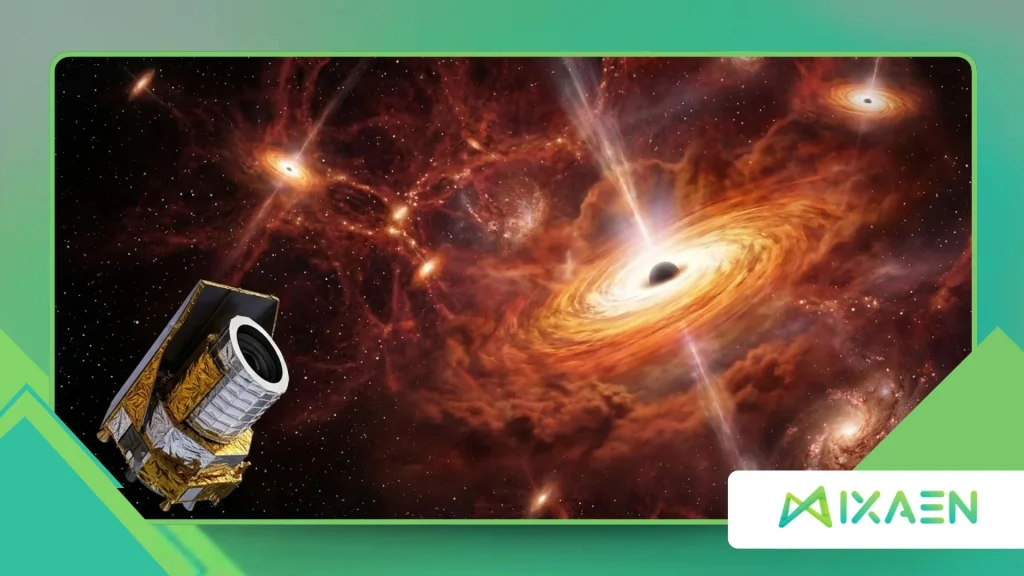
Euclid’s Ancient Quasars are forcing modern astrophysicists to tear up long-standing textbooks on how the universe built its earliest supermassive monsters.
When the European Space Agency launched the Euclid space telescope in July 2023, researchers expected a sharper map of dark matter and dark energy across ten billion years of cosmic history.
Instead, early data releases and deep-field surveys processed through 2025 and 2026 uncovered a startling population of luminous quasars shining brightly less than a billion years after the Big Bang.
These energetic beacons draw their immense power from supermassive black holes actively devouring surrounding gas at rates that defy traditional speed limits.
Standard cosmological models assume that black holes start small, born from the collapse of the first massive stars, and grow steadily over hundreds of millions of years.
Yet these newly cataloged ancient beacons already pack the mass of billions of suns during an era when the cosmos was still in its infancy.
Could our fundamental assumptions about early cosmic assembly be completely backward?
Exploring this astronomical puzzle reveals why current accretion physics cannot easily explain how such colossal engines assembled so rapidly in the primordial dark.
What You Will Discover in This Article:
- How the Euclid mission detected unexpectedly massive quasars inside the early universe.
- Why traditional Eddington accretion limits fail to explain rapid supermassive black hole growth.
- The competing physical theories from heavy seeds to super-Eddington feeding that might resolve this cosmic timeline crisis.
- A direct comparison between standard black hole evolution models and Euclid’s observational anomalies.
- Answers to pressing questions regarding early cosmic structures and upcoming observational milestones.
What Are Euclid’s Ancient Quasars and Why Do They Matter?
How Did the Euclid Space Telescope Spot These Primordial Giants?
Euclid’s Ancient Quasars emerged from the telescope’s unique ability to survey vast swaths of the sky in both visible and near-infrared wavelengths simultaneously.
Unlike the James Webb Space Telescope, which acts like a precision microscope staring deep into tiny patches of space, Euclid operates as a wide-angle cosmic surveyor.
Its Near-Infrared Spectrometer and Photometer (NISP) captures faint infrared light stretched across billions of light-years by the expansion of the universe.
By combining wide-field imaging with automated spectral analysis, astronomers filtered out millions of foreground stars and cooler red galaxies to isolate authentic high-redshift quasars.
This sweeping census revealed dozens of previously hidden luminous active galactic nuclei existing when the universe was less than seven percent of its current age.
Detecting these distant beacons requires spotting a sharp drop in brightness known as the Lyman-alpha break, caused by neutral hydrogen gas absorbing ultraviolet light in the early cosmos.
Euclid’s wide field of view allows researchers to catch rare, ultra-bright outliers that narrower telescopes simply miss due to limited sky coverage.
Think of searching for a single glowing ember across a darkened football stadium using either a drinking straw or a wide-angle floodlight; Euclid provides that essential wide-angle sweep.
During the telescope’s Quick Data Release and subsequent Data Release 1 analysis, international teams confirmed that bright quasars were far more abundant at redshifts above six than standard simulations predicted.
Finding so many mature supermassive engines so early proves that rapid galaxy formation was not an isolated fluke.
++ Why Relic Radio Structures Remain Among Space’s Biggest Mysteries
What Makes the Mass of These Early Black Holes So Difficult to Explain?
Astrophysicists measure a quasar’s central black hole mass by analyzing the width of specific emission lines, such as ionized magnesium and carbon, swirling in the surrounding accretion disk.
Faster orbital speeds near the event horizon stretch these spectral lines, revealing the gravitational pull of the invisible giant anchoring the galaxy.
When researchers applied this technique to Euclid’s high-redshift discoveries, the resulting numbers stunned the theoretical community.
Several of these primordial objects harbor black holes weighing between one billion and three billion solar masses.
Building such an astronomical concentration of matter requires a continuous, uninterrupted feast starting almost immediately after the first atoms formed.
To appreciate the absurdity of this timeline, imagine planting an acorn on Monday morning and walking outside on Tuesday afternoon to find a fully grown, hundred-foot oak tree towering over your roof.
According to the European Space Agency’s mission updates and collaborative studies with ground-based observatories like the Very Large Telescope, Euclid’s Ancient Quasars leave virtually no time for gradual assembly.
The universe simply had not existed long enough for a typical stellar-mass remnant to swallow enough gas without blowing its own food supply away.
Consequently, every billion-solar-mass object found in this early epoch directly contradicts the timeline established by conventional gravitational collapse models.
++ Could Cosmic Rays Be Messengers from Another Dimension?
How Do Quasar Outflows Usually Regulate Galaxy Evolution?
A quasar does not quietly sip gas from its host galaxy; instead, it generates ferocious radiation and relativistic jets that violently reshape its cosmic neighborhood.
As matter spirals inward through the accretion disk, intense friction heats the gas to millions of degrees, unleashing blinding X-ray and ultraviolet light.
This outward radiation pressure pushes back against incoming material, creating a natural cosmic thermostat that limits how fast a black hole can grow.
In mature galaxies, these powerful winds heat and expel cold gas, eventually shutting down both star formation and further black hole feeding.
However, Euclid’s spectroscopic data indicates that many ancient quasars continued packing on mass despite blasting out massive ionized gas outflows at thousands of kilometers per second.
Rather than choking off their own fuel supply, these young monsters somehow sustained relentless accretion while simultaneously hosting vigorous bursts of star formation.
Standard feedback models struggle to balance this simultaneous growth without triggering an immediate shutdown of the central engine.
Researchers are now forced to reconsider how cold gas streams penetrate dense primordial halos without dispersing under intense quasar radiation.
Why Do Current Black Hole Growth Models Fail the Euclid Test?
What Is the Eddington Limit and How Does It Restrict Accretion?
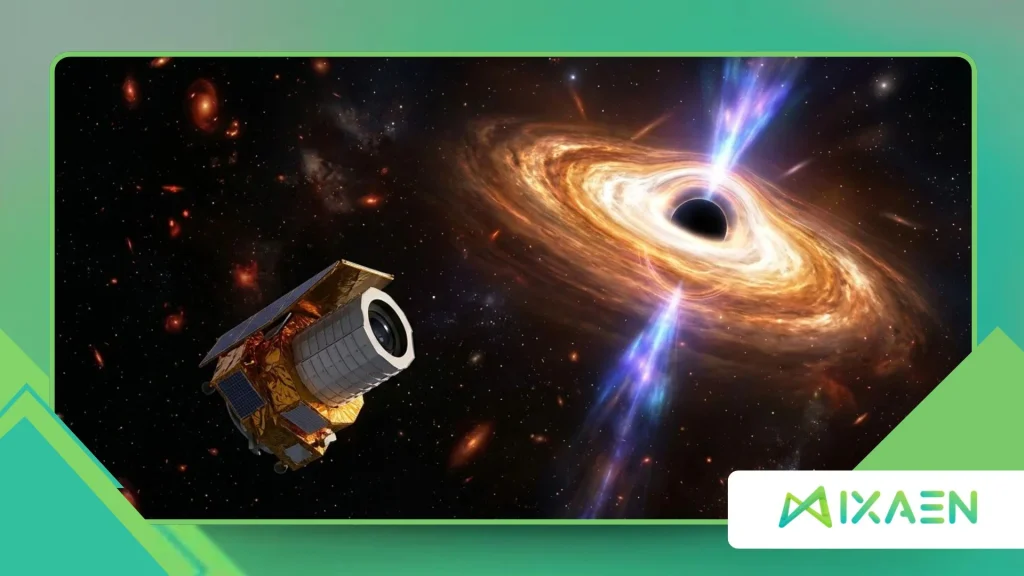
In classical astrophysics, the Eddington limit defines the maximum luminosity a body can achieve when outward radiation force balances inward gravitational pull.
If a black hole tries to swallow gas faster than this threshold, the intense light generated by the infalling plasma blasts away surrounding material, starving the engine.
Under steady Eddington-limited accretion, a black hole’s mass grows exponentially, doubling roughly every forty to fifty million years depending on how efficiently it converts mass into energy.
While exponential growth sounds fast, starting from a tiny seed requires nearly a full billion years to reach quasar proportions.
Euclid’s Ancient Quasars routinely violate this comfortable mathematical schedule by achieving billion-solar-mass status hundreds of millions of years ahead of time.
Even if a newborn black hole fed continuously at one hundred percent of the Eddington limit without a single pause, the cosmic clock still runs out too early.
Real galactic environments are messy, turbulent places where mergers, supernova explosions, and gas depletion frequently interrupt feeding cycles.
Therefore, maintaining uninterrupted maximum accretion across hundreds of millions of years borders on physical impossibility under standard radiative efficiency assumptions.
Also read: The Most Powerful Explosion Ever Detected: Still No Clear Explanation
Why Can’t Stellar-Mass Black Holes Grow Fast Enough?
Conventional theory states that the earliest black holes formed when the first generation of metal-free stars, known as Population III stars, exhausted their nuclear fuel and collapsed.
These primordial stars likely weighed between ten and one hundred times the mass of our Sun, leaving behind relatively lightweight black hole remnants.
Starting from a hundred-solar-mass seed means a black hole must increase its mass by a factor of ten million to power a bright quasar.
Bridging that colossal gap requires at least sixteen consecutive doubling cycles under ideal, uninterrupted feeding conditions.
Observational evidence from Euclid’s deep-field catalogs shows that the early universe was far too clumpy and chaotic to support smooth, continuous feeding onto lightweight seeds.
Small black holes also possess weak gravitational wells, making it easy for nearby supernova shockwaves to kick them out of dense gas clouds altogether.
Once ejected into low-density interstellar space, a lightweight seed stops growing entirely and drifts silently through its host galaxy.
Thus, relying solely on Population III stellar remnants cannot account for the thriving population of luminous giants documented in modern infrared surveys.
How Does Dark Matter Halo Assembly Complicate the Timeline?
Supermassive black holes do not evolve in isolation; they grow inside massive cradles of invisible dark matter that pull surrounding hydrogen gas inward through gravity.
According to the standard Lambda Cold Dark Matter cosmological framework, cosmic structure builds hierarchically from the bottom up.
Small dark matter clumps form first, gradually merging over hundreds of millions of years into larger galactic halos capable of trapping hot gas.
Early in cosmic history, massive dark matter halos were exceedingly rare, limiting the number of environments capable of feeding a giant black hole.
Yet the spatial distribution of Euclid’s Ancient Quasars reveals that many reside in surprisingly average dark matter environments rather than exclusively inside ultra-rare cosmic peaks.
If massive black holes can assemble inside moderate halos during the first billion years, gravity alone is not the sole bottleneck controlling their growth.
Something within baryonic gas physics such as magnetic fields, angular momentum loss, or unusual cooling mechanisms must accelerate central collapse far faster than dark matter assembly alone predicts.
Which New Theories Could Explain Euclid’s Discovery?
Could Direct-Collapse Black Holes Provide a Massive Head Start?
To bypass the agonizingly slow growth of stellar remnants, many astrophysicists favor the direct-collapse black hole hypothesis.
Under specific conditions in the primordial universe, gigantic clouds of pristine hydrogen and helium gas could collapse directly into a black hole without first fragmenting into stars.
If intense ultraviolet radiation from nearby galaxies prevented the hydrogen gas from cooling and forming molecular hydrogen, the entire cloud would implode monolithically.
This dramatic process yields a “heavy seed” weighing anywhere from ten thousand to one hundred thousand solar masses right at birth.
Starting with a hundred-thousand-solar-mass seed eliminates roughly ten doubling cycles from the black hole’s growth timeline, making billion-solar-mass quasars plausible within eight hundred million years.
Euclid’s statistical census provides crucial testing grounds for this model by measuring how frequently these early giants appear across different cosmic epochs.
If heavy seeds dominated early black hole formation, future data releases should reveal a distinct shortage of intermediate-mass quasars at extreme redshifts.
How Might Super-Eddington Accretion Bypass Cosmic Speed Limits?
Another compelling solution involves breaking the Eddington speed limit itself through episodes of chaotic, hyper-efficient feeding known as super-Eddington accretion.
The classic Eddington calculation assumes that gas falls onto a black hole symmetrically in a smooth, spherical shell.
In reality, gas forms a thick, flattened accretion disk where intense radiation can escape vertically along the rotational poles while dense streams of matter continue pouring in along the equator.
Under these geometric conditions, trapped photons get dragged inward past the event horizon faster than they can push outward.
During brief, violent bursts lasting a few million years, a black hole might swallow matter at ten or twenty times the traditional Eddington rate.
Even a lightweight stellar seed experiencing three or four intense super-Eddington feeding frenzies could rapidly balloon into a supermassive giant before the universe turned a billion years old.
Astronomers studying Euclid’s spectra look for telltale signatures of this runaway feeding, including unusually steep X-ray profiles and broad, blueshifted emission lines.
Do Primordial Black Holes Offer a Radical Cosmological Alternative?
A more provocative hypothesis suggests that the seeds of these ancient monsters did not form from stars or gas clouds at all, but emerged directly from density fluctuations during the Big Bang.
Known as primordial black holes, these hypothetical objects could have formed fractions of a second after cosmic inflation when ultra-dense pockets of spacetime collapsed under their own gravity.
Unlike stellar remnants, primordial black holes could theoretically span a wide range of initial masses, giving early galaxies ready-made gravitational anchors around which gas quickly accumulated.
While primordial black holes remain speculative, the sheer abundance of high-redshift structures uncovered by Euclid and complementary observatories keeps the theory alive in academic journals.
If primordial seeds existed in sufficient numbers, they would naturally accelerate early galaxy assembly without requiring exotic gas physics or fine-tuned radiation fields.
Testing this idea requires precise measurements of gravitational waves and subtle distortions in the cosmic microwave background over the coming decade.
Standard Growth Models vs. Euclid’s Observational Reality
| Cosmic Parameter | Traditional Black Hole Growth Model | Euclid’s Ancient Quasar Observations | Astrophysical Implication |
| Initial Seed Mass | 10 to 100 solar masses (Population III stellar remnants) | Likely requires 10,000+ solar masses or rapid early mergers | Lightweight stellar seeds cannot reach observed masses in time |
| Accretion Rate Limit | Strictly capped at the radiative Eddington limit | Evidence points toward episodic super-Eddington feeding bursts | Spherical accretion symmetry breaks down in dense gas disks |
| Assembly Timeline | 1.0 to 1.5 billion years to reach 1 billion solar masses | Mature 1–3 billion solar mass engines seen at 700–800 million years | Early cosmic structure formed significantly faster than simulated |
| Host Environment | Restricted exclusively to the rarest, most massive dark matter halos | Found across broader, moderately dense primordial environments | Baryonic gas physics accelerates collapse beyond dark matter pacing |
| Feedback Behavior | Radiation pressure halts accretion once critical luminosity is reached | Sustained mass growth alongside powerful ionized gas outflows | Cold gas filaments penetrate outflows to keep feeding the core |
Rewriting the First Chapter of Cosmic History
The discoveries emerging from Euclid’s Ancient Quasars prove that the early universe was far more dynamic, efficient, and surprising than standard cosmological simulations ever imagined.
Rather than slowly assembling over billions of years through gentle mergers and capped accretion, the first supermassive black holes harnessed extreme physics to dominate their host galaxies almost immediately.
As the Euclid mission continues mapping billions of galaxies across a third of the sky through the end of the decade, its expanding catalog will pinpoint whether direct-collapse heavy seeds, super-Eddington feeding bursts, or primordial remnants built these early titans.
Each new spectrum sharpens our understanding of how darkness gave way to the first blinding beacons of cosmic light.
What mechanism do you think played the biggest role in building these early cosmic giants massive direct-collapse seeds or runaway super-Eddington feeding? Share your thoughts and theories in the comments below.
Frequently Asked Questions
What is the Euclid space telescope’s main mission?
The European Space Agency launched Euclid primarily to investigate the nature of dark matter and dark energy by mapping the three-dimensional distribution of billions of galaxies across ten billion years of cosmic history.
While measuring weak gravitational lensing and galaxy clustering, its wide-field infrared instruments also capture vast numbers of distant quasars and early galaxies.
How can we see quasars from the early universe if black holes trap light?
Black holes themselves emit no light, but the superheated disk of gas, dust, and plasma spiraling furiously around the event horizon glows brighter than an entire galaxy of hundreds of billions of stars.
Friction and magnetic forces convert gravitational energy into intense ultraviolet and optical radiation, which stretches into infrared wavelengths as it travels across expanding space toward Earth.
How do Euclid’s observations differ from those of the James Webb Space Telescope?
The James Webb Space Telescope acts like a high-magnification zoom lens capable of studying individual faint objects in extraordinary detail over tiny patches of sky.
Euclid functions like a wide-angle survey camera, scanning massive regions of the cosmos quickly to discover rare, ultra-bright objects like ancient quasars that narrow-field telescopes might miss entirely.
What is a quasar’s redshift and what does it tell astronomers?
Redshift measures how much the expansion of the universe has stretched a light wave during its journey to our telescopes.
A higher redshift indicates that the light left its source farther back in cosmic time, allowing astronomers to pinpoint both the distance of a quasar and the exact age of the universe when that light was emitted.
Could these ancient black holes pose any threat to our own Milky Way galaxy?
No, these ancient quasars sit billions of light-years away, meaning we observe them as they existed more than twelve billion years ago when the universe was young.
Today, those early quasars have long since consumed their surrounding fuel supplies and evolved into quiet, dormant supermassive black holes resting peacefully at the centers of modern elliptical galaxies, much like Sagittarius A* at the heart of our Milky Way.
