
What MMX’s Idefix Rover Will Search for on Phobos
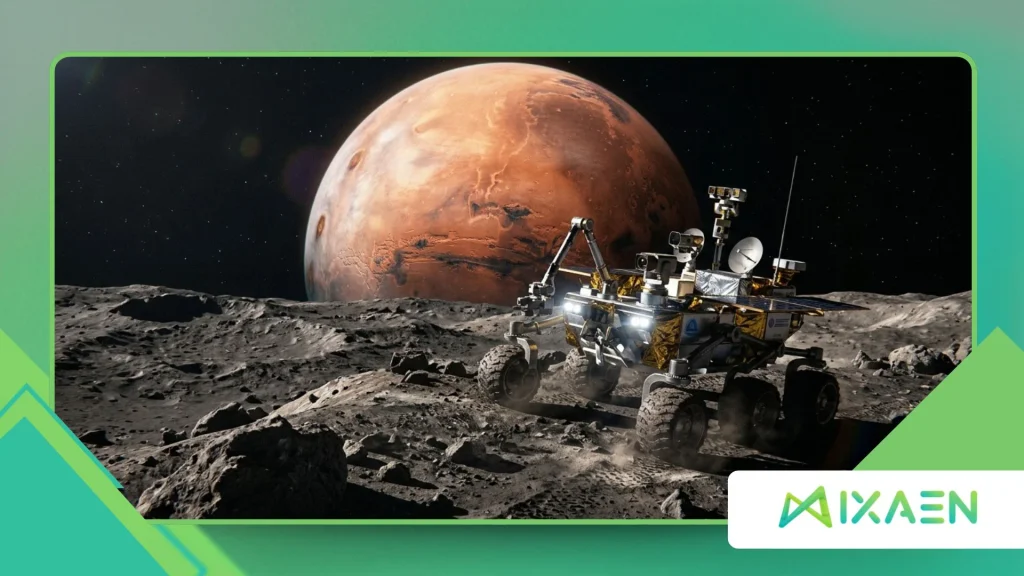
MMX’s Idefix Rover represents one of the most ambitious robotic scouts ever built for deep space exploration, designed to solve a fifty-year-old mystery about Mars’ largest moon.
Developed jointly by the German Aerospace Center (DLR) and the French National Centre for Space Studies (CNES), this compact, wheeled explorer rides aboard the Japan Aerospace Exploration Agency’s (JAXA) Martian Moons eXploration (MMX) spacecraft.
As mission engineers finalize preparations following the launch window adjustments toward late 2026, planetary scientists are eagerly anticipating what happens when this agile machine touches down on a world where gravity is nearly two thousand times weaker than on Earth.
Unlike traditional Mars rovers that slowly traverse rocky plains, this 25-kilogram vehicle must actively right itself after a forty-meter free-fall drop onto a dusty, low-gravity surface.
Once upright, its primary mission begins: analyzing the raw surface material, measuring thermal behavior, and scouting safe landing zones before the main spacecraft descends to collect samples for return to Earth.
Will this tiny robotic pathfinder finally prove whether Phobos is a captured asteroid from the outer solar system or a fragment blasted off ancient Mars by a colossal impact?
In This Guide:
- What Primary Scientific Targets Will the Rover Investigate on Phobos?
- How Will the Rover’s Instruments Analyze Surface Composition and Dust?
- Why Does Phobos’ Origin Matter for Understanding the Solar System?
- Technical Overview of the Idefix Scientific Payload
- Charting the Future of Martian Moon Exploration
- Frequently Asked Questions
What Primary Scientific Targets Will the Rover Investigate on Phobos?
What Surface Properties Will the Rover Examine First?
The immediate priority upon touchdown involves characterizing the physical mechanics of Phobos’ regolith, which is the loose layer of dust and crushed rock covering the moon’s bedrock.
Scientists need to know exactly how deep this powdery blanket goes and how tightly its individual grains stick together in microgravity.
If the dust behaves like dry talcum powder or electrostatic ash, the rover’s wheels could sink or spin uselessly without gaining forward traction.
To prevent mission failure, engineers equipped the vehicle with specialized cameras that observe wheel-soil interactions in real time as the rover inches across the terrain.
Imagine trying to walk across a beach made of flour while wearing moon boots that weigh almost nothing; every step could send clouds of debris floating into space.
Measuring cohesion, grain size, and surface porosity provides the exact engineering metrics JAXA needs to safely land the much larger mother spacecraft nearby.
Which Geological Features Hold Clues to the Moon’s Past?
Beyond basic soil mechanics, the rover will search for exposed rock outcrops, fresh impact craters, and mysterious linear grooves that crisscross the Martian moon’s surface.
Many researchers believe these parallel troughs formed when debris ejected from massive Martian impacts scraped across Phobos, or when tidal forces from Mars slowly began pulling the moon apart.
Inspecting the walls and floors of small craters allows the rover to peer beneath the weathered top layer into pristine subsurface material.
By driving up to 100 meters across varied geological units, the rover acts as a mobile field geologist comparing different patches of terrain.
Each boulder and crater rim tells a distinct chapter of violent cosmic collisions that shaped the inner solar system over four billion years ago.
Documenting the shape, angularity, and distribution of these rocks helps scientists distinguish between native lunar bedrock and foreign meteorite fragments scattered across the landscape.
++ How Hera’s CubeSats Will Study Dimorphos During Arrival
How Does Space Weathering Alter the Phobos Landscape?
Airless worlds like Phobos endure constant bombardment from solar wind particles, cosmic rays, and micrometeorites that chemically and physically alter exposed minerals over millions of years.
MMX’s Idefix Rover will search for variations in color and brightness between undisturbed surface dust and freshly exposed soil churned up by its own wheels.
Comparing darkened, radiation-baked grains with brighter material underneath reveals how quickly space weathering transforms planetary surfaces near Mars.
Understanding these alteration processes is essential because orbital telescopes only see the very top micrometer of a planetary body’s skin.
Without ground-truth measurements from a surface rover, remote spectral readings can easily misidentify common minerals as exotic compounds.
Tracking how solar radiation modifies iron-bearing silicates on Phobos establishes a crucial calibration benchmark for studying asteroids and moons throughout the solar system.
How Will the Rover’s Instruments Analyze Surface Composition and Dust?
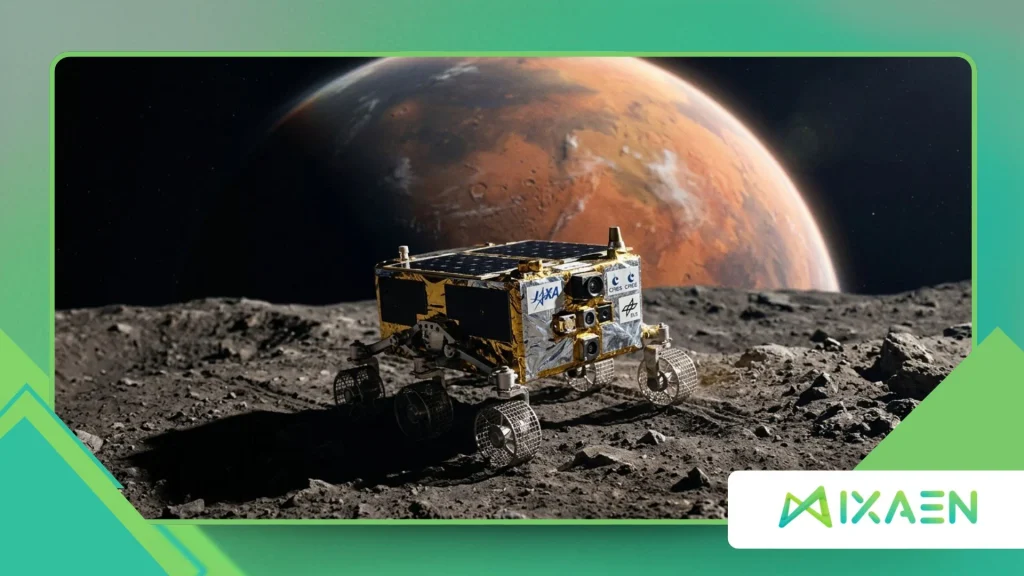
How Does the Raman Spectrometer Identify Hidden Minerals?
At the heart of the rover’s analytical suite sits RAX, a compact Raman spectrometer developed by DLR, JAXA, and Spanish research institutions to identify molecular structures without touching the sample.
This instrument fires a focused green laser beam onto the Martian moon’s soil and measures the faint scattered light that bounces back at shifted wavelengths.
Because every mineral vibrates at a unique atomic frequency, the returning light acts as an unmistakable chemical fingerprint for silicates, sulfates, and carbon-rich organic compounds.
Detecting hydrated minerals or complex carbon molecules on Phobos would provide compelling evidence that the moon originated in the cold, water-rich outer asteroid belt.
Conversely, finding dry volcanic minerals identical to those on the Martian crust would strongly support the giant-impact formation hypothesis.
Operating this laser laboratory directly on the ground eliminates atmospheric distortion and delivers definitive mineralogical answers within minutes of each measurement.
++ How In-Space Mobility Systems Expand Deep Space Exploration
What Will the Wheel Cameras Reveal About Soil Cohesion?
Mounted directly beneath the rover’s chassis, two downward-looking WheelCams continuously photograph the contact patch where the aluminum grousers press into the dark regolith.
These optical sensors capture high-resolution images of soil compression, clumping, and grain displacement during every rotation of the four independent wheels.
Engineers designed this system specifically because laboratory simulations on Earth cannot fully replicate microgravity dust behavior inside a vacuum chamber.
When a wheel turns on Phobos, electrostatic forces between tiny dust particles can become stronger than the local pull of gravity itself.
Think of how static electricity makes styrofoam packing peanuts cling stubbornly to your hands on a dry winter day; Phobos’ dust behaves in a remarkably similar way.
Analyzing these images ensures that MMX’s Idefix Rover can navigate safely while teaching spacecraft designers how to build better landing pads for future human missions to Mars.
Also read: Why Cislunar Communications Matter Beyond Lunar Exploration
Why Are Surface Temperature Measurements Critical for Mission Success?
Completing the scientific payload, the miniRAD radiometer measures thermal infrared radiation emitted by the soil to determine how fast Phobos heats up and cools down during its rapid seven-hour rotation.
Coarse gravel and solid bedrock retain heat long after sunset, whereas fine, fluffy dust loses thermal energy almost instantaneously when plunged into shadow.
By mapping these temperature swings across day-night cycles, the radiometer calculates the exact thermal inertia and grain size distribution of the landing site.
According to mission data published by the German Aerospace Center (DLR), surface temperatures on Phobos swing dramatically between roughly minus 4 degrees Celsius in direct sunlight and minus 112 degrees Celsius during the frigid lunar night.
Surviving and measuring across this 108-degree thermal chasm tests the endurance of the rover’s insulated electronics and solar arrays.
Furthermore, thermal mapping helps identify localized pockets of subsurface water ice that might remain trapped inside permanently shadowed crater recesses.
Why Does Phobos’ Origin Matter for Understanding the Solar System?
Could Phobos Be a Captured Asteroid from the Outer Solar System?
One major scientific hypothesis proposes that Phobos and its smaller sibling Deimos are primitive C-type or D-type asteroids captured by Mars’ gravity during the chaotic early days of planetary formation.
Spectral observations from orbit show that Phobos reflects very little light, making it as dark as fresh asphalt and visually similar to carbon-rich asteroids near Jupiter.
If MMX’s Idefix Rover confirms this asteroid identity, it means Mars successfully snagged volatile-rich building blocks that normally reside much farther from the Sun.
Captured asteroids are essentially frozen time capsules containing water and prebiotic organic molecules delivered to the inner planets billions of years ago.
Proving this theory would reshape current models of how Earth and Mars acquired their oceans and atmospheric gases.
Rather than spending decades sending separate probes to the outer asteroid belt, scientists could study pristine outer-solar-system material right in Mars’ backyard.
Did a Giant Impact on Ancient Mars Create Its Two Moons?
The competing scientific theory argues that a protoplanet roughly one-third the size of Mars slammed into the red planet billions of years ago, blasting a massive ring of molten debris into orbit.
Over time, gravity coalesced that orbiting disk of vaporized Martian rock and impactor material into the two irregular moons we observe today.
Orbital dynamics strongly favor this scenario because Phobos orbits almost directly above Mars’ equator in a nearly circular path, which is difficult to achieve through random asteroid capture.
If the rover’s instruments detect high-temperature minerals and isotopic ratios matching Martian basalt, the giant-impact model will triumph.
Such a discovery would offer unprecedented insight into Mars’ early crust before erosion, volcanism, and climate collapse altered the planet’s surface.
Studying Phobos would effectively allow geologists to examine a preserved piece of ancient Mars without having to launch a heavy rocket off the Martian surface.
How Will Rover Findings Guide Sample Return and Human Exploration?
Beyond pure planetary science, every measurement collected by MMX’s Idefix Rover directly reduces operational risks for the main JAXA mothership, which must touch down to collect at least 10 grams of regolith.
Knowing the exact bearing strength and boulder density of the surface prevents the larger spacecraft from tipping over or damaging its sampling corer during its brief touch-and-go maneuver.
Once returned to Earth, those samples will undergo microscopic laboratory analysis far beyond the capability of any robotic spacecraft.
In the broader context of space exploration, Phobos is widely considered a strategic stepping stone for future crewed expeditions to Mars.
Because escaping Phobos’ weak gravity requires minimal rocket fuel, future astronauts could establish a base on the moon to tele-operate robots on the Martian surface below in real time.
Identifying potential water-bearing minerals or radiation-shielding regolith properties today lays the practical groundwork for sustainable human infrastructure in the Martian system tomorrow.
Technical Overview of the Idefix Scientific Payload
| Instrument / Subsystem | Lead Developing Agency | Primary Target on Phobos | Key Scientific & Engineering Output |
| RAX (Raman Spectrometer) | DLR, JAXA, INTA, Univ. of Valladolid | Surface mineral grains and rocks | Identifies molecular composition, silicates, sulfates, and carbon compounds |
| NavCam (Stereo Navigation Cameras) | CNES (France) | Surrounding terrain and topography | Generates 3D stereo maps for obstacle avoidance and geological context |
| WheelCam (Two Downward Cameras) | CNES (France) | Regolith directly beneath the wheels | Measures soil cohesion, grain displacement, and wheel sinkage in microgravity |
| miniRAD (Thermal Radiometer) | DLR (Germany) | Surface thermal infrared emissions | Determines regolith grain size, porosity, and surface temperature variations |
Charting the Future of Martian Moon Exploration
The upcoming surface operations of MMX’s Idefix Rover mark a defining milestone in international planetary robotics, uniting European engineering ingenuity with Japanese deep-space navigation.
By combining laser spectroscopy, close-up wheel imaging, and thermal radiometry on a 25-kilogram platform, the mission will decode the true origin of Phobos while safeguarding the primary sample-return spacecraft.
Whether Mars’ enigmatic moon turns out to be a captured carbonaceous asteroid or a remnant of a cataclysmic Martian impact, the data gathered on its dusty plains will rewrite planetary science textbooks.
What discovery on Phobos are you most excited to see proof of ancient Martian crust or pristine organic building blocks from the outer solar system? Share your thoughts and predictions in the comments below!
Frequently Asked Questions
1. Why is the MMX rover named Idefix?
The rover is named after Idefix (known as Dogmatix in English), the small, clever, and loyal white dog from the classic French comic series Asterix.
DLR and CNES chose the name to symbolize the rover’s compact 25-kilogram stature, agility, and pioneering spirit as the first wheeled robot to explore a Martian moon.
2. How does the Idefix rover land on Phobos without crashing or bouncing into space?
Because Phobos’ gravity is roughly 1/2,000th that of Earth, conventional parachutes and heavy retrorockets are ineffective.
Instead, the main MMX spacecraft descends to an altitude of about 40 meters and releases the rover into a gentle free fall, allowing it to bounce softly on the surface before deploying its four legs to right itself automatically.
3. How long will the rover operate on the surface of Phobos?
Mission planners designed the rover to operate nominally for approximately 100 Earth days on the Martian moon’s surface.
During this three-month campaign, solar panels will power its cameras, spectrometers, and drive motors as it travels up to 100 meters across different geological targets.
4. What happens to the rover after its primary mission ends?
Once the rover completes its surface measurements and transmits all scientific telemetry back to the orbiting MMX mothership, it will remain permanently on Phobos as a silent robotic monument.
The main JAXA spacecraft will subsequently conduct its own touch-and-go sampling maneuvers before departing Mars orbit to return Phobos regolith samples to Earth.
5. Can the Idefix rover drill deep beneath the surface of Phobos?
No, the rover does not carry a deep-drilling rig due to its strict 25-kilogram mass limit and Phobos’ extremely low gravity, where drilling would push the vehicle off the ground.
Instead, its spinning wheels churn up the top few centimeters of dust, exposing fresh subsurface grains for its Raman laser spectrometer and cameras to analyze.
