
How Kelvin-Helmholtz Instabilities Create Tiny Solar Vortices
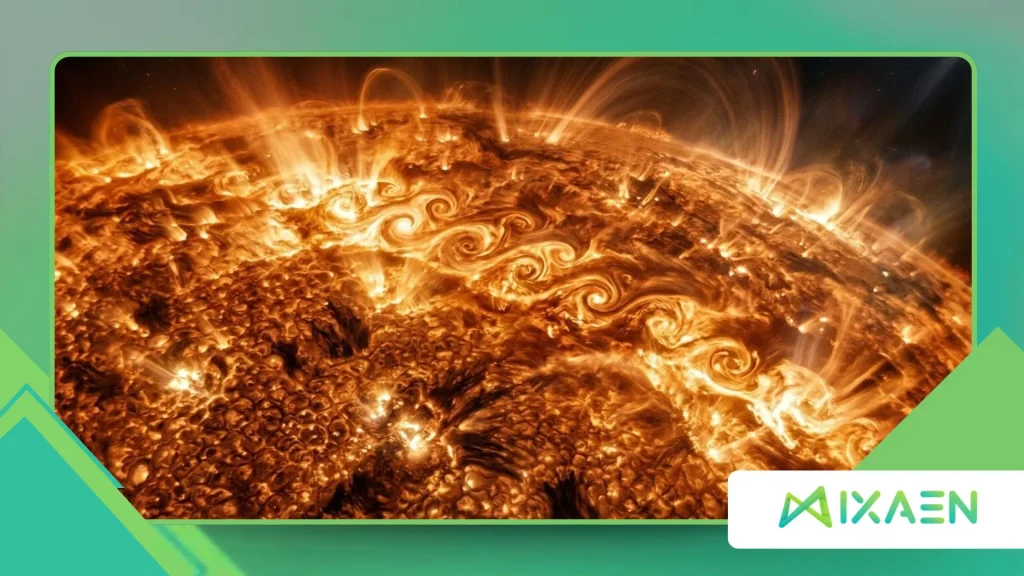
Kelvin-Helmholtz Instabilities Create Tiny Solar Vortices across the turbulent, magnetically charged outer layers of our star, transforming steady plasma flows into mesmerizing rotational phenomena.
Modern heliophysicists studying solar dynamics have uncovered that whenever two adjacent streams of magnetized plasma flow past each other at differential speeds, hydrodynamic friction takes over.
This relentless shearing action mirrors terrestrial fluid mechanics observed in Earth’s oceans and atmospheric cloud layers, yet operates on an extreme astrophysical scale powered by intense magnetic fields.
Understanding these miniature swirling structures offers profound insights into how energy travels through the sun’s atmosphere and ultimately impacts interplanetary space weather.
Quick Overview of Core Topics Covered
- The fundamental fluid mechanics governing plasma shear and velocity differences in the solar atmosphere.
- Advanced spaceborne observational instruments tracking high-resolution coronal loops in real time.
- The critical role these microscopic rotational structures play in coronal heating and solar wind acceleration.
What Drives Dynamic Plasma Shear in the Solar Atmosphere?
What triggers magnetic shear in the solar atmosphere?
Magnetic shear originates when footpoints of coronal loops shift across the photosphere due to deep-seated convective motions.
These relentless subsurface currents twist and distort overarching magnetic field lines, creating localized regions of extreme mechanical stress.
As magnetic pressure builds, adjacent flux tubes are forced into opposing trajectories, setting the stage for velocity discontinuities.
Within these high-stress boundaries, the magnetic field acts as an elastic anchor rather than a rigid barrier.
When the velocity gradient between two adjacent plasma streams exceeds a critical threshold, laminar flow breaks down entirely.
This exact physical mechanism underpins how Kelvin-Helmholtz Instabilities Create Tiny Solar Vortices along narrow coronal structures, translating bulk kinetic energy into small-scale turbulence.
How does plasma flow drive velocity differences?
Plasma velocity variations on the sun are driven by differential rotation and intense thermal gradients erupting from the convective zone.
Hot, ionized gas surges upward through granules at velocities reaching several kilometers per second, while cooler surrounding plasma descends.
When these diverging flows collide or run parallel at unequal speeds, a sharp shear interface forms instantly.
Consider an original example: picture two opposing river currents meeting where a solid pier divides the water, instantly spinning up whirlpools along the boundary layer.
Similarly, fast solar wind streams passing slower-moving coronal loops generate severe velocity discrepancies.
This shearing friction strips momentum from the faster flow, curling the interface into distinct, rotating vortices that ripple across the solar limb.
++ How the Sun’s Magnetic Field Shapes the Entire Solar System
What role do coronal loops play in vortex generation?
Coronal loops serve as natural magnetic conduits that trap dense, luminous plasma high above the solar surface.
Because these arching structures are anchored to active regions rotating at different latitudes, their internal plasma experiences continuous lateral displacement.
The resulting boundary friction creates ideal conditions for wave steepening and hydrodynamic instability.
As these loops oscillate under the influence of global solar vibrations, internal shear layers experience periodic amplification.
A second original example involves a vibrating guitar string interacting with ambient air currents to create localized eddies; similarly, vibrating coronal loops spawn microscopic vortices along their flanks.
These rotational structures act as efficient conduits, channeling magnetic energy into thermal dissipation across the outer corona.
How Modern Observational Instruments Capture Solar Dynamics
What instruments capture high-resolution solar imagery?
Unlocking the secrets of sub-arcsecond solar features requires unprecedented optical resolution and extreme ultraviolet sensitivity.
Instruments aboard modern orbital observatories, such as the Atmospheric Imaging Assembly (AIA) on NASA’s Solar Dynamics Observatory (SDO) and the Extreme Ultraviolet Imager (EUI) on ESA’s Solar Orbiter, provide the necessary precision.
These advanced telescopes peer deep into the sun’s chaotic outer atmosphere with remarkable clarity.
By capturing images at rapid cadence intervals, scientists can track rapid morphological changes in active regions.
Researchers analyzing these high-resolution data streams have documented that Kelvin-Helmholtz Instabilities Create Tiny Solar Vortices lasting only a few minutes before dissipating into thermal energy.
Such temporal fidelity is vital for distinguishing genuine magnetohydrodynamic waves from instrumental noise.
Also read: Solar Tornadoes: What They Are and Why They Matter
How do space observatories measure magnetic fields?
Measuring invisible magnetic fields across a dynamic star requires sophisticated spectropolarimetric techniques.
Instruments like the Heliospheric Magnetic Imager (HMI) analyze the Zeeman effect in photospheric absorption lines, mapping vector magnetic fields with extraordinary accuracy.
This allows researchers to reconstruct the three-dimensional magnetic architecture underlying visible plasma flows.
When combined with ultraviolet coronal imagery, magnetic field maps reveal the precise locations where velocity shear reaches critical limits.
A relevant statistic highlights this precision: advanced spaceborne coronagraphs routinely track solar wind velocity shear zones exceeding $300\text{ km/s}$ across coronal boundaries.
These quantitative measurements confirm theoretical fluid models under extreme astrophysical conditions.
Read more: The Parker Solar Probe: Flying Into the Heart of Our Star
Why is ultraviolet imaging crucial for tracking vortices?
Ultraviolet and extreme ultraviolet wavelengths are emitted by highly ionized iron and helium atoms blazing at temperatures between one and three million Kelvin.
Standard visible-light telescopes cannot resolve the faint, superheated plasma features threading through the corona.
Ultraviolet imaging isolates specific thermal emission bands, illuminating the intricate structure of loops, flares, and turbulent shear layers.
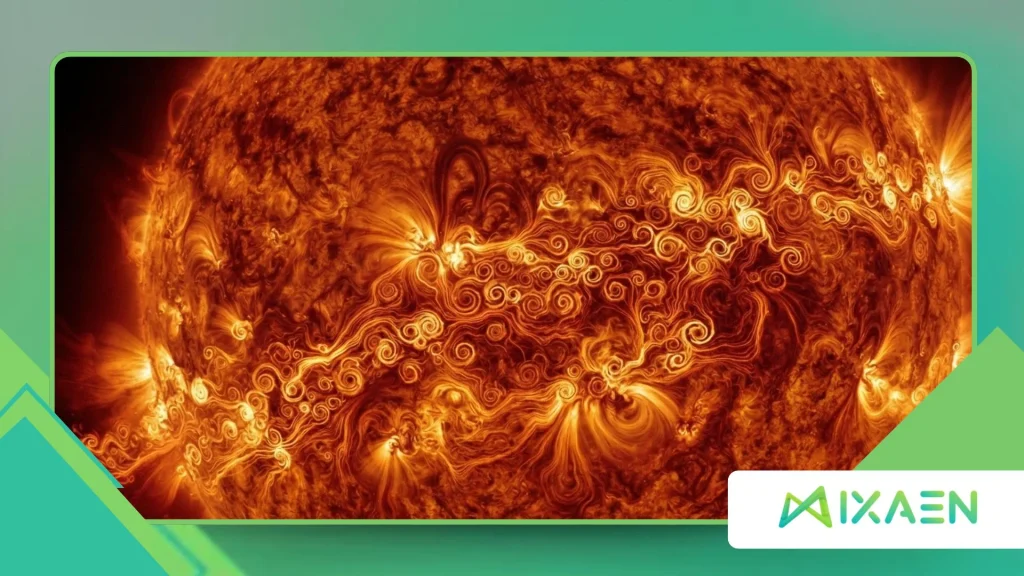
Through these specialized filters, astronomers observe the classic roll-up pattern characteristic of fluid instabilities in real time.
It is here that Kelvin-Helmholtz Instabilities Create Tiny Solar Vortices become visually apparent as bright, curling tendrils of plasma wrapping around darker magnetic cores.
This direct visualization bridges the gap between theoretical magnetohydrodynamics and empirical observation.
Why Tiny Solar Vortices Matter for Space Weather Dynamics
How do magnetic waves heat the solar corona?
One of the longest-standing mysteries in solar physics is why the sun’s outer atmosphere is hundreds of times hotter than its underlying surface.
While photospheric temperatures hover around 6,000 Kelvin, the corona reaches staggering temperatures exceeding two million Kelvin.
Recent studies point toward microscopic turbulence and wave dissipation as primary heating mechanisms.
As swirling structures break down, they generate turbulent cascades that dissipate magnetic energy as heat through resistive and viscous damping.
A notable scientific reference, published in The Astrophysical Journal by prominent solar physicists analyzing SDO telemetry, demonstrates that localized vortex dissipation contributes significantly to coronal plasma heating.
This continuous churning prevents the solar atmosphere from cooling down.
What impact do solar vortices have on geomagnetic storms?
Solar weather originates from dynamic events in the solar atmosphere that eject magnetized plasma toward Earth.
While large coronal mass ejections drive major geomagnetic storms, smaller-scale turbulence influences the steady background solar wind.
Tiny vortices generated by plasma shear contribute to the complex internal structuring of interplanetary magnetic fields.
When these structured solar wind streams arrive at Earth, they interact with our planet’s magnetosphere, modulating auroral displays and satellite operations.
Understanding how Kelvin-Helmholtz Instabilities Create Tiny Solar Vortices helps forecasters model the propagation of space weather disturbances with greater accuracy.
This predictive capability protects critical orbital infrastructure and global communication networks.
How do researchers model coronal turbulence today?
Simulating the sun’s violent magnetohydrodynamic environment pushes the boundaries of modern supercomputing.
Researchers utilize complex three-dimensional numerical models to replicate plasma behavior under conditions that cannot be duplicated in terrestrial laboratories.
Analogously, just as meteorologists use fluid dynamic equations to model atmospheric jet streams on Earth, astrophysicists apply magnetohydrodynamic Navier-Stokes equations to solar plasma.
These sophisticated computer simulations successfully reproduce the onset, growth, and eventual breakdown of rotational instabilities in coronal loops.
By comparing model outputs with real-time orbital telemetry, scientists continuously refine our understanding of solar thermodynamics.
Ultimately, tracking how Kelvin-Helmholtz Instabilities Create Tiny Solar Vortices remains a cornerstone of modern space physics research.
Informative Solar Dynamics Data Reference
| Parameter / Feature | Observational Instrument | Typical Scale / Value | Primary Astrophysical Role |
| Coronal Loop Shear | SDO / AIA | 1,000 to 10,000 km | Triggers boundary layer instability |
| Plasma Velocity Gradient | Solar Orbiter / EUI | 100 to 300 km/s | Drives kinetic energy transfer |
| Vortex Lifetime | Hinode / SOT | 3 to 15 minutes | Dissipates energy into coronal heat |
Unlocking the Secrets of Solar Dynamics
Summarizing these groundbreaking insights, the intricate interplay between magnetic fields and plasma flows continuously shapes the chaotic environment of our nearest star.
From localized velocity shear to large-scale coronal heating, microscopic rotational phenomena play a profound role in governing space weather.
As observational technology advances, heliophysicists continue to decode the mysteries hidden within the sun’s blazing atmosphere.
Share your thoughts or questions about these remarkable solar phenomena in the comments below!
Frequently Asked Questions
What exactly is a solar vortex?
A solar vortex is a localized swirling motion of superheated plasma occurring within the sun’s atmosphere, driven by magnetic and hydrodynamic forces.
How do scientists detect these microscopic vortices?
Scientists detect them using advanced spaceborne telescopes operating in extreme ultraviolet wavelengths, capturing rapid changes in coronal loop morphology.
Why are Kelvin-Helmholtz instabilities important for coronal heating?
They create turbulent energy cascades that efficiently convert magnetic and kinetic energy into thermal heat, maintaining high coronal temperatures.
Can solar vortices affect technology on Earth?
Yes, by contributing to the complex structure of the solar wind, they influence geomagnetic activity that interacts with Earth’s magnetosphere and satellites.
Where can I follow real-time solar observation updates?
You can monitor daily solar activity through public portals managed by space agencies like NASA and the European Space Agency.
