
Why Noncommutative Spacetime Models Challenge Classical Physics
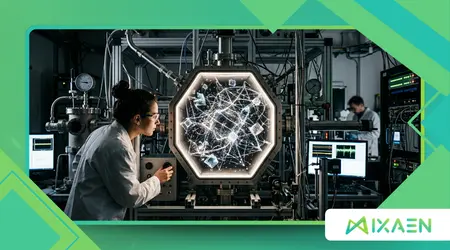
Noncommutative Spacetime Models offer a revolutionary perspective that changes our core understanding of reality by challenging traditional views of space, time, and classical geometry.
This radical framework suggests that the coordinates of our universe do not commute, meaning that measuring a precise position changes our ability to accurately define another variable simultaneously.
In the vast landscape of theoretical physics, this concept serves as a crucial bridge aimed at resolving the long-standing conflict between general relativity and quantum mechanics.
By treating smooth spacetime as a microscopic structure of blurry coordinates, physicists are attempting to construct a viable theory of quantum gravity.
Key Discussion Points
- The Foundational Shift: Why traditional geometry fails at subatomic distances.
- The Heisenberg Factor: How noncommuting coordinates redefine the fabric of space.
- Empirical Constraints: The rigorous satellite data testing these abstract models.
- The Quantum Resolution: How fuzzy space avoids catastrophic black hole singularities.
What is the Core Meaning of Noncommutative Spacetime Models?
To grasp this concept, we must first realize that classical physics treats space as a smooth, continuous fabric where anyone can locate an object with absolute precision.
However, when we apply quantum principles to the fabric of reality, that neat predictability completely breaks down at the Planck scale.
At this unfathomably tiny distance, the smooth mathematical coordinates traditionally used by scientists are replaced by operators that do not commute with each other.
This physical change implies that space itself becomes fundamentally blurry, preventing the precise, simultaneous measurement of length, width, and height in the universe.
++ How Causal Dynamical Triangulation Reveals Fractal Spacetime
Why Do These Mathematical Models Eliminate Point-Like Particles?
If coordinates cannot be isolated independently, the classic concept of an infinitely small point in space becomes physically impossible to define or sustain.
This shift forces physicists to abandon traditional point-like particles, replacing them with fuzzy, localized cells of energy that occupy a minimum volume.
Consider a practical example: when an artist paints using tiny, sharp dots, a closer look reveals distinct, isolated points on the canvas.
If the canvas itself becomes fuzzy, those sharp points inevitably dissolve into interconnected pools of color, which perfectly mirrors how this framework blurs reality.
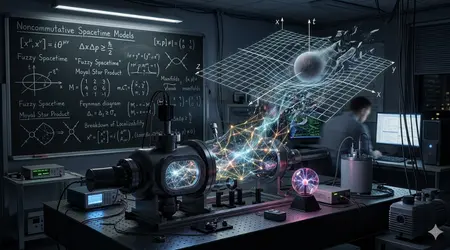
Why Do These Models Actively Challenge Classical Physics?
Classical physics relies on the assumption that space is an empty, passive background where physical events unfold without altering the underlying coordinate system.
Einstein changed this by showing that mass bends space, yet general relativity still assumes that the spatial canvas remains smooth and continuous.
By introducing a grainy, noncommuting structure, these new theories directly challenge the foundational mathematics that scientists have relied upon for centuries.
They suggest that our smooth reality is merely a macroscopic illusion, much like a digital image that appears fluid until you zoom into individual pixels.
| Physical Attribute | Classical Physics View | Noncommutative Spacetime View |
| Space Structure | Smooth, continuous, and infinitely divisible | Fuzzy, grainy, and quantized into cells |
| Measurement Limits | No fundamental limit to spatial precision | Bound by a minimal, indivisible length |
| Locality | Events are strictly isolated and local | Non-local interactions alter distant coordinates |
| Singularities | Infinite density occurs at black hole centers | Infinite densities are naturally prevented |
How Do They Solve the Crisis of Infinite Density?
In classical general relativity, the collapse of a massive star creates a black hole singularity where gravity and density become completely infinite.
These infinite values frustrate physicists because they signal that our current mathematical equations have stopped working and require a deep rethink.
When applying noncommutative spacetime models, these problematic mathematical infinities are naturally eliminated because space cannot be compressed into an infinitely small point.
The minimum structural volume acts as a natural buffer, spreading the collapsing mass across a fuzzy region and preventing physical singularities.
Also read: Could Time Be a Psychological Artifact Instead of a Physical Dimension?
What Role Does Non-Locality Play in the Quantum Cosmos?
Another startling consequence of this framework is the emergence of inherent non-locality, where an action here instantly influences an event over there.
Because the coordinate operators are fundamentally intertwined, modifying a local parameter automatically alters the properties of the broader spatial network.
An excellent analogy is a tightly woven piece of fabric: tugging on a single loose thread instantly warps the pattern across the entire shirt.
This holistic spatial interconnectedness shatters the classical belief that forces can only interact through localized, independent fields in the universe.
How Can Scientists Validate These Abstract Theories Realistically?
The greatest obstacle facing these advanced frameworks is the extreme difficulty of conducting direct physical experiments at the microscopic Planck scale.
This tiny realm is many orders of magnitude smaller than what our most powerful particle accelerators can currently probe on Earth.
Despite these immense scale limitations, modern astrophysicists are finding clever ways to test noncommutative spacetime models by observing giant cosmic events.
By analyzing light that has traveled billions of years across the universe, researchers can look for tiny, accumulated distortions in photon behavior.
What Do Recent Space Satellite Observations Reveal?
A major breakthrough occurred when scientists analyzed data from the Fermi Gamma-ray Space Telescope to track high-energy photons emitted by distant gamma-ray bursts.
If space were truly grainy and noncommuting, different wavelengths of light would travel at slightly altered speeds through the fuzzy coordinate network.
The strict empirical data revealed that photons of varying energies arrived at the satellite detectors at essentially the exact same cosmic moment.
This precise observation placed a vital constraint on early theories, forcing mathematical physicists to refine their equations to match observed reality.
Read more: Is Consciousness a Fundamental Component of Spacetime?
How Do Atomic Interferometers Test the Graininess of Space?
Closer to home, precision laboratory experiments are utilizing advanced atomic interferometers to detect the subtle, microscopic signature of fuzzy spatial coordinates.
These sensitive instruments split atomic waves apart and recombine them to measure incredibly microscopic shifts in phase, position, and overall cosmic orientation.
If the background coordinates are truly noncommuting, the atoms should exhibit a microscopic, random jitter as they move through the laboratory space.
While no definitive jitter has been verified yet, these ongoing experiments are continuously narrowing the allowed parameters for modern quantum gravity.
What is the Future of Unified Physics Knowledge?
The ongoing exploration of noncommuting coordinates is transforming how humanity views the ultimate origin and final destiny of our universe.
By challenging classical physics at its core, this framework offers a fresh path toward the long-sought Unified Theory of Everything.
As observational technology improves, the boundary between abstract mathematical philosophy and concrete empirical science will continue to blur.
Whether these models are completely vindicated or replaced, they are forcing us to rethink the true meaning of space and time.
Final Thoughts
Ultimately, noncommutative spacetime models show us that the universe is far more interconnected than classical physics ever anticipated.
By replacing smooth, predictable points with a dynamic network of fuzzy quantum relationships, this framework redefines the cosmos. As we gather more astrophysical data, we move closer to uncovering the true, pixelated nature of our reality.
What are your thoughts on a blurry, pixelated universe? Share your thoughts and insights in the comments section below!
Frequently Asked Questions
What does it mean when coordinates do not commute?
It means the mathematical order of measurement changes the final result, implying that identifying one spatial value blurs the accuracy of another.
How does this model differ from Einstein’s general relativity?
Einstein viewed space as a smooth, continuous fabric bent by mass, whereas this model views space as fundamentally grainy, fuzzy, and quantized.
Has fuzzy spacetime been proven by modern science?
No, it remains a brilliant theoretical framework, though active satellite observations and atomic experiments are currently testing its cosmic boundaries.
Why does this theory eliminate black hole singularities?
Because space cannot be divided infinitely, collapsing mass cannot shrink to zero volume, which prevents density from ever becoming truly infinite.
