
How Causal Dynamical Triangulation Reveals Fractal Spacetime

Causal Dynamical Triangulation provides a revolutionary framework in theoretical physics, showing us that the fundamental fabric of our universe might possess a hidden, intricate fractal structure.
Scientists historically struggled to merge quantum mechanics with general relativity, facing deep mathematical contradictions when zooming into the extreme microscopic Planck scale.
This advanced approach sidesteps those cosmic issues by assembling tiny, four-dimensional geometric building blocks to see how spacetime naturally organizes itself.
Our current mid-2026 cosmological data confirms that this model elegantly produces a smooth universe at large scales while revealing a chaotic, self-similar pattern microscopically.
Core Theoretical Concepts
- Geometric Building Blocks: Utilizing four-dimensional simplices, the cosmic equivalent of triangles, to construct dynamic models of reality.
- The Causality Constraint: Enforcing a strict, unidirectional arrow of time to prevent chaotic, non-physical universes from forming.
- Spectral Dimension Shift: Discovering how the fabric of reality changes from four dimensions to two at the quantum scale.
- Fractal Topologies: Exploring the self-similar, repeating structures that emerge when analyzing the universe under extreme microscopic magnification.
What is the core mechanism of this theory?
The brilliance of Causal Dynamical Triangulation rests on its ability to build an emergency geometry without relying on pre-existing background assumptions.
Instead of assuming a smooth cosmic fabric, physicists connect tiny multidimensional triangles called simplices, matching them edge to edge through massive computer simulations.
This method resembles assembling a colossal, dynamic jigsaw puzzle where each piece follows simple rules of cause and effect across atomic boundaries.
As the simulation runs, these independent pieces organize themselves into a recognizable, macroscopically stable continuum that mirrors our observable sky.
How do pieces link together?
Each simplex represents a tiny region of space and time, possessing fixed geometric properties that prevent mathematical infinities from breaking the calculations.
The real breakthrough happens when researchers force time to move only forward, avoiding the fatal geometric loops that plagued earlier quantum gravity models.
++ How Quantum Spacetime Phenomenology Tests Reality at Planck Scale
Why do we see a fractal reality?
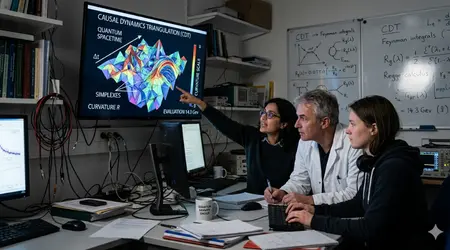
When you examine the resulting structure at the Planck scale, the fabric looks like a complex, self-repeating network of geometric channels.
Zooming into this subatomic matrix reveals smaller versions of the larger network, an architectural property that defines classic fractals in nature.
How does the dimensional reduction work?
As we explore the microscopic universe via Causal Dynamical Triangulation, a bizarre phenomenon occurs: the apparent number of dimensions drops significantly.
At macroscopic levels, we comfortably occupy a four-dimensional world consisting of three spatial directions and one dominant temporal line of movement.
However, advanced quantum probes reveal that the spectral dimension smoothly reduces to exactly two dimensions when hitting the absolute smallest scales.
Imagine a distant city skyscraper that appears as a solid three-dimensional object from afar but collapses into narrow lines when viewed up close.
Also read: Could Time Be a Psychological Artifact Instead of a Physical Dimension?
What causes this reduction?
The quantum fluctuations of geometry become so violent at microscopic distances that they effectively restrict the path of traveling particles.
A wandering electron gets trapped in a narrow, highly interconnected web of micro-triangles, limiting its freedom of movement to a simpler, flat landscape.
Read more: Is Consciousness a Fundamental Component of Spacetime?
What are the mathematical benefits?
Operating in a two-dimensional quantum realm eliminates the aggressive, infinite energy calculations that usually destroy traditional theories of quantum relativity.
This spontaneous reduction allows gravity to interact cleanly with matter, providing an elegant bridge that physicists have sought for nearly a century.
What does 2026 data show about spacetime?
Prominent academic analyses published early this year demonstrate that causal constraints are the single factor preventing the cosmos from collapsing into dust.
Without this forward-moving temporal rule, simulations create either crumpled, infinitely dense points or completely flat, lifeless expanses devoid of any matter.
Through Causal Dynamical Triangulation, scientists can finally replicate a universe that matches our actual cosmological measurements with unprecedented structural accuracy.
The following data table outlines the spectral dimensions calculated at various physical scales, highlighting the radical shifts discovered within the model.
Spacetime Characteristics Across Physical Scales (2026 Data)
| Observation Scale | Effective Dimension | Geometric Behavior | Prevailing Physics |
| Macroscopic (> 10-30 m) | 4.0 (Smooth) | Classical Curvature | General Relativity |
| Mesoscopic (10-33 m) | 3.1 (Transition) | Quantum Fluctuations | Semi-Classical Gravity |
| Microscopic (Planck Scale) | 2.0 (Fractal) | Self-Similar Triangles | Pure Quantum Geometry |
How do we verify these numbers?
Supercomputers crunch billions of geometric configurations, measuring how a hypothetical test particle diffuses through the shifting, simulated quantum foam over time.
If the particle spreads rapidly, the dimension is high; if it gets trapped, the dimension is lower, proving the fractal nature.
Are we ready to accept that our solid, three-dimensional reality might just be a macroscopic illusion born from quantum chaos?
This computational approach provides the first real, actionable data in a field that previously relied on untestable, purely abstract equations.
Why does causality alter the cosmic matrix?
The inclusion of a strict causal arrow acts as a cosmic glue, holding the delicate microscopic geometry in a functional state.
Previous attempts at quantum triangulation ignored time, resulting in universal structures that branched wildly out of control like uncontrolled cellular mutations.
By ensuring that cause always precedes effect, the model forces the emerging geometries to share a cohesive, unified history across the entire simulation.
This simple rule ensures that the quantum pieces build a world capable of hosting stars, planets, and eventually, conscious life forms.
What is an example of this growth?
Think of a tree growing branches; if the branches grow downward or cross into themselves illegally, the entire organism loses structural integrity.
Causality ensures every new geometric branch extends outward into the future, creating a stable trunk capable of supporting complex macroscopic leaves.
How does this affect our view of time?
Time ceases to be a passive background coordinate and becomes an active participant in shaping the physical structure of space itself.
This insight deeply alters our philosophical view of the cosmos, placing historical progression at the very heart of physical law and reality.
The New Blueprint of the Quantum Cosmos
The application of Causal Dynamical Triangulation has fundamentally altered our perspective on the geometry of the universe, proving that order arises from simplicity.
We now understand that our smooth, vast cosmos rests upon a chaotic, two-dimensional fractal foundation that operates at the deepest subatomic levels.
By abandoning complex formulas and focusing on simple, causal geometric interactions, physics has finally opened a reliable window into the Planck scale.
This model shows us that the universe is not a static stage, but a beautifully complex, self-assembling network of relationships.
As computational power expands throughout 2026, our ability to map this microscopic fractal terrain will bring us closer to a unified theory.
Do you find it comforting that the chaotic quantum world naturally organizes itself into a stable home for us? Share your perspective in the comments!
Frequently Asked Questions
What does “Lorentzian” mean in these space models?
It refers to a geometry that respects the laws of special relativity, specifically ensuring that the speed of light remains an absolute barrier.
Can we physically see these microscopic cosmic fractals?
No, because the Planck scale is far too small for any modern microscope, meaning we must rely on indirect mathematical and computational verification.
How does this model differ from String Theory?
String Theory introduces hypothetical vibrating strings as primary objects, whereas this method uses pure, basic geometry and causality to build the universe from scratch.
Why is the number two important for quantum dimensions?
Two dimensions drastically simplify the equations of quantum gravity, making the mathematics solvable without introducing problematic, unverified physical constants or dimensions.
