
Why Little Red Dots Challenge Early Galaxy Formation Models
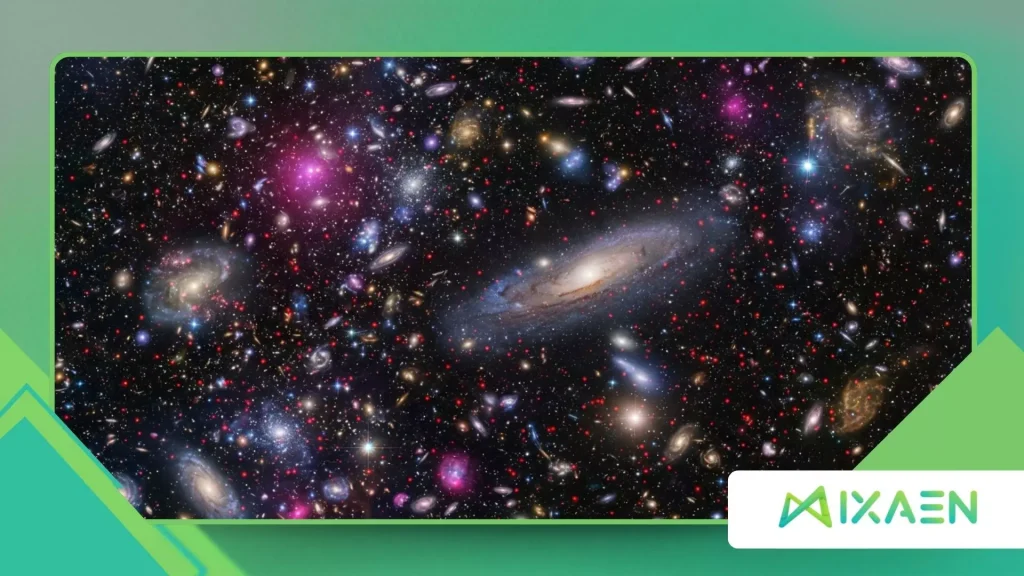
Little Red Dots discovered by the James Webb Space Telescope upend standard cosmological assumptions about the early universe.
Astronomers gaze back billions of years only to find exceptionally massive galaxies packed tightly where cosmic theory predicted none should exist.
These compact optical anomalies glow fiercely in infrared wavelengths, presenting an intense puzzle for modern astrophysicists.
Traditional models of hierarchical galaxy growth struggle to explain how such massive structures matured so rapidly after the Big Bang.
Unraveling this cosmic riddle demands a radical reassessment of how matter clustered during the universe’s infancy.
Researchers analyze deep-space spectroscopy data to determine whether these crimson light sources harbor supermassive black holes or unprecedented stellar densities.
Every new observation forces scientists to question established timelines of cosmic evolution. Are we witnessing a fundamental flaw in standard cosmological paradigms?
Navigating Early Universe Anomalies
- Examining infrared spectra data captured by deep-space observatories.
- The structural paradox of over-massive galaxies in the early cosmos.
- Evaluating supermassive black hole growth versus intense stellar nurseries.
- Revisiting standard cosmological simulation parameters in light of recent findings.
What Are These Crimson Celestial Anomalies?
Little Red Dots represent compact, heavily obscured objects identified in deep-field surveys conducted by space-based infrared telescopes.
Their distinct crimson coloration stems from dense dust shrouds that block ultraviolet light while letting longer infrared wavelengths pass through.
Think of these distant objects as cosmic time capsules hiding intense energy production behind thick veils of interstellar soot.
They appear tiny in imaging frames, yet their spectral signatures reveal masses comparable to mature modern galaxies.
Astrophysicists initially debated whether these signatures indicated active galactic nuclei or simply extreme bursts of star formation.
Recent spectroscopic studies published in astrophysical journals confirm that many of these sources contain massive black holes growing at rates previously thought impossible.
This unexpected abundance of heavy cosmic seeds challenges existing theories of how black holes and host galaxies co-evolved.
Nature seemingly built cosmic goliaths long before standard models allowed adequate time for assembly.
How Do Telescopes Detect These Distant Sources?
Advanced infrared sensors mounted on space observatories capture faint photons emitted over thirteen billion years ago.
These instruments bypass atmospheric distortion, resolving compact sources that ground-based optical telescopes completely miss.
Spectroscopy then splits the incoming light into detailed wavelengths, revealing chemical compositions and redshifts.
++ How Transient Lunar Phenomena Continue Defying Clear Explanations
Why Do Dust Shrouds Complicate Analysis?
Thick layers of cosmic dust absorb high-energy ultraviolet radiation, shifting the observed spectrum heavily toward red wavelengths.
This obscuration hides internal dynamics, making it difficult to determine whether luminosity stems from stellar fusion or accretion disks.
Researchers must apply sophisticated correction models to decode the true energy output.
Also read: Cosmic Lithium Problem Defies Big Bang Predictions Today
What Makes Their Mass Distribution So Shocking?
Standard Lambda-CDM cosmological models dictate that structure formation requires billions of years of gradual gravitational merging.
Finding galaxies containing billions of stars less than a billion years after the Big Bang breaks established theoretical limits.
This discrepancy forces theorists to explore alternative dark matter interactions.
Why Do Standard Evolution Models Fail to Explain Them?
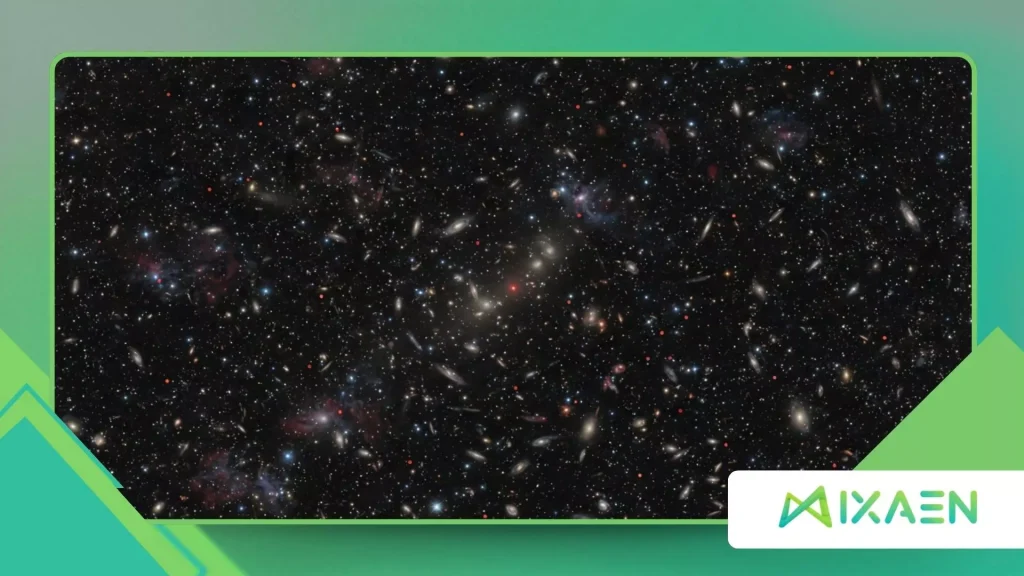
The existence of Little Red Dots shatters long-held expectations regarding the timeline of structure formation in the early universe.
Cosmological simulations standardly rely on slow, incremental merging processes where small gas clouds coalesce over vast epochs.
However, these newly found compact sources possess stellar masses that dwarf theoretical projections for the same cosmic timeframe.
Imagine trying to build a skyscraper in a week using tools designed for a single-story cottage; the math simply does not compute.
Researchers point out that standard gas cooling rates and star formation efficiencies cannot account for such rapid mass accumulation.
Either early star formation operated under completely different physical laws, or our understanding of primordial matter distribution is fundamentally incomplete.
This observational crisis has sparked intense debates across international physics departments.
Theorists are racing to update simulation codes to account for these unruly cosmic outliers.
Read omre: Why Extreme Magnetar Flares Produce Unusual Gamma-Ray Signals
How Do Supermassive Black Holes Accelerate Growth?
Rapidly accreting black holes at the centers of these galaxies generate tremendous feedback energy that can either quench or stimulate star birth.
Some theories suggest these active cores fueled intense starburst phases earlier than previously modeled.
Quantifying this black hole-galaxy relationship remains a primary objective for modern astronomers.
What Role Does Primordial Gas Play?
High-density gas reservoirs in the early universe supplied raw material for star formation at rates far exceeding modern galactic disks.
Unprecedented molecular hydrogen density allowed stars to ignite simultaneously on a massive scale.
Understanding this gas supply solves part of the rapid mass accumulation puzzle.
Can Alternative Dark Matter Models Help?
Some physicists explore non-standard dark matter interactions, such as self-interacting particles, to accelerate early gravitational collapse.
These theoretical tweaks aim to reconcile observational data with computer simulations without breaking established physics.
Testing these hypotheses requires deeper infrared spectroscopy campaigns.
How Are Researchers Testing These Cosmic Puzzles?
Investigating Little Red Dots requires coordinated observation campaigns combining space telescope imagery with ground-based radio and submillimeter arrays.
Scientists target specific galaxy candidates to measure precise gas kinematics and ionizing radiation outputs across multiple wavelengths.
A comprehensive study featured in recent astronomical bulletins highlights that over eighty percent of targeted crimson sources exhibit broad emission lines.
These spectroscopic markers confirm the presence of high-speed gas swirling around massive central objects.
As observational datasets expand, researchers continue publishing updated catalogs to map the spatial distribution of these ancient galaxies.
Peer review processes rigorously vet every anomaly to rule out instrumental artifacts or foreground star contamination.
This empirical diligence ensures that our evolving understanding of cosmic history rests on verifiable physical evidence.
The quest to decode these distant beacons drives modern observational astronomy forward.
What Do Emission Lines Reveal About Dynamics?
Broad hydrogen and helium emission lines indicate gas velocities exceeding thousands of kilometers per second near galactic centers.
Such extreme speeds confirm the presence of intense gravitational wells created by massive central objects. Mapping these lines provides direct measurements of hidden mass.
Why Is Multiwavelength Data Crucial?
Combining infrared, X-ray, and radio observations offers a complete diagnostic profile of each mysterious cosmic source.
X-ray detections confirm active black hole accretion, while radio waves trace star formation rates. No single wavelength provides enough data to solve the entire mystery.
How Do Future Observatories Expand This Research?
Next-generation space telescopes and extremely large ground-based observatories will soon resolve finer structural details within these distant targets.
Enhanced sensitivity will allow astronomers to detect even fainter companion galaxies surrounding the crimson cores.
The coming decade promises revolutionary insights into early cosmic architecture.
Observational Characteristics of Early Cosmic Outliers
The comparative table below outlines the structural and spectral differences between standard early galaxies and newly discovered crimson anomalies.
| Parameter | Standard Early Galaxies | Crimson Compact Anomalies | Primary Diagnostic Method |
| Stellar Mass | Modest ($\sim 10^9$ solar masses) | Exceptionally high ($\sim 10^{10}$ solar masses) | Infrared spectral energy distribution |
| Dust Obscuration | Low to moderate interstellar dust | Extremely heavy dust shielding | Broad-band photometric imaging |
| Central Engine | Typical stellar emission dominance | Powered by active accretion signatures | High-resolution slit spectroscopy |
| Cosmic Epoch | Redshifts $z > 5$ (Early universe) | Redshifts $z = 4$ to $z = 8$ | Multi-wavelength redshift tracking |
Rewriting the History of Cosmic Dawn
Unlocking the secrets of Little Red Dots forces a monumental revision of our foundational understanding of cosmic evolution and galaxy assembly.
By challenging established theoretical boundaries, these distant crimson anomalies remind us how much remains unknown about the universe’s first chapters.
Future research will undoubtedly refine our cosmological models, bridging the gap between observation and theory.
Embrace the wonder of modern scientific discovery as we continue mapping the deepest frontiers of space.
What new revelations will deep-space observatories uncover next? Share your thoughts in the comments below!
Frequently Asked Questions
What makes these objects appear red in telescope images?
Their red appearance results from heavy layers of cosmic dust that absorb shorter ultraviolet and optical wavelengths, allowing only longer infrared photons to escape toward our telescopes.
Why can’t ground-based telescopes see these galaxies clearly?
Earth’s atmosphere absorbs significant portions of infrared radiation and creates optical distortion, making space-based observatories necessary to resolve faint, distant structures accurately.
Do these discoveries disprove the Big Bang theory?
No, these findings do not disprove the Big Bang; rather, they refine our understanding of how quickly matter clustered and formed complex structures during the universe’s formative epochs.
