
How Hera’s CubeSats Will Study Dimorphos During Arrival
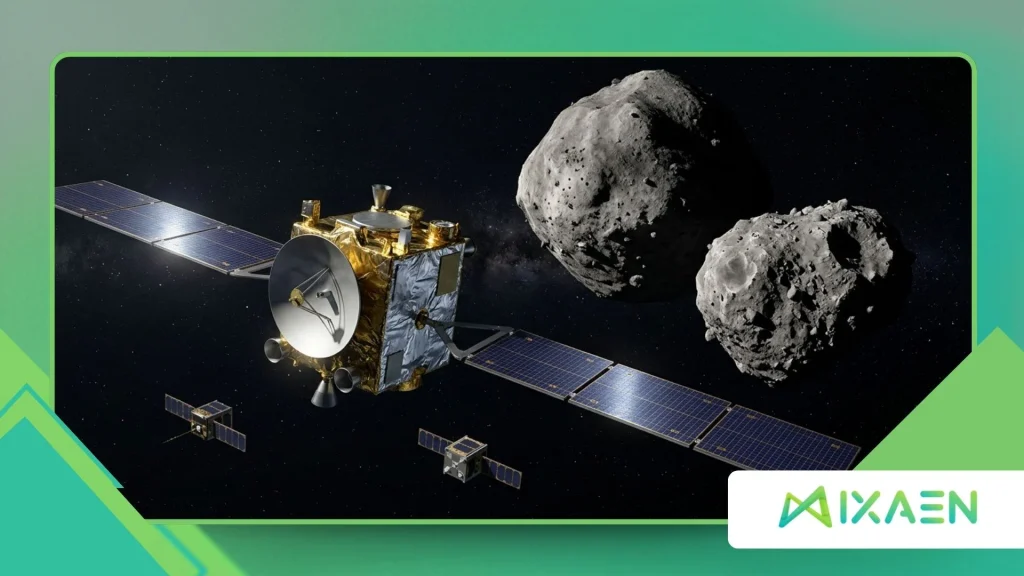
Hera’s CubeSats represent a monumental leap forward in deep-space planetary defense technology, specifically designed to closely examine the aftermath of humanity’s first kinetic impact test on an asteroid.
As part of the European Space Agency’s ambitious Hera mission, these miniature spacecraft are engineered to perform high-risk, high-reward proximity operations around the binary asteroid system Didymos and its smaller moonlet, Dimorphos.
Following NASA’s DART spacecraft collision, the scientific community eagerly anticipates the detailed telemetry and imagery these small probes will transmit back to Earth.
This article dives deep into the operational mechanics, technological marvels, and scientific objectives of these pioneering explorers as they rendezvous with their target.
- Discovering the core mission architecture and why miniature spacecraft are transforming deep-space exploration.
- Understanding the deployment phase and orbital mechanics around the Didymos binary system.
- Exploring the advanced onboard instruments used to analyze Dimorphos’s surface composition and internal structure.
- Analyzing the collaborative data return strategies that bridge deep-space probes with ground stations on Earth.
What Is the Hera Mission Architecture?
Why Were Miniature Probes Chosen for This Deep-Space Journey?
The selection of small, standardized satellite platforms for interplanetary exploration marks a paradigm shift in modern aerospace engineering.
Traditional deep-space probes are massive, expensive, and carry immense financial risk if a mission fails during critical orbital insertion phases.
By leveraging compact architectures, space agencies can reduce launch weights while maximizing scientific redundancy through multiple independent units.
These compact platforms allow engineers to test cutting-edge miniaturized sensors, autonomous navigation algorithms, and propulsion systems in an actual planetary environment.
Furthermore, their lower cost enables higher risk tolerance, paving the way for bolder scientific maneuvers close to irregular celestial bodies.
How Do These Spacecraft Coordinate During Interplanetary Transit?
During the long cruise phase from Earth to the target asteroid system, the miniature explorers remain safely berthed within their primary carrier spacecraft.
Power, telemetry, and thermal regulation are managed collectively through an umbilical interface until the moment of separation arrives.
Communication protocols must handle extreme signal delays, requiring the onboard computers to execute complex orbital insertion sequences with minimal human intervention.
Flight dynamics teams on Earth upload pre-calculated trajectory corrections, but the local navigation relies heavily on star trackers and optical horizon sensors.
This autonomous coordination ensures that once released, each unit can immediately acquire its designated target without relying on constant real-time ground commands.
++ How In-Space Mobility Systems Expand Deep Space Exploration
How Do Hera’s CubeSats Operate Near Dimorphos?
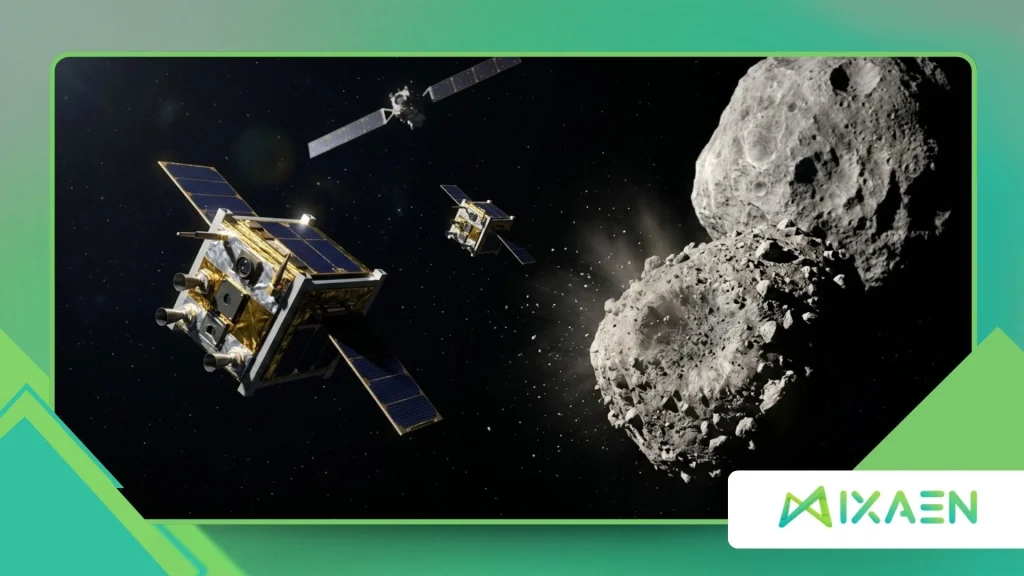
What Is the Deployment Strategy Upon Arrival?
Upon reaching the Didymos system, the primary spacecraft carefully maneuvers into a safe staging orbit before releasing its secondary payloads.
The deployment mechanism uses calibrated spring-loaded pushers to gently eject the miniature units away from the main structure at precise velocities.
Immediately following release, each unit initializes its attitude determination control system to stabilize its orientation relative to the Sun and the primary asteroid.
Thruster checkouts and initial radio frequency link tests are conducted within the first few hours to verify structural integrity and system health.
This delicate phase requires absolute precision, as any trajectory error could result in an uncontrolled drift away from the target gravitational field.
How Do They Maintain Stable Orbits Around Irregular Asteroids?
Orbiting a binary asteroid system presents unique gravitational challenges because neither body has a uniform mass distribution or a spherical shape.
The gravitational field fluctuates constantly as Didymos and Dimorphos rotate around their common barycenter, creating unstable zones for orbiting objects.
To overcome this, the navigation software utilizes advanced constant-thrust station-keeping maneuvers combined with optical landmark tracking.
By continuously photographing surface boulders and crater rims, the onboard navigation computer calculates precise position updates relative to the moving center of mass.
This autonomous station-keeping prevents the small probes from crashing into the surface or escaping into heliocentric orbit.
Also read: Why Cislunar Communications Matter Beyond Lunar Exploration
What Are the Scientific Objectives of Hera’s CubeSats?
Which Instruments Are Used for Surface Analysis?
Equipped with high-resolution multispectral imagers and miniature thermal infrared spectrometers, the probes can map mineralogical variations across the landscape.
These instruments capture detailed snapshots of regolith distribution, boulder size-frequency distributions, and impact-generated fracture patterns on the target body.
Spectroscopic sensors analyze reflected sunlight to determine surface weathering, space-weathering effects, and the presence of volatile compounds trapped near the polar regions.
By combining visual imagery with thermal emissivity data, scientists can reconstruct the geological history and mechanical properties of the asteroid’s outer crust.
Read more: Reimagining the Hubble: How It Changed the Way We See Space
How Does Radar Sounding Reveal Internal Structure?
Penetrating radar instruments onboard these compact craft transmit high-frequency radio waves directly into the interior of the celestial body.
As the waves travel through the material, internal density variations, voids, and structural fault lines reflect the signals back to the receivers.
Analyzing these reflection profiles allows researchers to construct a three-dimensional internal tomographic map without needing to drill or land on the surface.
Understanding the internal porosity and fragmentation level of Dimorphos provides crucial context for predicting how future asteroid deflection missions might behave.
This subsurface insight answers fundamental questions about how rubble-pile asteroids accrete and hold together under microgravity conditions.
| Parameter | Spacecraft Alpha | Spacecraft Beta | Primary Mothercraft |
| Dry Mass | 4.5 kg | 4.8 kg | 215.0 kg |
| Primary Instrument | Multispectral Imager | Low-Frequency Radar | Asteroid Framing Camera |
| Power Generation | Deployable Solar Arrays | Body-Mounted Solar Panels | High-Efficiency Gallium Arsenide |
| Primary Objective | Surface Mineralogy | Internal Tomography | Global Navigation & Relay |
A New Era in Planetary Defense
The successful execution of these proximity operations marks a vital turning point in our ability to protect Earth from potential cosmic impacts.
By gathering empirical data on how a rubble-pile asteroid responds to kinetic strikes and prolonged gravitational interactions, humanity gains invaluable knowledge.
The insights captured by Hera’s CubeSats will directly inform future planetary defense strategies and engineering standards for deep-space exploration.
As we look toward the horizon of interplanetary science, international collaboration remains our greatest asset in unlocking the secrets of the cosmos. Share your thoughts on planetary defense in the comments below.
Frequently Asked Questions
What is the primary mission of Hera’s CubeSats?
The primary mission is to perform close-up scientific observations, surface mapping, and internal radar sounding of Dimorphos following the DART impact test.
How do these miniature spacecraft communicate with Earth?
They utilize the main Hera carrier spacecraft as a high-bandwidth relay station to transmit compressed scientific data packs back to deep-space network antennas on Earth.
Why is studying Dimorphos important for Earth safety?
Studying Dimorphos helps scientists understand the kinetic deflection efficiency and structural characteristics of rubble-pile asteroids, which could threaten our planet.
What kind of propulsion systems do they use?
They rely on miniature cold-gas or chemical reaction control thrusters designed for precise orbital adjustments and station-keeping near irregular gravity fields.
When did the mission reach the Didymos asteroid system?
The spacecraft arrived at the Didymos binary system to begin its intensive operational phase during the active mission timeline in late 2026.
