
Why Intergalactic Gas Filaments Hide the Universe’s Missing Matter
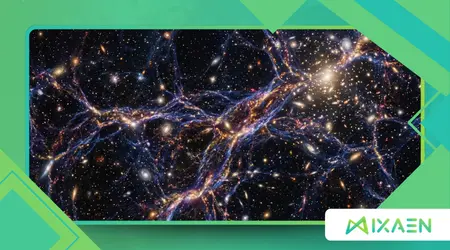
Intergalactic Gas Filaments represent the most elusive structural component of the cosmic web, acting as the skeletal framework that holds the entire universe together.
For decades, astronomers struggled to locate nearly half of the “normal” baryonic matter predicted by Big Bang models, leading to a profound cosmic mystery.
Modern observations in 2026 suggest this missing matter isn’t gone; it is simply hiding in the vast, hot, and diffuse bridges between galaxy clusters.
These ethereal threads are so thin that they remained invisible until our most advanced telescopes began detecting their faint X-ray and radio signatures last year.
Cosmic Web Overview
- The Missing Link: Exploring why 40% of ordinary matter was historically unaccounted for by scientists.
- Structural Anatomy: Analyzing how hydrogen gas stretches across millions of light-years to connect galaxies.
- Detection Methods: The shift from optical light to X-ray and Fast Radio Burst (FRB) analysis.
- Baryonic Evolution: How gas cools and collapses within these threads to eventually form new stars.
What is the Warm-Hot Intergalactic Medium?
The search for Intergalactic Gas Filaments has led researchers to the Warm-Hot Intergalactic Medium (WHIM), a plasma state that defines the cosmic void.
This gas exists at temperatures ranging from 100,000 to 10 million degrees, yet its density is incredibly low, appearing almost like a vacuum.
Think of the universe as a giant neurological network where galaxies are the neurons and these filaments are the axons facilitating communication and transport.
This analogy helps us visualize how matter flows along these invisible highways to feed the growth of massive galactic structures over billions of years.
How do we see the invisible?
Detecting these filaments requires looking for the “Sunyaev-Zeldovich effect,” where ancient light from the Big Bang scatters off the electrons within the gas.
This subtle distortion provides a silhouette of the filaments, allowing us to map the invisible architecture of the cosmos with unprecedented 2026 precision.
Recent data from the eROSITA mission has provided the first high-resolution maps of these bridges, confirming they contain enough mass to solve the missing matter problem.
We are finally seeing the “ghosts” of the universe that have evaded our best instruments for more than three full decades.
++ How Ultra-Energetic Cosmic Rays Travel Across Empty Space
Why does this matter for galaxy growth?
Galaxies do not grow in isolation; they are constantly fed by a steady stream of cold and warm gas pulled from the filaments.
This process acts like an umbilical cord, providing the raw hydrogen necessary for sustained star formation and the evolution of complex planetary systems.
Without the constant replenishment provided by Intergalactic Gas Filaments, galaxies would quickly run out of fuel and become “red and dead” celestial graveyards.
Understanding this inflow is critical for predicting how our own Milky Way will interact with its environment in the distant future.
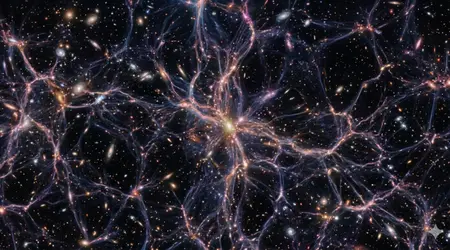
Why was the “Missing Matter” so hard to find?
The mystery of the missing baryons haunted astrophysics because the matter we could see in stars and nebulae didn’t match our mathematical predictions.
However, Intergalactic Gas Filaments store this matter in a state so diffused that a single cubic meter might contain only a few atoms.
Imagine trying to see a thin wisp of steam in a vast, dark stadium using only a tiny flashlight from a great distance.
This is the challenge astronomers faced until they utilized the light from distant quasars to illuminate the gas through absorption line spectroscopy.
Also read: Could Dark Energy Be Linked to a Force We Haven’t Discovered?
What are Fast Radio Bursts?
Fast Radio Bursts (FRBs) have become a revolutionary tool in 2026 for weighing the universe, as they “slow down” when passing through ionized gas.
By measuring this delay, scientists can calculate exactly how much material exists between us and the source of the radio signal.
Research published in Nature recently indicated that the dispersion measure of these bursts accounts for the total predicted baryonic density of the universe.
This breakthrough provides empirical proof that the “missing” matter has been sitting in the intergalactic voids all along, waiting for us to find it.
Read more: Why the Universe Keeps Producing Anomalies We Can’t Classify
How does dark matter influence gas?
Dark matter provides the gravitational well that pulls ordinary gas into these long, thin strands, creating the large-scale structure we observe today.
Ordinary matter follows the invisible “scaffolding” of dark matter, like water flowing through a pre-built pipe system across the reaches of the vacuum.
This relationship shows that Intergalactic Gas Filaments are the visible shadows of the universe’s most mysterious and dominant invisible substance.
By mapping the gas, we are effectively mapping the distribution of dark matter, bringing us closer to understanding the true nature of gravity.
What are the latest 2026 discoveries?
In early 2026, the combined efforts of the James Webb Space Telescope and new ground-based arrays detected “heavy” elements within Intergalactic Gas Filaments.
This confirms that galaxies “pollute” the cosmic web by blowing out metals through supernova explosions and powerful black hole winds.
Is it possible that the atoms in your body once traveled through these intergalactic highways before being incorporated into the Earth?
This connectivity suggests that the history of life is inextricably linked to the grand, filamentary circulatory system of the entire observable universe.
Can we simulate the cosmic web?
Advanced supercomputer simulations, such as the IllustrisTNG project, have successfully replicated the formation of these filaments starting from the initial conditions of the Big Bang.
These digital models perfectly match our current 2026 observations, proving that our fundamental understanding of cosmic evolution is remarkably accurate.
Simulations allow us to fast-forward the universe’s life, showing how Intergalactic Gas Filaments will eventually thin out as the expansion of space accelerates.
This provides a glimpse into the “Big Freeze,” where the cosmic web eventually tears apart, leaving galaxies isolated in an infinite, dark void.
Why is the “Cosmic Dawn” relevant?
The first filaments formed during the Cosmic Dawn, a period shortly after the Big Bang when the first light began to ionize the surrounding gas.
Studying these ancient structures allows us to see the very beginning of complexity in a universe that started as a nearly uniform soup.
By observing the most distant and ancient filaments, we are effectively looking back in time to the childhood of the cosmos itself.
This research bridges the gap between the subatomic world of the early universe and the massive, sprawling structures we see in our modern telescopes today.
2026 Cosmic Matter Distribution Analysis
| Matter Category | Percentage of Total | Observation Method 2026 | Current Status |
| Dark Energy | 68.3% | Type Ia Supernovae | Accelerating Expansion |
| Dark Matter | 26.8% | Gravitational Lensing | Invisible Scaffolding |
| WHIM (Filaments) | 2.4% | X-ray / FRB Dispersion | Missing Matter Found |
| Stars & Planets | 0.5% | Optical / Infrared | Fully Mapped (Local) |
| Interstellar Gas | 1.8% | Radio / Spectroscopy | Active Star Formation |
| Neutrinos | 0.1% | Particle Detectors | Mass Confirmed |
| Cosmic Dust | 0.1% | Far-Infrared | Recycled Material |
The discovery and mapping of Intergalactic Gas Filaments have effectively closed the book on the missing baryon problem that defined 20th-century cosmology.
As we refine our measurements, we move from the era of “discovery” to the era of “precision mapping,” treating the universe as a singular, connected entity.
This journey reminds us that in science, the things we cannot see are often the most important parts of the story.
By looking into the dark, we have found the light that explains our origin, our structure, and the ultimate fate of everything that exists.
The cosmic web is no longer a theoretical model; it is a tangible reality that we can measure, weigh, and understand with stunning accuracy.
We are the first generation of humans to see the full architecture of the home we inhabit among the infinite stars.
What other secrets do you think are hiding in the vast “emptiness” between the stars? Share your experience in the comments below!
Frequently Asked Questions
Are intergalactic gas filaments the same as dark matter?
No, filaments are made of ordinary baryonic matter (mostly hydrogen), while dark matter is an unknown substance that provides the gravity to shape them.
How long are these filaments?
Some Intergalactic Gas Filaments stretch for over 300 million light-years, making them the largest single structures ever identified in the history of science.
Can we travel through a filament?
While they are “roads” for gas, the density is so low that a spaceship wouldn’t feel the gas at all; it would feel like flying through empty space.
Why did it take so long to find them?
The gas is extremely thin and hot, emitting only very faint X-rays that were drowned out by the bright light of galaxies until recently.
